You may have seen a colourful chart in a Telegram group claiming Earth’s frequency “exploded” overnight. Or maybe a meditation track promised to tune you to the planet. Both point back to the same phenomenon.
Here’s the direct answer. The Schumann Frequenz, known in English as the Schumann resonance, is a set of natural, extremely low-frequency electromagnetic waves. They travel around the globe in the gap between the ground and the ionosphere, and lightning keeps them going. The strongest wave sits at roughly 7.83 hertz, with weaker overtones near 14, 21, 27 and 34 Hz.
That much is measurable physics. A German physicist predicted it in 1952, and instruments have confirmed it ever since. The health and “spiritual shift” claims attached to it are a different story. This guide covers how the resonance works, what the numbers mean, how to read the charts people share and which popular claims hold up.
What Is the Schumann Frequenz?
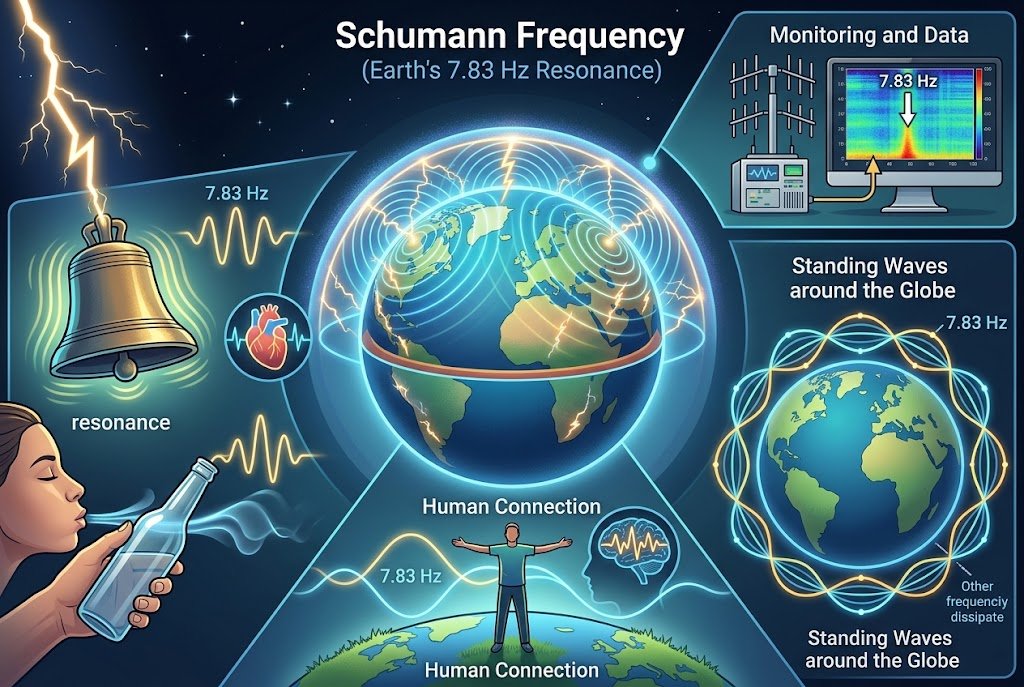
Picture Earth sitting inside a giant hollow shell. The ground and the oceans conduct electricity well. So does the ionosphere, the electrically charged upper layer of the atmosphere, which begins roughly 60 to 100 km overhead. The air between them conducts poorly, so the gap works like a channel that traps certain radio waves and lets them run around the whole planet.
When a wave’s length fits the planet’s circumference neatly, its peaks line up with themselves on every lap. The wave grows stronger instead of fading out. Those reinforced waves are the Schumann resonances.
In German you’ll see both “Schumann Frequenz” and “Schumann-Resonanz”. Scientists usually say “Schumann resonances”, plural, because there’s a whole series of them.
Quick facts at a glance
| Feature | What’s known |
|---|---|
| Main (fundamental) frequency | About 7.83 Hz, varying slightly |
| Overtones | Roughly 14.3, 20.8, 27.3 and 33.8 Hz |
| Frequency band | Extremely low frequency (ELF) |
| Energy source | Global lightning, around 50 flashes per second |
| Upper boundary | Lower edge of the ionosphere, about 60–100 km up |
| Field strength | Tiny, measured in picotesla |
| Named after | Winfried Otto Schumann, physicist in Munich |
How Lightning Keeps the Signal Alive
NASA’s Goddard team reported that about 2,000 thunderstorms are active on Earth at any moment. Together they produce around 50 lightning flashes every second. Each flash releases a burst of electromagnetic energy across many frequencies, and part of that energy falls in the extremely low range the cavity can trap.
Think of a bell that never stops being struck. A single tap fades quickly. Thousands of taps from storms over Central Africa, the Amazon and Southeast Asia keep it ringing around the clock. If global lightning stopped, the resonance would fade almost at once, because nothing would be feeding it.
Why 7.83 Hz and not some other number?
A rough calculation gets you surprisingly close. Radio waves travel at nearly the speed of light, about 300,000 km per second. Earth’s circumference is about 40,000 km. Divide one by the other and a wave could circle the planet roughly 7.5 times per second.
The precise value comes from a fuller calculation. It includes the planet’s spherical shape and the fact that the ionosphere absorbs some energy instead of reflecting it perfectly. That’s why measurements settle near 7.8 Hz rather than a tidy round number. You don’t need the maths for the key point: the size of the planet and the properties of its atmosphere set the frequency. Nothing mystical is involved.
The overtones
The higher peaks follow the same idea one step up. They come from waves that fit around the planet in two, three or more cycles. These weaker overtone peaks are less stable than the fundamental. On a spectrogram they show up as faint horizontal bands stacked above the 7.83 Hz line.
From Munich to Orbit: A Short History
- 1952: Winfried Otto Schumann, working at the institution now known as the Technical University of Munich, calculated that the space between ground and ionosphere should resonate at low frequencies. His early estimate was closer to 10 Hz.
- Early 1960s: Researchers detected the resonances reliably and confirmed the prediction, with the fundamental near 7.8 Hz.
- Following decades: Herbert König, Schumann’s successor in Munich, compared the signal with human EEG recordings and noted the overlap with certain brain waves. Many later health claims trace back to that observation.
- 2011: An instrument aboard the US Air Force’s C/NOFS satellite picked up the resonance from 400–800 km above the ground in around 10,000 examples. Scientists hadn’t expected the signal to leak that high, so their models needed adjusting.
Does the Schumann Frequenz Change?
Yes, but far less dramatically than social media suggests. The fundamental usually wobbles by a few tenths of a hertz around 7.8 Hz. The signal’s strength changes much more than its frequency does.
The main drivers:
- Time of day: Global lightning follows the sun. It peaks as afternoon storms build over Africa, and later over the Americas.
- Seasons: Thunderstorm activity shifts north and south with each hemisphere’s summer.
- Solar activity: Flares and particle events reshape the ionosphere and nudge both frequency and intensity.
- Conditions at the station: Nearby storms, rain, wind and human-made interference all show up in the recordings.
What doesn’t happen is a steady climb from 7.83 Hz to 13 Hz or beyond. That claim has circulated in wellness circles for years. Neither the measurement data nor the physics supports it. A jump that large would require the planet to shrink or its atmosphere to change radically.
How to Read a Schumann Frequenz Chart
Many of the “live” images shared in German groups are spectrograms, often credited to a monitoring station in Tomsk, Russia. They look dramatic, but the layout is simple:
- Horizontal axis: time, usually in the station’s local time. Tomsk is five or six hours ahead of Germany, depending on the season.
- Vertical axis: frequency in hertz. The lowest steady band is the fundamental near 7.83 Hz.
- Colour: intensity. Brighter or whiter areas mean a stronger signal at that moment.
- Stacked bands: the overtones. Seeing several of them is normal.
Mistakes people make with these charts
- Reading a bright block as a frequency jump. A white patch usually means the whole spectrum got louder, often because of nearby storms or interference. It doesn’t mean the resonance moved to a new value.
- Ignoring the time zone. A “spike at midnight” may have happened in the early evening in Berlin.
- Treating one station as the whole planet. Every station picks up local noise. Researchers compare several sites before drawing conclusions.
- Taking “power” values literally. Amplitude scales on shared charts are often unlabelled or rescaled, so a big number may mean very little on its own.
The Schumann Frequenz and Your Health: What the Evidence Shows
The overlap with brain waves sits at the centre of most health claims. Alpha waves (roughly 8–12 Hz) and theta waves (roughly 4–8 Hz) cluster around 7.83 Hz, and that numerical overlap is real. But a shared number doesn’t prove a connection. If a song’s tempo happens to match your resting heart rate, that doesn’t mean the song is controlling your heart.
A few things to keep in mind:
- The signal is extremely weak. Its magnetic component is tens of millions of times weaker than Earth’s ordinary magnetic field. The 50 Hz wiring in a typical German flat produces stronger fields near your sofa than the resonance ever does.
- The research is thin. A few small studies have reported correlations between Schumann activity and brain or heart-rhythm measurements. They’re interesting leads, not proof, and none has shown a health effect.
- “Spike symptoms” lack support. Physicists and fact-checkers have found no evidence that changes in the resonance cause headaches, fatigue, dizziness or sleep problems.
Persistent headaches, poor sleep or anxiety deserve a proper check-up with your Hausarzt. Blaming the planet’s frequency can delay finding the real cause.
What about 7.83 Hz music, generators and bracelets?
Online shops sell 7.83 Hz “Schumann generators”, mats and jewellery that claim to restore a missing natural field. No credible clinical evidence, such as randomised controlled trials, shows that these products improve health.
Audio tracks are a separate case. A 7.83 Hz tone is sound, not an electromagnetic wave, and it falls below the roughly 20 Hz lower limit of human hearing. Most “Schumann” tracks therefore use binaural beats or gentle pulses. If calm audio helps you unwind, that’s a perfectly good reason to listen. Just don’t expect it to sync you with Earth.
Common Claims vs. What’s Actually Known
| Claim | What’s known |
|---|---|
| “The frequency is rising towards 13 Hz.” | No measurement data supports a long-term rise. |
| “Days feel shorter because of it.” | Fact-checkers have rated this false; it has no physical basis. |
| “Nikola Tesla discovered it.” | The prediction was Schumann’s, in 1952. The Tesla link is a popular misattribution. |
| “Bright chart spikes mean a mass awakening.” | They usually reflect local storms, interference or station noise. |
| “It’s Earth’s heartbeat.” | A catchy nickname. Lightning drives the signal; the planet itself isn’t pulsing. |
Why Scientists Actually Study It
Away from the hype, the resonance is a useful research tool:
- Tracking global lightning: A small number of stations can estimate thunderstorm activity worldwide.
- Climate signals: Researchers have linked resonance intensity to tropical temperatures, since warmer conditions tend to fuel more lightning.
- Studying the ionosphere: Shifts in the signal show how solar events reshape the upper atmosphere.
- Exploring other worlds: Any planet or moon with both an atmosphere and an ionosphere should have its own resonances. Scientists have studied the possibility on Mars, Venus and Saturn’s moon Titan. The Huygens probe recorded a low-frequency signal on Titan in 2005, and its interpretation is still debated.
The Bottom Line
The Schumann Frequenz is a real, lightning-powered resonance that scientists have measured for more than 60 years. Its main tone near 7.83 Hz is set by the size of our planet and the layers of its atmosphere. It offers a fascinating view of storms, climate and space weather. The leap from there to symptoms, awakenings and miracle gadgets isn’t backed by evidence.
When the next dramatic chart lands in your feed, check the time zone, the station and whether the “spike” is just a nearby thunderstorm. The real physics is more interesting than the myths.
FAQ
Is the Schumann Frequenz the same as the Schumann resonance?
Yes. “Schumann Frequenz” is the everyday German phrase, and “Schumann resonance” is the English scientific term. Both describe the same set of lightning-driven waves.
Can I feel or hear 7.83 Hz?
No. The resonance is an electromagnetic signal, not sound, and its field is far too weak for the human body to sense. Detecting it takes specialised magnetometers or antennas.
Where can I see live Schumann data?
Several research and hobby stations publish spectrograms online, including the widely shared Tomsk charts. Treat them as recordings from one station, not verdicts on the whole planet.
Is the Schumann resonance harmful?
There’s no evidence that it harms people. The resonance has been part of Earth’s natural environment for as long as there has been lightning, which means throughout human history.