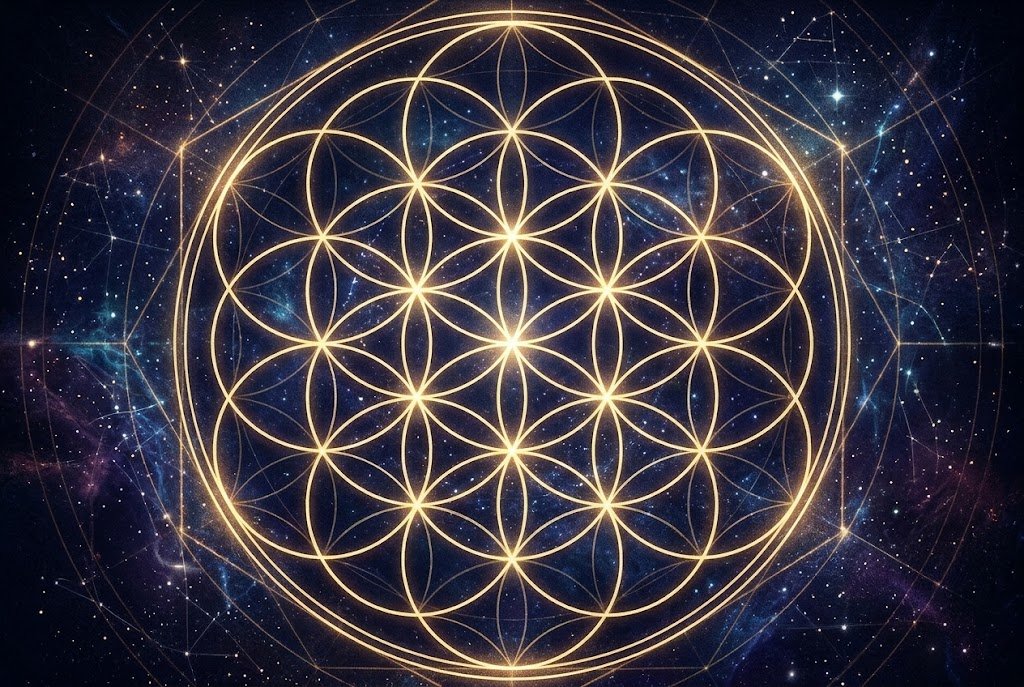
The Blume des Lebens (Flower of Life) is built from 19 circles of exactly the same size. One sits in the middle, six surround it, and twelve more form an outer ring: 1 + 6 + 12 = 19. One simple rule holds the whole design together. Every circle’s edge passes through the centre points of its neighbours.
Because the radius equals the distance between neighbouring centres, every centre lands on a grid of equilateral triangles. That’s why the pattern looks so tidy, and why it closes neatly inside one large outer circle exactly three times the radius of the small ones.
That’s the short answer. The rest of this guide covers why the rule works, where each of the 19 centres sits, the key measurements, and how to draw the figure yourself with a compass.
The One Rule Behind the Whole Pattern
Pick any radius you like and call it r. Draw a circle. Now put the compass point anywhere on that circle’s edge and draw a second circle with the same radius.
The second circle passes straight through the centre of the first, and the first passes through the centre of the second. Their centres are exactly one radius apart. That’s the entire rule, repeated over and over.
Here’s why it produces such a regular shape. If you draw a third circle at one of the two points where the first two cross, its centre sits at distance r from both earlier centres. Three centres, all r apart, form an equilateral triangle. Keep going and the centres tile the page in equilateral triangles, the same grid you see on a sheet of isometric paper.
Six of those triangles meet around any centre point, and that’s where the six-fold symmetry of the Blume des Lebens comes from. Each circle has exactly six neighbours touching its centre, arranged at 60° steps like the hours on a six-hour clock.
Counting the 19 Circles Ring by Ring
It helps to think of the figure as rings around the middle. The table below shows where every centre sits, measured from the centre of the whole figure.
| Ring | Number of circles | Distance of centres from the middle | Running total |
|---|---|---|---|
| Centre | 1 | 0 | 1 |
| First ring | 6 | r | 7 |
| Second ring (corners) | 6 | 2r | 13 |
| Second ring (in between) | 6 | √3 × r ≈ 1.73r | 19 |
The first ring is easy to picture: six circles whose centres sit on the edge of the middle circle, evenly spaced. Those seven circles together are called the Seed of Life.
The second ring is where people often get confused, because its twelve centres aren’t all the same distance from the middle.
- Six corner circles sit straight out from the middle, 2r away, continuing the line through each first-ring centre. Their centres form the corners of a large hexagon.
- Six in-between circles sit in the gaps, about 1.73r away. Their centres are at the outer crossing points where two neighbouring first-ring circles meet.
Both groups still obey the rule. Each one passes through the centres of its neighbours, so nothing is placed by eye.
Why 19 and Not 20?
The number isn’t arbitrary. If you keep adding complete hexagonal rings around a single point, the totals run 1, 7, 19, 37, 61 and so on. Ring number n always adds 6 × n circles: 6, then 12, then 18.
Mathematicians call these the centred hexagonal numbers. Nineteen is simply what you get when you stop after two full rings. Stop after three and you’d have a 37-circle version, which some artists draw for a denser look.
The Measurements That Make It Close Perfectly
Once you know the grid, the main measurements follow directly. They’re handy if you want to print, laser-cut, embroider or paint the pattern at a specific size.
- Outer boundary: the large enclosing circle has a radius of 3r. It just touches the far edges of the six corner circles (centre at 2r, plus one radius).
- Total width: 6r edge to edge. A pattern with 2 cm circles is therefore 12 cm across.
- Inner hexagon: the six first-ring centres form a regular hexagon with sides of length r.
- Petals: each pointed “petal” is the overlap of two circles. It’s exactly r long but only about 0.27r wide at its fattest point. That’s why the petals look so slim and leaf-like rather than round.
That 0.27r figure comes from simple geometry. The two circles forming a petal have centres √3 × r apart, so their overlap is 2r minus 1.73r. It also explains a common printing problem: at small sizes, the petals become so thin that the lines merge into a blur.
| Small circle radius (r) | Full pattern width (6r) | Fits on |
|---|---|---|
| 1 cm | 6 cm | Coaster, pendant sketch |
| 2 cm | 12 cm | Notebook page |
| 3 cm | 18 cm | A4 sheet (21 cm wide) with margins |
| 5 cm | 30 cm | A3 sheet or a small wall piece |
How to Draw the Blume des Lebens With a Compass
You don’t need a ruler for any of this. Every point you need appears as a crossing of lines you’ve already drawn.
What You’ll Need
- A compass that locks its width (a screw-adjust “Schnellverstellzirkel” holds better than a cheap friction one)
- A hard pencil, such as a 2H, for light construction lines
- Smooth paper, ideally A4 or larger
- A fineliner for inking the final lines, if you want a clean finish
Step by Step
- Set the radius once and don’t touch it again. For A4, 3 cm works well. Every circle in the figure uses this same setting.
- Draw the centre circle. Mark its centre clearly.
- Draw the first neighbour. Place the compass point anywhere on the circle’s edge and draw a full circle.
- Walk around the ring. Each new crossing point on the central circle becomes the next centre. After six circles you’re back where you started, and you’ve got the Seed of Life.
- Add the six in-between circles. Look for the outer crossing points where two neighbouring first-ring circles meet. Centre a circle on each.
- Add the six corner circles. New crossing points will have appeared straight out from each first-ring centre. Centre the last six circles there. That makes 19.
- Draw the outer boundary. Open the compass to three times the radius (9 cm if you used 3 cm) and draw one large circle from the original centre.
- Ink and erase. Trace the lines you want to keep with a fineliner, then erase the pencil.
Many versions also complete the partial arcs that poke out between the 19 circles, so every shape inside the boundary looks finished. It’s a style choice, not a geometric requirement.
Mistakes That Throw the Pattern Off
- Radius creep. If the compass slips even 1 mm early on, the error grows with every circle, and the last ones won’t meet the crossing points. Check the setting against your first circle every few steps.
- Landing between two crossings. Where three lines meet almost at one spot, place the compass point exactly where they cross, not near it.
- Pressing too hard. Deep construction lines won’t erase, and the dented paper will show under ink or paint.
- Losing the centre. After 19 circles the middle is a crowd of lines. Mark it with a small dot or a light cross before you start.
How It Connects to the Seed of Life, Fruit of Life and Metatron’s Cube
Several related figures are cut from the same triangular grid, which is why sacred-geometry books often present them as a family.
- Seed of Life: the first seven circles (centre plus first ring).
- Fruit of Life: 13 circles that touch each other without overlapping. Their centres sit on the same grid but further apart, so drawing it means extending the grid beyond the 19-circle version.
- Metatron’s Cube: connect all 13 centres of the Fruit of Life with straight lines. There are 78 possible connections (13 × 12 ÷ 2), and drawing them all produces the cube-like figure.
Seeing them this way removes a lot of the mystery. They’re different selections from one infinite grid of equal circles, not separate inventions.
Is the Geometry Really Ancient?
Overlapping circle patterns appear in decorative art from many periods. Similar hexagonal circle designs show up on ancient stonework, in medieval ornament, and in Leonardo da Vinci’s geometric studies.
Two cautions are worth knowing, though. The name “Flower of Life” is modern. It became popular through New Age writing about overlapping circle grids in the late 20th century. And the dating of some famous examples, such as the markings at the temple of Abydos in Egypt, is disputed. Treat claims that the exact 19-circle figure is many thousands of years old with care.
The Takeaway
The Blume des Lebens fits together because of one rule: equal circles, each passing through its neighbours’ centres. That rule puts every centre on an equilateral-triangle grid, gives you 1 + 6 + 12 = 19 circles over two rings, and makes the outer boundary exactly three times the small radius.
If you want to understand the pattern properly, draw it once yourself. A compass, a 3 cm radius and an A4 sheet are all you need, and the construction takes about 20 minutes.
FAQ
How many circles are in the Blume des Lebens?
The standard version has 19 complete circles of equal size, plus one large enclosing circle with three times the radius. Some designs add partial arcs or a third ring of 18 more circles.
What’s the difference between the Seed of Life and the Blume des Lebens?
The Seed of Life is the inner 7 circles. The Blume des Lebens adds a second ring of 12 circles around them.
Can I draw it without a compass?
You can trace around a round object, such as a coin or lid, but placing the centres accurately is much harder. A compass is far more reliable.
Why do all the circles have to be the same size?
The equal radius is what makes each circle pass through its neighbours’ centres. Change one size and the triangular grid, and the whole pattern, falls apart.