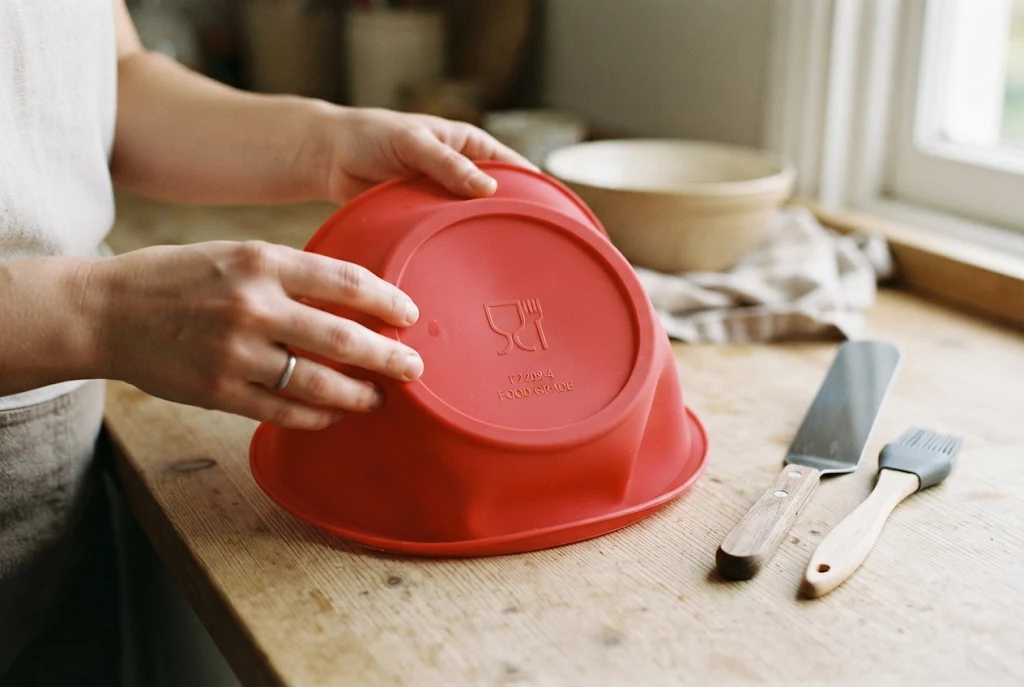
A muffin tray from a supermarket special offer, a spatula from an online marketplace, a baking mat with “100 % Silikon, lebensmittelecht” printed on the sleeve. In Germany, Silikon is simply the everyday word for silicone, and you’ll find it on a huge range of kitchen tools. The hard part is knowing whether the material behind that label is actually fit for food.
The short answer: you can’t prove a silicone product is food-safe with a home test. What you can do is check the signs that a real, traceable product leaves behind. Look for the glass-and-fork symbol or the words “für Lebensmittel” (unless the item is obviously meant for food), a named manufacturer or importer, a batch number, and clear instructions such as a maximum temperature. Prefer sellers who can point to compliance with the German BfR Recommendation XV for silicones. The well-known “pinch test” and a sniff test can flag a poor product, but they can’t confirm a good one.
What “food-grade” actually means for Silikon in Germany
There’s no single EU law written just for silicone kitchenware. Instead, silicone falls under the general rules that cover every food contact material. Under those rules a product must not release substances into food in amounts that could harm health or change the food’s taste, smell or composition. Manufacturers also have to follow good manufacturing practice and keep documents that show their product conforms.
Germany adds another layer. The Federal Institute for Risk Assessment (BfR) publishes recommendations for materials that touch food, and number XV covers silicones. These recommendations aren’t laws, but German food inspectors use them as their benchmark. The current version is the BfR Recommendation XV on silicones, dated 1 August 2024. It lists which starting substances are allowed and sets a key limit: finished silicone rubber shouldn’t release more than 0.5 % volatile organic compounds.
Why that 0.5 % figure matters
Freshly made silicone still contains small, volatile leftovers from production, including short-chain siloxanes. Good manufacturers remove most of them with a final heat treatment called tempering (in German, Tempern). It costs energy and time, so cheaper producers sometimes skip it or cut it short.
That’s the real difference between good and bad silicone. It usually isn’t a fake material. It’s the same material, finished properly or not.
A note on “LFGB” labels
You’ll often see “LFGB tested” or “LFGB certified” in product listings. LFGB is the abbreviation for Germany’s Food and Feed Code (Lebensmittel- und Futtermittelgesetzbuch), which is a law, not an official seal or certification body. The phrase can mean that a lab tested the product against German requirements. It can also mean nothing at all. Treat it as a reason to ask for the test report, not as proof.
What recent tests in Europe found
Two investigations show that the problem is real but fixable.
| Study | What was tested | Key findings |
|---|---|---|
| BEUC consumer groups, December 2022 | 44 silicone baking moulds bought in several European countries | 23 % released chemicals in high amounts or in amounts that increased with repeated use; 82 % contained substances of concern, mostly at low levels |
| Bavarian State Office for Health and Food Safety (LGL), 2025 | 60 silicone baking items from German shops: 35 moulds, 4 mats, 21 helpers such as brushes and spatulas | 49 items passed every check; 3 released 0.7 % to 1.6 % volatile compounds, above the 0.5 % benchmark |
The Bavarian results contain a detail most buying guides miss. In the 2025 LGL inspection results, all six products with questionable volatile-compound levels were baking helpers, not moulds. That means pastry brushes, spatulas and whisks. Small, cheap tools are easy to overlook, but they deserve the same scrutiny as a cake tin.
Research also shows that migration tends to rise with heat, fatty foods and long contact times. That’s worth keeping in mind for things like a brownie mould that spends 40 minutes at 180 °C with buttery batter.
Label checks before you buy
When you’re standing in a shop or scrolling a listing, run through these checks:
- Food-contact marking. Look for the glass-and-fork symbol or wording such as “für Lebensmittelkontakt”. Items obviously meant for food, like a cake mould, don’t always have to carry it, so its absence isn’t automatically a red flag. If it’s there, though, someone has taken legal responsibility.
- A real company name and address. EU rules require a manufacturer, importer or seller to be identifiable. A product with no brand and no address gives you nobody to hold accountable.
- Instructions for use. A serious product tells you its temperature range and whether it’s safe in the oven, microwave, freezer or dishwasher. Vague claims like “heat resistant” without numbers are a weak sign.
- A batch or lot number. This allows a recall if something goes wrong. It’s often printed in small type on the packaging or moulded into the item.
- Specific compliance wording. “Complies with BfR XV” or “EU 1935/2004” is more useful than “100 % safe” or “eco”. A “BPA-free” claim is pointless for silicone, which isn’t made from BPA-based plastics.
Buying on online marketplaces
Marketplace listings are where the gaps show most. Before ordering, check whether the seller names an EU-based responsible company. If you care about the item, message the seller and ask for a declaration of conformity (Konformitätserklärung) or a lab report that references BfR XV. A legitimate supplier should have documentation like this on file. A seller who can’t or won’t answer has told you what you need to know.
Watch out for “medical-grade” or “platinum silicone” claims with no paperwork behind them, and for prices far below comparable branded items.
Home checks: what they can and can’t tell you
Home tests are popular because they’re free. They’re also easy to over-trust.
The pinch-and-twist test
Pinch or twist a flat section of the item. If white streaks appear, the silicone likely contains fillers. Many guides treat this as proof of fake silicone, but that’s too simple. The BfR permits certain fillers in food-contact silicone under its separate filler recommendation (LII). White streaks don’t automatically mean a product is unsafe, and no streaks don’t mean it passed any test. Treat the result as one clue among several.
The smell test
Wash the item in hot, soapy water. A strong chemical or “plastic” smell that lingers after washing, or gets worse once the item is heated, is a sensible reason to return it. A neutral smell is reassuring but doesn’t measure volatile compounds.
Safe first use
- Wash every new item before its first use.
- If the manufacturer recommends heating the item empty before first use, follow that instruction exactly.
- Never go above the stated maximum temperature, and keep silicone away from direct flame, grills and hot plates.
- Start with lower-fat recipes in a brand-new mould if you’re unsure about it.
When to replace silicone
Retire a silicone item if its surface turns permanently sticky or tacky, if it cracks or tears, if it holds onto odours or colours after cleaning, or if it starts leaving residue on food. These are signs that the material is breaking down.
Don’t mix up kitchen silicone and DIY Silikon
This catches people out more often than you’d think. In a German hardware store, “Silikon” usually means sealant in a cartridge, the kind used for bathroom joints, showers and window frames. Sanitary sealant often contains fungicides to stop mould, and it isn’t made for contact with food.
So if you’re thinking of repairing a cracked baking mould, sealing a homemade chopping board, or casting your own chocolate moulds, an ordinary bathroom cartridge is the wrong product. For DIY moulds, look for casting silicone that the manufacturer explicitly sells as suitable for food contact, with its own data sheet and curing instructions. Let it cure fully for the stated time before any food touches it.
Common mistakes that shorten silicone’s life
Even a well-made product can turn bad if it’s used the wrong way. These are the habits that cause most problems:
- Cutting on silicone mats. Knife marks damage the surface and trap grease and bacteria. Lift baked goods off before you slice them.
- Using harsh scrubbers. Steel wool and abrasive powders roughen the surface. A soft sponge with washing-up liquid, or a soak in hot water with baking soda, is usually enough.
- Spraying oil every time. Silicone doesn’t need much grease. Heavy use of oil sprays can build up a sticky film that’s hard to remove.
- Storing it folded or crushed. Sharp creases can become weak points that crack over time. Store moulds flat or nested, and roll mats instead of folding them.
- Ignoring the temperature limit in an air fryer. Air fryers move very hot air close to the basket walls. Check that your liner or mould is rated for the setting you use.
Quick reference: signs and what they mean
| Sign | What it suggests | What it doesn’t prove |
|---|---|---|
| Glass-and-fork symbol | Someone declared it suitable for food | That it was lab-tested |
| Named EU company plus batch number | Traceable and recallable | That it meets BfR XV |
| BfR XV compliance stated | It was made to the German benchmark | Your specific batch was tested |
| Temperature range printed | The maker understands safe use | That the range is accurate |
| White streaks when pinched | Fillers are present | That it’s unsafe |
| No smell after washing | Likely a well-finished product | Low volatile-compound release |
A word on health concerns
Health agencies, including Health Canada, have described food-grade silicone cookware as low-risk. At the same time, some scientists have raised questions. A 2025 paper in the Journal of Applied Toxicology discussed links between certain siloxanes and effects on the hormone system, and said more research is needed. The sensible middle ground is to buy traceable products, respect the temperature limits and replace worn items. If you have specific health concerns, for example about products for babies or during pregnancy, talk to a doctor or a consumer advice centre (Verbraucherzentrale).
The bottom line
Real food-grade silicone isn’t something you can spot by feel alone. In Germany, the most reliable signs are on the label and in the paperwork: a food-contact marking, a traceable company, clear temperature instructions and a reference to BfR Recommendation XV. Use the pinch and smell tests as a quick screen, pay extra attention to cheap brushes and spatulas, and choose sellers who can answer questions. If a Silikon product fails those checks, return it and buy one that passes.
FAQ
Is “lebensmittelecht” the same as food-grade?
Yes, in everyday use. “Lebensmittelecht” is the German term for food-safe, but on its own it’s just a claim. It means more when it comes with a named company, a batch number and a reference to BfR XV.
Is “LFGB certified” an official certification?
No. LFGB is the name of the German food law. A product can be tested against German requirements by a lab, but there’s no official “LFGB seal” issued by the state. Ask for the actual test report.
Can I test silicone at home to know if it’s safe?
Not reliably. The pinch test hints at fillers and the smell test can expose badly finished products. Neither one measures chemical migration, which takes a lab.
Where can I report a suspicious silicone product in Germany?
Contact your local food control authority (Lebensmittelüberwachung), which is usually part of your city or district administration. Official product warnings are also published on lebensmittelwarnung.de.