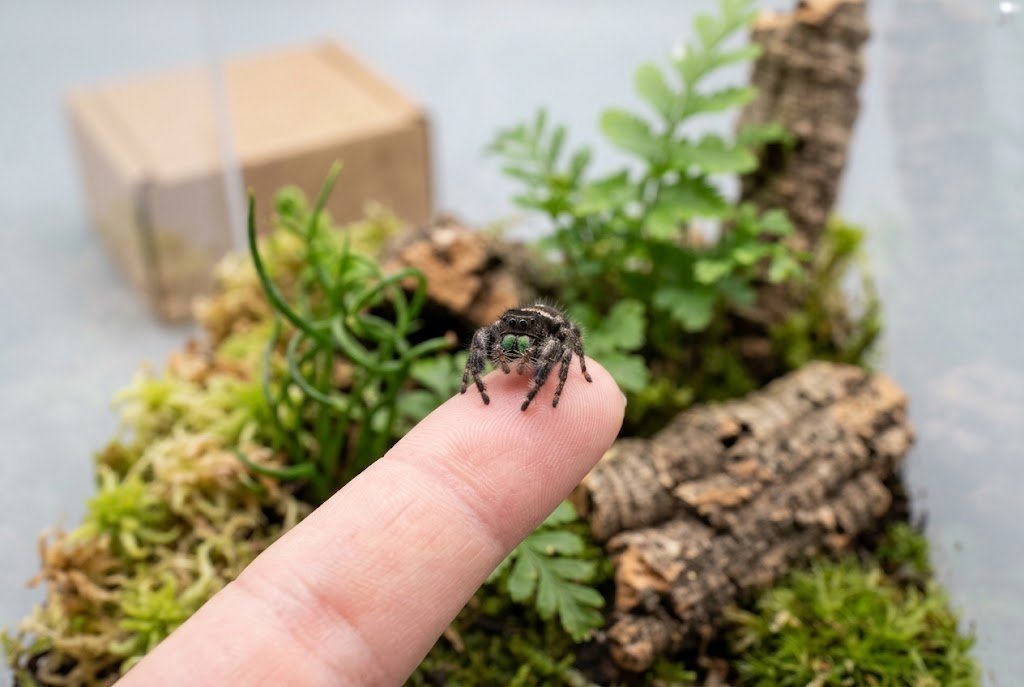
Buying a jumping spider online can go very well or badly, and the seller decides most of that. A safe breeder sells captive-bred spiders, names the exact species, shows real photos of the animal you’ll get, ships only in safe weather, and states its live-arrival policy in writing before you pay. If a jumping spider for sale listing is missing two or more of those things, keep looking.
This guide covers how to check a breeder in practice: what to look for in a listing, which questions to ask, how shipping should work, and what’s different when you’re buying in the UK.
What a Safe Jumping Spider Breeder Looks Like
Good sellers have a lot in common, whether they’re one-person hobby breeders or established invertebrate shops. Use this as a quick screen before you look at prices:
- Captive-bred stock, clearly labeled. The listing says “captive-bred” (CB). It doesn’t leave you to guess.
- Scientific names. Phidippus regius rather than just “regal spider.” Hybrids are labeled as hybrids.
- Real photos. Photos of the actual spider, or at least its parents or the current batch. Not stock images or obvious edits.
- Sex and size stated. For example “female, 5–6 mm” or “unsexed spiderling,” so you know roughly how long it will live and what it eats.
- A written live-arrival guarantee (LAG). It has clear conditions, such as reporting a problem within a set time with a photo of the unopened package.
- Weather holds. The breeder won’t ship during heat waves or freezes, even if you ask them to.
- Care support. They answer questions before and after the sale, and many include a basic care sheet.
None of these guarantees a perfect experience. A seller that ticks all of them is still far less likely to leave you with a dead or mislabeled spider.
Captive-Bred vs Wild-Caught: Why It Matters
Captive-bred spiders are hatched and raised in a keeper’s setup. They’re usually used to enclosures, they’ve eaten feeder insects from the start, and you get a rough idea of their age.
Wild-caught spiders are collected from outdoors. Some wild-caught animals are sold openly and honestly. They’re more likely to carry parasites, though, and you won’t know their age. An adult female caught late in the season may have only a few months left.
Collecting can also break local wildlife rules depending on where the spider was taken. If a seller has a constant supply of large adults at very low prices and can’t tell you where they came from, treat that as a warning sign.
How to Read a Jumping Spider for Sale Listing
Most of what you need to know is in the listing, or noticeably missing from it.
Species and lineage
The regal jumping spider (Phidippus regius) is the most popular species in the hobby. The bold jumping spider (Phidippus audax) is a close second. Both are commonly recommended for beginners.
Regals come in several color forms, often named after the region the bloodline came from. A good breeder will tell you the locality or line. A vague seller will just say “rare color” and charge more for it.
Sex and life stage
This affects how long you’ll have your pet:
| Listing says | What it usually means |
|---|---|
| Unsexed spiderling | Young and small. Needs tiny feeders such as fruit flies. You get the longest time with it, but you won’t know the sex yet. |
| Subadult / penultimate | One or two molts from adulthood. Usually sexable. A good balance of size and lifespan. |
| Adult female | Larger and easier to feed. Females generally outlive males. |
| Adult male | Often cheaper. Males usually have a shorter remaining lifespan once mature. |
Exact lifespans vary by species and care. Treat any listing that promises a specific number of years with caution.
Photos and descriptions
Look closely at the photos. Do they show a spider in a real enclosure? Does the background stay consistent across listings? Does the size described match what you see?
Heavily filtered photos, or the same image reused for every “morph,” suggest you won’t see your animal until it arrives.
Shipping and Live-Arrival Guarantees
Shipping is where most problems happen, so it deserves more attention than price does.
How careful breeders ship
Reputable sellers usually do the following:
- Ship early in the week so packages don’t sit in a depot over a weekend.
- Use fast, tracked services, typically overnight or next-day.
- Pack for temperature, using insulated boxes plus heat packs in cold weather or cold packs in hot weather.
- Hold orders in extreme weather, even when the buyer is impatient.
- Avoid shipping a spider that’s about to molt. A spider in premolt is fragile, and rough handling during a molt can be fatal.
What a fair live-arrival guarantee includes
A live-arrival guarantee only helps if its terms are realistic. Look for:
- A clear reporting window, often a few hours to a day after delivery.
- A photo requirement, usually of the unopened container with the spider inside.
- A stated remedy: replacement, refund, or store credit.
- Plain conditions about what voids it. Common examples are refused packages, wrong addresses, or packages left uncollected at a depot.
If the guarantee is buried, vague, or only “at our discretion,” assume you’re taking on the full risk yourself.
Red Flags When You Find Jumping Spiders for Sale
| Red flag | Why it matters | What to do |
|---|---|---|
| No scientific name, only “cute jumping spider” | The species could be anything, including a mislabeled wild-caught spider | Ask for the species and locality. Move on if they can’t say |
| Stock or stolen photos | You don’t know what you’re buying | Ask for a current photo with a dated note |
| Ships any day, any weather | Higher risk of heat or cold death in transit | Pick a seller with weather holds |
| Price far below the market | Could be wild-caught, elderly, or a scam | Compare with several established sellers |
| Payment only by bank transfer or “friends and family” | Little or no buyer protection | Use a card or another protected payment method |
| No reviews older than a few weeks | A new or recycled account | Check for an off-site track record |
| Pressure tactics (“last one, pay in 10 minutes”) | Rushed decisions lead to bad buys | Walk away |
Questions to Ask the Breeder Before You Pay
A good breeder won’t mind these questions. Many will be glad you asked.
- Is this spider captive-bred, and from which line or locality?
- What sex and size is it right now, and when did it last molt?
- What is it eating, and how often?
- Which days do you ship, and which service do you use?
- What’s your live-arrival policy, and how do I make a claim?
- Will you hold my order if the weather is too hot or cold?
- Can I contact you with care questions after it arrives?
Pay attention to how they answer as well as what they say. Specific, quick, friendly answers are a good sign. One-word replies or annoyance at basic questions are not.
What Price Can Tell You
Prices change with species, sex, size and color form. As a rough guide, US news coverage in 2025 reported single pet jumping spiders selling for about $30 to $100. Shipping and setup costs come on top of that.
In the UK, captive-bred regal spiderlings from established sellers have been listed at around £30, with adults and rarer forms costing more. Treat these figures as a snapshot rather than a fixed price list.
A low price isn’t automatically a scam. Just ask why it’s lower. Common honest reasons are that it’s an adult male, an unsexed spiderling, or a common bold jumping spider. Dishonest reasons include wild-caught stock sold as captive-bred, or a spider that doesn’t exist.
Buying UK Jumping Spiders for Sale: What’s Different
UK buyers face a few extra considerations.
Species legality. The Dangerous Wild Animals Act 1976 requires a council licence for specific dangerous spiders, including widow spiders, brown recluse spiders and Sydney funnel-webs. Jumping spiders (family Salticidae) aren’t on that list, so keeping a regal or bold jumper doesn’t need a dangerous wild animals licence.
Seller licensing. In England, businesses that sell animals as pets, including online sellers, generally need a licence from their local council under the 2018 animal activities licensing rules. Council guidance often describes these rules in terms of vertebrate pets, so it isn’t always clear whether a seller dealing only in invertebrates is covered. Many established UK invertebrate shops hold a licence because they also sell reptiles or other animals.
Asking whether a seller is licensed is still reasonable. A licence number you can check with the issuing council is a good trust signal. A missing licence isn’t automatically a red flag for a small hobby breeder.
Shipping within the UK. Next-day tracked delivery is the norm among good UK sellers, with the same weather holds described above. Ask which service they use before you order.
Importing from abroad. Ordering from overseas sellers adds customs, longer transit and possible import restrictions. For most UK buyers, a domestic captive-bred source is the safer choice.
If you’re in Scotland, Wales or Northern Ireland, check with your local council. Licensing rules are set separately and the details can differ.
Breeder, Pet Shop or Marketplace?
| Source | Pros | Cons |
|---|---|---|
| Specialist breeder | Knows the lineage, often gives the best care support | Smaller stock, may have waiting lists |
| Invertebrate or reptile shop (online) | Clear policies, regular shipping days, often licensed | Less detail on individual animals |
| High-street pet chain | You can see the spider in person | Fewer species, staff knowledge varies |
| General marketplaces and social groups | Wide choice, sometimes cheaper | Weakest buyer protection, higher scam risk |
The First 48 Hours After Delivery
Even a well-chosen spider needs a calm start:
- Open the package promptly in a room at normal temperature. Photograph it first if you’ll need to make a claim.
- Move the spider into an enclosure that’s already set up, rather than building one around it.
- Give it a light mist for water, then leave it alone.
- Hold off on feeding for a day or so, especially if it’s building a web hammock, which can mean it’s about to molt.
- Tell the breeder it arrived. A good breeder will want to know, and you’ll have an easy way to ask questions later.
Bottom Line
The safest jumping spider for sale isn’t always the cheapest or the most colorful. It comes from a breeder who is open about the species, sex, origin, shipping and guarantees before you pay. Narrow your list to two or three sellers, ask them the questions above, and buy from the one whose answers are clear and specific.
FAQ
Is it safe to buy a jumping spider online?
Usually, yes, if you buy captive-bred stock from an established seller that ships in safe weather and offers a written live-arrival guarantee. Most problems come from rushed shipping or marketplace scams.
What’s the best jumping spider for a first-time owner?
The regal jumping spider (Phidippus regius) is the usual first pick, with the bold jumping spider (Phidippus audax) as a common alternative. Both are widely available as captive-bred spiders.
Do I need a licence to keep a jumping spider in the UK?
Jumping spiders aren’t on the Dangerous Wild Animals Act schedule, so a private keeper doesn’t need that licence. Rules can change, so check with your local council if you’re unsure.
Should I buy a male or a female?
Females usually live longer and are often recommended for a first pet. Males can be a good, cheaper choice if you understand they typically have less time left once mature.