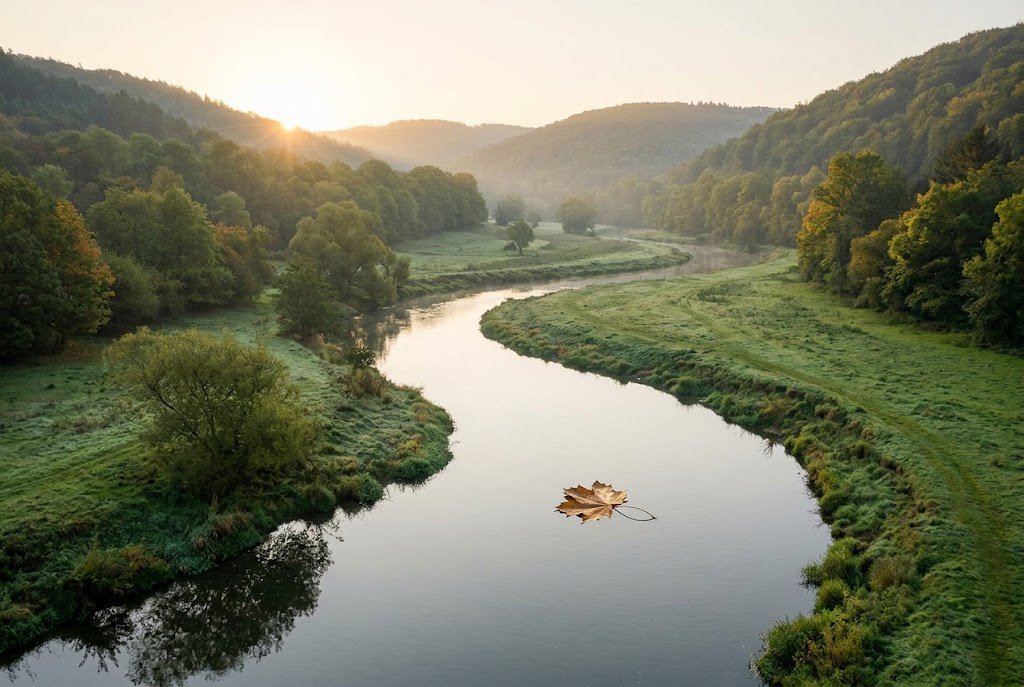
Good go with the flow quotes come from people who thought seriously about change: Stoic philosophers, early Taoist writers, Heraclitus, Shakespeare. They mostly agree on one point. You don’t control the river, but you do control how you move in it.
Below are 40 lines. The first 19 come from real, traceable sources, and each one says where it comes from. The other 21 are original lines written for this page and labeled that way, so you never pass off a made-up quote as Marcus Aurelius. If you searched for “go in the flow” quotes, you’re in the right place. The common English idiom is “go with the flow,” but the idea is the same.
What “Go With the Flow” Actually Means
The phrase means accepting what’s happening instead of fighting it at every turn. It took off in American English in the 1960s and 70s, and the image is simple: a swimmer who works with the current tires less than one who fights it.
People often confuse it with not caring. The two are different things.
| Going with the flow | Giving up |
|---|---|
| You accept what you can’t change | You stop acting on what you can change |
| Plans adjust when facts change | Plans get dropped at the first problem |
| You stay engaged, just less rigid | You check out |
| It lowers friction | It lowers effort |
Most of the quotes below make this same point in different ways: acceptance first, then action.
Classic Quotes From Philosophy and Ancient Texts
Taoist and Early Greek Lines
- “You cannot step into the same river twice.” This is the popular summary of Heraclitus’s teaching. It has reached us through later writers such as Plato rather than in Heraclitus’s own surviving words.
- “The highest excellence is like (that of) water.” Tao Te Ching, chapter 8, in James Legge’s 1891 translation.
- Nothing is softer or weaker than water, yet nothing beats it at wearing down what is hard. This is a paraphrase of Tao Te Ching, chapter 78. Translations vary a lot, so check the version you quote.
Stoic Lines
- “The universe is transformation: life is opinion.” Marcus Aurelius, Meditations 4.3, George Long translation.
- “Time is like a river made up of the events which happen, and a violent stream.” Marcus Aurelius, Meditations 4.43, George Long translation.
- “Require not things to happen as you wish, but wish them to happen as they do happen, and you will go on well.” Epictetus, Enchiridion 8, Elizabeth Carter translation (1758).
- “Some things are in our control and others not.” Epictetus, Enchiridion 1, Carter translation. This is the opening line of the whole handbook, and arguably the foundation for every other quote here.
- “Fate leads the willing and drags the unwilling.” This is a common English rendering of Seneca’s ducunt volentem fata, nolentem trahunt from Letter 107. Seneca himself credits the thought to the earlier Stoic Cleanthes.
- “Grant me the serenity to accept the things I cannot change.” This is the opening of the Serenity Prayer, usually credited to theologian Reinhold Niebuhr. Its exact origin has been debated, so “commonly attributed to” is the safe wording.
Lines From Literature, Scripture and Old Proverbs
- “There is a tide in the affairs of men, / Which, taken at the flood, leads on to fortune.” Shakespeare, Julius Caesar, Act 4, Scene 3. It’s a useful reminder that going with the flow sometimes means acting quickly when the moment is right.
- “The readiness is all.” Shakespeare, Hamlet, Act 5, Scene 2. Hamlet says it when he stops trying to control the outcome.
- “To every thing there is a season, and a time to every purpose under the heaven.” Ecclesiastes 3:1, King James Version.
- “All the rivers run into the sea; yet the sea is not full.” Ecclesiastes 1:7, King James Version.
- “Time is but the stream I go a-fishing in.” Henry David Thoreau, Walden (1854).
- “Plunge into it, move with it, and join the dance.” Alan Watts, writing about change in The Wisdom of Insecurity (1951). This is an excerpt, so quote it as one.
- “Empty your mind, be formless, shapeless, like water.” Bruce Lee, from his appearance in the TV series Longstreet (1971). The famous follow-up line is “Be water, my friend.”
- “This too shall pass.” This proverb is usually traced to Persian sources. Abraham Lincoln retold the story behind it in an 1859 speech.
- “Fall seven times, stand up eight.” A Japanese proverb. It isn’t strictly about flow, but it’s about the same kind of resilience.
- The reed bends in the storm and survives; the stiff oak breaks. This is the moral of Aesop’s fable The Oak and the Reeds, paraphrased.
21 Original Go With the Flow Lines (Written for This Page)
These lines are original and have no famous author. Use them freely, but don’t credit them to anyone else.
Short Lines for Captions and Notes
- Loose grip, steady feet.
- Plans are drafts. Days are edits.
- Less steering, more noticing.
- The detour had a view.
- Let the day be what it is, then make the most of it.
- Calm is a skill, not a mood.
- I packed a plan and an open mind.
- The current knows the way to the sea.
For a Hard Week
- You don’t have to like this part. You just have to get through it.
- Fighting the wave costs more than riding it.
- Some days the win is not making it harder than it already is.
- What you can’t fix today, you can carry lightly.
- Accepting it isn’t approving it. It’s just where you start.
- Rest is part of the flow too.
- The storm sets the waves, not your breathing.
For Work, Plans and Last-Minute Changes
- The meeting moved. So can I.
- A rigid plan breaks on the first surprise. A flexible one bends and keeps going.
- Adjust the route, keep the destination.
- Good teams don’t panic when the brief changes. They ask what’s new.
- Flow isn’t drifting. It’s paying attention to where things are already moving.
- Hold the goal tightly and the method loosely.
Popular Quotes We Left Out (and Why)
Search for quotes about going with the flow and you’ll see some lines everywhere that don’t hold up when you check them:
- “Life is a series of natural and spontaneous changes…” This is usually credited to Lao Tzu, but it doesn’t appear in standard translations of the Tao Te Ching.
- “Let go or be dragged.” It’s often labeled a Zen proverb, but there’s no traceable source.
- “Life is what happens to you while you’re busy making other plans.” It’s widely credited to John Lennon. Quote researchers have found a near-identical line printed years earlier, credited to cartoonist Allen Saunders.
These lines can still be worth sharing, but label them “unknown” or “popular saying” rather than pinning them on a famous name.
Which Quote Fits Your Situation?
| Situation | Try quote # |
|---|---|
| Travel plans fell apart | 23, 26, 37 |
| Stressful week at work | 35, 36, 40 |
| Grief or a loss you can’t change | 9, 17, 32 |
| Feeling stuck and overthinking | 3, 22, 39 |
| Waiting for the right moment to act | 10, 11, 12 |
| Instagram or journal caption | 20, 21, 25, 27 |
How to Use These Lines Well
A quote works best when it’s tied to a specific moment. Some practical ways to use them:
- Pick one, not ten. One line on a sticky note by your desk does more than a saved list of 40.
- Match the source to the setting. A Stoic line suits a work presentation. A short original line fits a caption better.
- Credit translations. For Marcus Aurelius, Epictetus or the Tao Te Ching, name the translator if you can. The wording changes a lot between versions.
- Pair acceptance with a next step. “This too shall pass” lands better followed by one small thing you’ll actually do today.
A Final Thought
Whether you call it going with the flow or go in the flow, the useful version isn’t passive. It’s knowing which parts of a situation are yours to change and putting your energy there. If one line from this list sticks, write it down where you’ll see it tomorrow morning.
FAQ
Is it “go in the flow” or “go with the flow”?
The standard English idiom is “go with the flow.” “Go in the flow” is understandable but less common. In writing, use “with.”
What is the most famous go with the flow quote?
Bruce Lee’s “Be water, my friend” and the Serenity Prayer are among the most widely shared. Heraclitus’s river line is probably the oldest idea in the group.
Who said “go with the flow” first?
Nobody is credited with coining it. The phrase spread in American English during the 1960s and 70s, and the water image behind it is much older.
Is going with the flow good advice?
Usually, for things outside your control. It’s poor advice when you use it as a reason to avoid decisions that are actually yours to make.