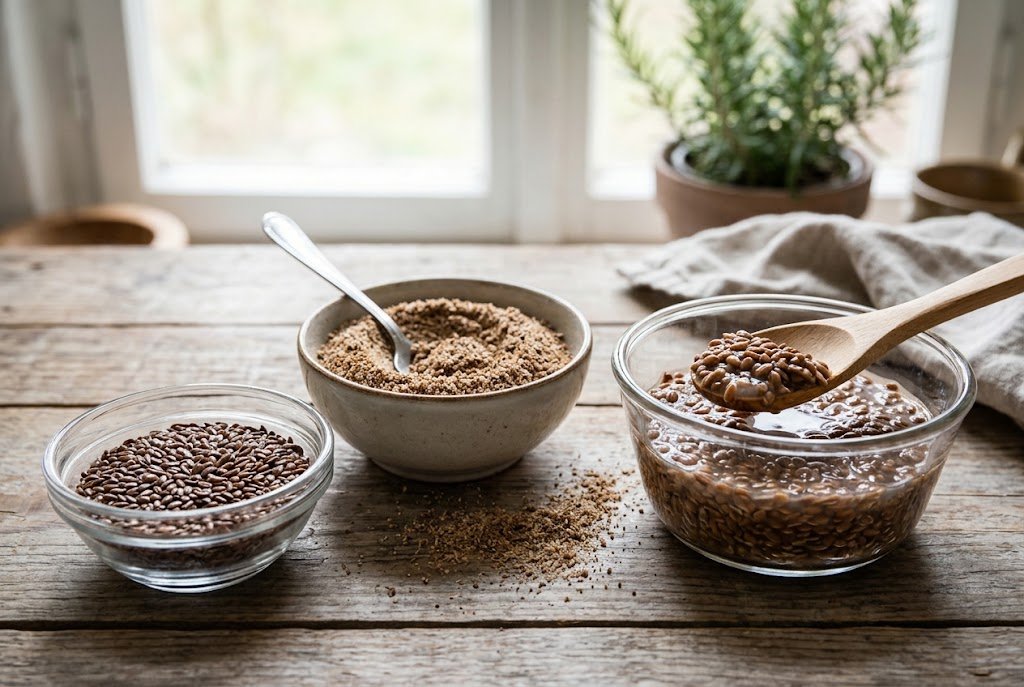
The short answer: for most people, ground Leinsamen (geschrotet) is the most useful way to eat flaxseed. Grinding breaks the hard shell, so your body can absorb more of the omega-3 fat and plant compounds inside. Whole seeds often pass through the gut largely intact, but with enough water they still work as a gentle bulking agent for digestion. Soaking softens the seeds and turns them into a gel, which many people find easier on the stomach.
Whichever form you pick, three rules matter more than the form itself:
- Keep raw portions moderate. Germany’s Federal Institute for Risk Assessment (BfR) considers up to about 15 g per meal safe for adults.
- Always drink plenty of water with the seeds.
- Leave a gap of two to three hours between flaxseed and any medication.
The rest of this guide explains why, and how to use each form well.
Whole, Ground or Soaked: A Quick Comparison
| Form | What happens in your body | Best for | Watch out for |
|---|---|---|---|
| Whole | The tough shell often isn’t broken down, so fewer nutrients are absorbed | Gentle bulk for digestion, long storage | Needs a lot of water; chew well |
| Ground (geschrotet) | Nutrients are far more accessible | Everyday nutrition in muesli, yoghurt and smoothies | Goes rancid quickly; stick to portion limits |
| Soaked | Forms a soft gel (mucilage) that’s easier to swallow and digest | Sensitive stomachs, overnight oats, egg replacement in baking | Prepare fresh; drink the soaking water too |
Whole Leinsamen: Long-Lasting but Hard to Digest
Whole flaxseeds are small, shiny and surprisingly tough. Your teeth crack some of them, but plenty slip through the digestive tract without being opened. You’ll miss much of the alpha-linolenic acid (ALA), the plant-based omega-3, and the lignans stored inside.
That doesn’t make whole seeds useless. Their outer layer contains mucilage, a soluble fibre that swells in liquid and adds soft bulk to stool. This is why whole or cracked linseed has long been a home remedy in Germany for sluggish digestion.
Whole seeds also have practical advantages:
- They keep for months in a cool, dry cupboard.
- Less of the naturally occurring cyanide-forming compounds is released when the seeds stay intact.
- They add a pleasant crunch to bread rolls, crackers and granola.
If you eat them whole, chew properly and pair them with a full glass of water.
Ground Leinsamen: The Most Practical Everyday Choice
If your goal is nutrition rather than just regularity, ground flaxseed is the better option. Once the shell is broken, the fibre, protein, ALA and lignans become far more accessible. This is the form you’ll find most often in German supermarkets and drugstores as Leinsamen geschrotet.
The trade-off is freshness. Grinding exposes the oil to air, light and warmth, and those delicate fats oxidise quickly. Rancid flaxseed smells sharp or paint-like and tastes bitter instead of mildly nutty. If yours smells off, throw it out.
How to Grind Flaxseed at Home
Grinding small batches yourself is easy and keeps the flavour fresh:
- Measure out only what you’ll use in about a week.
- Pulse the seeds in a spice grinder, coffee grinder or high-speed blender for 10 to 20 seconds.
- Stop once you have a coarse meal; you don’t need fine flour.
- Store the result in an airtight jar in the fridge.
A cheap electric coffee grinder kept just for seeds does the job well. Mortars work too but take patience, because the seeds tend to jump out.
Soaked Leinsamen: Gentler and More Filling
Soaking turns linseed into something closer to a pudding than a seed. The mucilage dissolves into the water and forms a slippery gel. Many people with sensitive digestion find this texture easier to tolerate than dry seeds.
A simple method:
- Stir one tablespoon of ground or whole seeds into about 100 ml of water, milk or a plant drink.
- Leave it for at least 15 minutes, or overnight in the fridge.
- Eat it with the liquid, not drained, since much of the fibre is in the gel.
Soaked flaxseed is also a well-known egg replacement in vegan baking. Mix one tablespoon of ground seeds with about three tablespoons of water. Let it sit for around ten minutes until it thickens, then use it in muffins, pancakes or veggie burgers. It binds well but won’t make cakes rise like eggs do.
How Much Leinsamen Is Safe Per Day?
This is where Germany has clearer guidance than many countries. Flaxseed naturally contains cyanogenic glycosides. When the seeds are chewed or ground, these can release small amounts of hydrogen cyanide (Blausäure). Healthy adults can break down small amounts without problems, but quantity matters.
Current guidance in Germany looks like this:
- Adults: The BfR considers up to about 15 g of raw flaxseed per meal safe, which is roughly one well-filled tablespoon. Some consumer sources also suggest a daily ceiling of about 20 g.
- Children aged four and over: No more than about 4 g of raw ground seeds a day, roughly one level teaspoon.
- Children under four: Raw ground flaxseed isn’t recommended at all.
Since 2023, EU law has set maximum cyanide levels for linseed sold to consumers. Products above the limit for raw eating must carry a warning on the pack, usually “Nur zum Kochen und Backen verwenden” (only for cooking and baking). If your bag says this, don’t sprinkle it raw over yoghurt.
Does Cooking or Baking Help?
Yes. Hydrogen cyanide is volatile and escapes when heated, so baking flaxseed into bread or toasting it briefly in a dry pan lowers the amount. Toasting also deepens the nutty flavour. Keep the heat moderate and stir often, because the seeds burn easily.
Moderate baking is generally fine for the omega-3 content, but long, high-heat frying isn’t ideal for any delicate oil.
Two Rules People Often Forget
Drink Enough Water
Flaxseed fibre absorbs a lot of liquid. Eating spoonfuls of dry seeds without drinking enough can cause bloating or a heavy, blocked feeling instead of relief. A good habit is a large glass of water with every portion, plus steady drinking through the day. Larger amounts can also cause bloating, fullness or diarrhoea, so start small and increase slowly.
Keep It Away From Your Medication
The swelling fibre can slow down or reduce how well your gut absorbs medicines. The usual advice is to take flaxseed at least two to three hours before or after any tablets. Flaxseed and flaxseed oil may also interact with blood thinners.
Talk to a doctor or pharmacist before using Leinsamen regularly if you:
- take prescription medication, especially blood thinners or diabetes drugs
- are pregnant or breastfeeding
- have a known narrowing of the oesophagus or bowel, or a history of bowel obstruction
- have chronic digestive problems that haven’t been checked by a doctor
Easy Ways to Add Flaxseed to Everyday Meals
You don’t need special recipes. A few simple ideas:
- Breakfast: Stir a tablespoon of ground seeds into muesli, porridge or Quark with fruit.
- Overnight oats: Add flaxseed alongside the oats so it gels overnight.
- Smoothies: Blend in ground seeds for extra body and fibre.
- Baking: Mix whole or ground linseed into homemade wholegrain bread or bread rolls.
- Savoury dishes: Sprinkle toasted seeds over salads or soups, or use ground flaxseed in a crunchy coating for vegetables.
If you’re new to flaxseed, start with a teaspoon a day for the first week. That gives your gut time to adjust to the extra fibre.
Common Mistakes to Avoid
- Buying a big bag of pre-ground seeds. It often goes stale before you finish it. Small packs or home grinding work better.
- Eating them dry and drinking too little. This is the most common reason people feel worse, not better.
- Doubling the dose when things don’t move. More isn’t better with raw linseed. Stick to the portion limits and see a doctor if constipation continues.
- Taking them together with tablets. Space them out by a few hours.
- Ignoring the label. Check for the cooking-only warning before eating seeds raw.
How to Store Leinsamen Properly
Whole seeds keep for up to about a year in a cool, dry, dark place. Ground seeds are far more fragile: keep them airtight, ideally in the fridge, and use them within a few weeks. A glass jar with a tight lid works better than the original bag once it’s been opened.
The Bottom Line
For most adults, ground or soaked Leinsamen gives you the most benefit with the least effort, while whole seeds are mainly useful for bulk and texture. Choose the form that suits your stomach and your routine. Keep raw portions moderate, drink plenty of water and space the seeds away from medication. If you have a health condition or take regular medicine, a quick chat with your pharmacist is a sensible first step.
FAQ
Is it better to eat flaxseed whole or ground?
Ground is better for absorbing nutrients, because whole seeds often pass through undigested. Whole seeds mainly add fibre and bulk.
Can I eat Leinsamen raw?
Yes, in moderate amounts and if the pack doesn’t carry a cooking-only warning. Adults should stick to about 15 g of raw seeds per meal.
Should I soak flaxseed before eating it?
It isn’t required, but soaking makes the seeds softer and easier to digest. Eat them with the soaking liquid.
When is the best time to eat flaxseed?
Any time of day works. If you use it for digestion, many people prefer the morning. Keep a two-to-three-hour gap from medication.