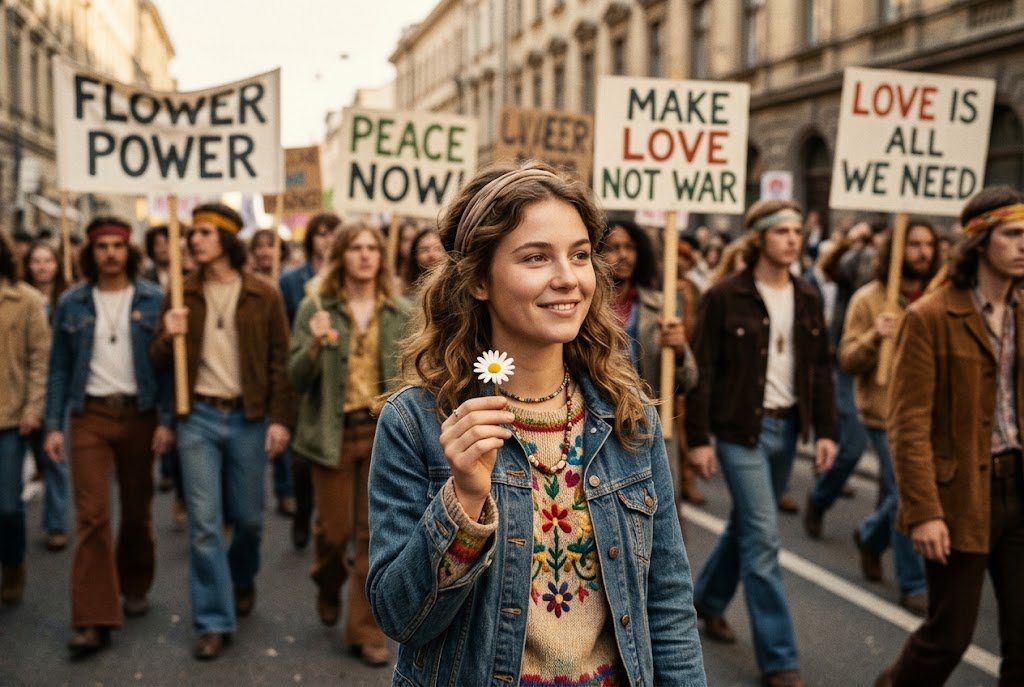
Flower power is the idea of resisting war and authority with peace, love and non-violence instead of force. American poet Allen Ginsberg came up with it in 1965. He suggested that anti-war marchers in Berkeley, California, carry flowers and hand them out to calm hostile crowds. By 1967 the phrase had become the slogan of the hippie counterculture, and the flower had become its symbol.
Today the term has two main meanings. The first is political: a peaceful protest philosophy that grew out of opposition to the Vietnam War. The second is cultural: the bright, floral, free-spirited style of the late 1960s and early 1970s. Here’s where the phrase came from, how it reached Australia, and what people mean when they use it now.
What Does Flower Power Mean?
At its heart, flower power says that gentleness can be stronger than violence. Protesters used flowers as a deliberate contrast to rifles, batons and uniforms. The message was simple: we’re not here to fight you.
The phrase gets used in a few different ways:
| Context | What it means | Example |
|---|---|---|
| Political | Non-violent protest, mainly against the Vietnam War | Offering flowers to police or soldiers at a march |
| Cultural | The peace-and-love values of the hippie movement | “The flower power generation” |
| Style and design | Bold floral prints, bright colours, psychedelic patterns | A daisy-print dress or a painted Kombi van |
| Everyday speech | Something peaceful, idealistic or a bit retro | “That’s a very flower power idea” |
That last use is usually affectionate, sometimes slightly teasing. Calling a plan “a bit flower power” often means it’s kind-hearted but optimistic.
Where the Phrase Came From
Allen Ginsberg and the 1965 Berkeley Marches
In late 1965, anti-war groups in Berkeley were organising marches against the United States’ growing role in Vietnam. Earlier marches had turned violent. Counter-protesters, including members of the Hells Angels motorcycle club, had attacked demonstrators. Organisers were worried the next march would end the same way.
Ginsberg, already well known as a Beat poet, offered an unusual answer in an essay usually titled “How to Make a March/Spectacle”. Instead of meeting aggression with anger, marchers should make the protest joyful and disarming. They would carry flowers, sing, bring toys and offer treats to onlookers, police and even the people who wanted to stop them. Historians generally trace the origins of the phrase to this moment in Berkeley.
The tactic was practical as well as poetic. It’s hard to justify hitting someone who’s handing you a daisy. With news cameras watching, a peaceful march made the protesters look reasonable and anyone attacking them look like the aggressor.
Why Flowers Worked as a Symbol
Flowers suited the job for a few simple reasons:
- They’re harmless. Nobody mistakes a flower for a weapon.
- They’re cheap. Anyone could take part, whatever their budget.
- They photograph well. A flower beside a gun barrel makes an image people remember.
- They stand for life. That set them directly against war and death.
The phrase moved from activist circles into newspapers and everyday speech fairly quickly. Merriam-Webster’s dictionary entry for the term gives 1967 as its first known use in this sense, which is the year it went mainstream.
How Flower Power Spread in 1966 and 1967
San Francisco and the Summer of Love
The slogan’s real home became San Francisco, especially the Haight-Ashbury neighbourhood. By 1967, thousands of young people had moved there, drawn by music, cheap rent and a rejection of mainstream values. Journalists called them “flower children” because so many wore flowers in their hair or handed them to strangers in the street.
That year is now remembered as the Summer of Love. Its best-known anthem, Scott McKenzie’s “San Francisco (Be Sure to Wear Flowers in Your Hair)”, carried the image around the world. For plenty of listeners outside the US, including in Australia, the song was their first taste of the idea.
The Photographs That Defined It
On 21 October 1967, tens of thousands of protesters marched on the Pentagon near Washington, DC. During the standoff, a young man was photographed sliding carnations into the barrels of soldiers’ rifles. Photographer Bernie Boston titled the picture “Flower Power”.
On the same day, French photographer Marc Riboud captured a young woman holding a single flower in front of a row of bayonets. These two images summed up the whole philosophy: unarmed people answering armed force with something gentle. They still appear in history books, documentaries and school lessons.
A Quick Timeline
| Year | What happened |
|---|---|
| 1965 | Ginsberg suggests flowers and song for Berkeley anti-war marches |
| 1966 | Hippie communities grow in San Francisco |
| 1967 | Summer of Love; “flower children” enters the news; Pentagon march photos |
| 1970 | Moratorium marches against the Vietnam War draw huge crowds in Australia |
| 1973 | Aquarius Festival held in Nimbin, New South Wales |
Flower Power in Australia
Australians weren’t just watching from a distance. Australia sent troops to Vietnam from the early 1960s, and the government introduced national service conscription in 1964. Young men were chosen by a ballot based on their birth dates, so the war reached into ordinary suburban homes. The anti-war movement grew alongside it.
Peaceful protest was central to the Moratorium marches of 1970. Tens of thousands of people walked through Melbourne, Sydney and other cities to oppose the war. Peace signs, floral imagery and handmade banners were everywhere, and the tone borrowed heavily from the American flower power style.
The counterculture side arrived too. The best-known Australian example is the 1973 Aquarius Festival in Nimbin, in northern New South Wales. It drew young people from across the country and helped turn the town into a lasting alternative-lifestyle community, one that still leans on that history for tourism today.
A small local note: in New South Wales, Flower Power is also the name of a garden centre chain. It shares the name but has no link to the 1960s movement, and the two often get mixed up in search results.
Flower Power as a Look and a Lifestyle
The movement quickly shaped how people dressed, decorated and travelled. Hippies rejected tidy, conservative clothing and used what they wore to show what they believed.
| Element | What it looked like | What it suggested |
|---|---|---|
| Floral prints | Big daisies and stylised blooms in bold colours | Peace, nature, joy |
| Flower crowns | Real or fabric flowers worn in the hair | Gentleness, freedom |
| Flared jeans and tie-dye | Loose, homemade or customised clothes | Individuality, rejecting conformity |
| Psychedelic posters | Swirling lettering and clashing colours | Music, creativity |
| Painted vans | Flowers and peace signs on VW Kombis | Travel, communal living |
Many of these looks have come back several times since. Floral prints, flares and 70s colour palettes return to shop windows every few years. Most revivals borrow the style and leave the politics behind, which is worth remembering if you’re dressing up for a themed party and want to get the history right.
How to Use the Phrase Correctly
If you’re writing an essay, a caption or a product description, a few pointers help:
- History writing: Use it for the non-violent anti-war protest style of roughly 1965 to the early 1970s.
- Fashion and design: It’s fine to describe retro floral looks, but “flower power style” or “flower power era” is clearer than the bare phrase.
- Casual speech: It works for anything gentle or idealistic. Just know it can sound slightly tongue-in-cheek.
- Avoid mixing it up: It isn’t the same as the peace sign itself, and it isn’t another name for the whole hippie movement. It’s one slogan within it.
Common Misunderstandings
“It was only about fashion.” The clothes came later. The phrase started as a protest tactic meant to stop violence at marches.
“Ginsberg started the hippie movement.” He didn’t. He gave the movement one of its best-known phrases. The counterculture grew from many roots, including rock music, student activism, the civil rights movement and earlier Beat writers.
“Everyone supported it.” Far from it. Many people saw hippies as naive or disruptive. Some activists thought flower power was too soft to change government policy.
“It ended the Vietnam War.” That’s an overstatement. The war continued for years after 1967. Historians still debate how much peaceful protest, compared with military, political and economic pressures, shaped how it ended.
The idea was also commercialised quickly. By the late 1960s, advertisers were using floral imagery to sell cosmetics, soft drinks and cars. Many people in the original movement saw that as the point where the slogan lost its bite.
Why It Still Matters
More than fifty years later, the phrase is still alive in three main ways:
- Protest. Offering flowers to police or soldiers still happens at peaceful demonstrations worldwide, a direct echo of the 1960s photos.
- Style. Each floral fashion revival brings the label back, often in shop marketing.
- Language. People still use it for anything idealistic, peaceful or a little bit hippie.
For students of the 1960s, the slogan is a neat window into the period. It shows how young people tried to shift politics with symbols and media attention rather than force.
The Takeaway
Flower power began as Allen Ginsberg’s practical suggestion: meet aggression with flowers and turn protests into peaceful spectacles. It became the defining slogan of the hippie counterculture. In Australia it was tied closely to opposition to the Vietnam War and conscription, and its counterculture side showed up at Nimbin’s Aquarius Festival. Knowing that history helps you see the anti-war message behind the daisy prints. For a closer look, search out photographs from the 1967 Pentagon march and Australia’s 1970 Moratorium marches. They show the idea in action better than any definition.
FAQ
Who invented the phrase flower power?
Allen Ginsberg is credited with coining it in 1965. He suggested that Berkeley anti-war protesters use flowers to keep marches peaceful.
What does flower power stand for?
It stands for non-violent resistance, peace and love. It was first aimed at the Vietnam War, then at the wider values of the 1960s hippie movement.
Why were hippies called flower children?
Many wore flowers in their hair or handed them out as a peace gesture, especially in San Francisco in 1967. The media nicknamed them “flower children”.
Was flower power part of Australian history?
Yes. Peaceful anti-war protest grew in Australia during the Vietnam War and conscription years, peaking with the 1970 Moratorium marches.