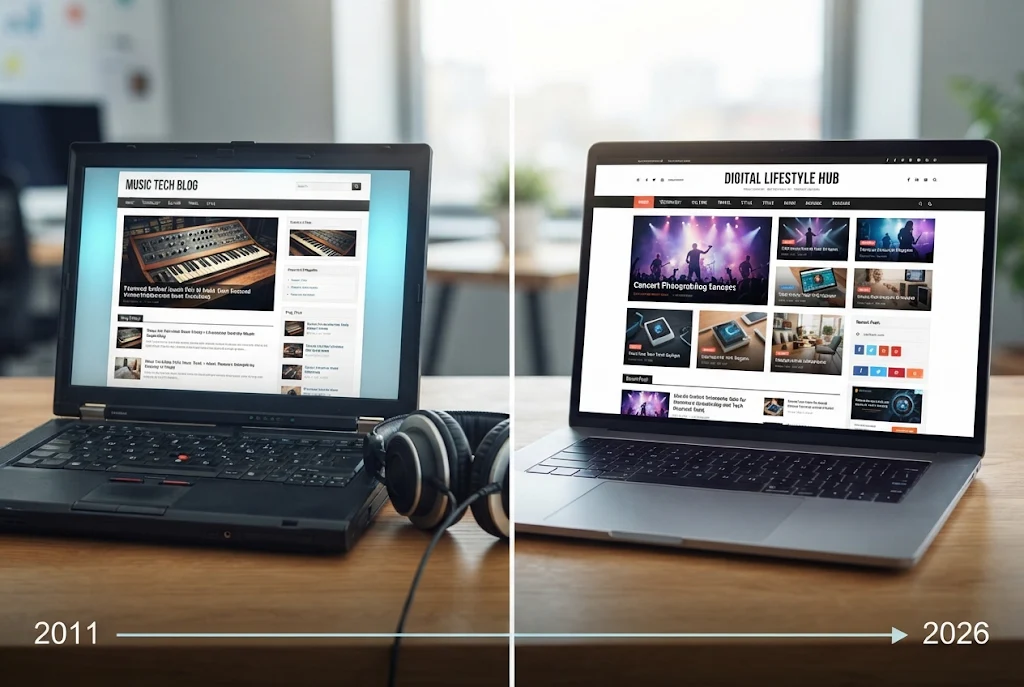
Sosoactive started in 2011 as a small interactive media company in Dallas, Texas. It wrote about social music startups, mobile music apps, product reviews and marketing tips for independent artists. In 2026 the same domain runs as a general online magazine covering business, finance, health, tech, travel and everyday life. What’s missing is a clear public record of who runs it today and exactly when the switch happened.
That gap is why so many write-ups about the site contradict each other. Below you’ll find what can be traced through dated records, what can’t be confirmed, and a simple method for checking any website’s history yourself.
The Short Version: Then vs. Now
If you only need the quick picture, this table covers it.
| Early years (2011 to mid-2010s) | Today (November 2026) | |
|---|---|---|
| Main focus | Social and mobile music, artist marketing | Business, finance, health, tech, travel, lifestyle |
| Typical reader | Independent musicians and music-tech fans | General web readers searching how-to topics |
| Typical content | App reviews, music business tips, festival coverage, interviews | Explainers, how-to guides, product roundups, general advice |
| Who’s visible | Named contributors with music industry ties | One byline on most posts, no named owner |
| Self-description | Interactive media company covering social and mobile music | “Independent online magazine” |
2011: A Dallas Startup Built Around Social Music
In the early 2010s, music discovery was moving onto smartphones and social feeds. Independent artists were trying to work out how to earn money from YouTube, sell merchandise online and get noticed without a label. That’s the gap the original site set out to fill.
Business directories still carry the company’s early profile. They list SoSoActive Media as founded in 2011, based in Dallas, privately held and run by a team of two to ten people. Keep in mind that team size and specialties on these listings are self-reported, so treat them as rough guides, not audited facts.
What the Early Site Actually Covered
The best evidence of the early Sosoactive comes from other music publications that linked to it at the time. A January 24, 2013 roundup of digital media resources for musicians on Music Think Tank pointed readers to five of its articles. They covered finding a music publisher, making money from merchandise, getting songs in front of music supervisors and building a yearly plan for indie musicians.
That mix tells you a lot. This wasn’t celebrity gossip or general lifestyle content. It was practical, career-focused advice for working musicians.
Other dated traces from 2013 and 2014 fill in the picture:
- Artist marketing guides. In May 2014, the music business site Hypebot sent readers to the site’s advice on promoting music videos through Facebook.
- Industry interviews. A May 2014 interview with an ASCAP repertory analyst first ran on Sosoactive and was later republished by Music Think Tank.
- Festival coverage. One former contributor’s professional profile lists coverage of SXSW in 2013 and the Essence Music Festival in 2013 and 2014 for the site.
- App reviews. A surviving social post from the radio app Grab Radio links to a Sosoactive review of the app, which offered social sharing and more than 40 stations. The review itself no longer appears on the current site.
Who Was Behind It?
The name most closely tied to the early brand is Kelland Drumgoole. His byline and name appear on early music articles, and some recent profiles describe him as the founder. However, no business filing or official company record that can be checked publicly confirms that title.
Even the old records aren’t perfectly tidy. On the 2013 Music Think Tank post, the author link credits Drumgoole while the visible byline names a different writer tagged with the site’s handle. That’s common on multi-author blogs, but it’s a good reminder not to treat any single page as the final word.
The Quiet Years: Where the Record Gets Thin
Most dated public mentions of the music-era site cluster around 2013 and 2014. After that, the trail fades. Some secondary accounts say music coverage stopped around 2019, but there’s no dated announcement, press release or archived editor’s note that confirms when or why.
There’s also no public record of a sale, merger or ownership transfer. That doesn’t mean one never happened. It means nobody has documented it in a place readers can check.
It helps to know how this often works online. Older domains with years of incoming links are valuable, and they’re sometimes sold or re-registered and then filled with new, broader content. Whether that’s what happened with this domain isn’t publicly known, so it shouldn’t be stated as fact.
Sosoactive Today: A General-Interest Online Magazine
Visit the homepage in November 2026 and you’ll see a very different publication. The footer of the current Sosoactive homepage describes it as an independent online magazine covering business, finance, health, technology, travel, culture and everyday life.
Here’s what stands out on the live site:
- Wide category list. The main menu includes business, finance, entrepreneurship, e-commerce, health, law, tech, education and insurance. Lifestyle, travel, home, real estate, automotive and entertainment show up in the category list too.
- Fresh posts. Featured articles are dated from late October to early November 2026, so the site is actively publishing.
- Limited ownership details. No About page link appears on the homepage, and no owner or company is named. Most posts share the same author byline.
- No music focus. The artist-marketing and music-tech coverage that defined the early years doesn’t appear in the current navigation.
Old Pages vs. New Pages: A Quick Comparison
The easiest way to see the shift is to set two eras of headlines side by side. In 2013, Sosoactive articles helped musicians find a publisher, earn money from merchandise and pitch songs to music supervisors. Each piece assumed the reader was an artist trying to build a career.
The 2026 homepage reads very differently. Recent headlines include pieces on why Gen Z is turning to no-KYC crypto cards and how Gen Z is using AI to build websites. Other posts cover insurance, real estate, online games and wedding topics. The reader could be almost anyone with a search query.
That change affects how you should use the site:
- Depth vs. breadth. The early Sosoactive went deep on one industry. The current version covers many subjects more lightly.
- Expert voices. Music-era pieces featured industry interviews and festival reporting. Today’s posts rarely show that kind of first-hand access.
- Shelf life. Music business tips from 2013 are dated now. Current posts on finance or crypto can go out of date quickly too, so check the publish date before acting on them.
None of this makes the current Sosoactive good or bad by default. It simply means you should judge it as a general-interest publication, not as the music-tech outlet it once was.
Why So Many Articles Describe It Differently
If you’ve searched the name recently, you’ve probably seen it called a social network, a millennial platform, a lifestyle blog and a guest posting site, sometimes all in one article. There are four main reasons for the mix-up:
- Old directory text lives on. Some business databases still describe the company as an interactive media brand aimed at millennials, covering entertainment, culture, fitness, family and political opinion. Writers copy that text without checking the live site.
- Promotional posts repeat each other. A wave of recent articles credit the brand with social features, matchmaking or virtual events. None of these features can be found on the current site.
- Lookalike domains. Researchers have reported sites using similar names on other domain endings, with no proven link to the original. At least one of them openly sells guest posts.
- Unverified numbers. A revenue figure of around $3 million circulates online, but no filing or company statement backs it up.
There are also unrelated spam pages that attach the name to a “wellness product.” They have nothing to do with the media brand and are best ignored.
Timeline: What’s Confirmed and What Isn’t
This table separates the solid facts from the guesswork. The “evidence” column is the part most write-ups skip.
| Period | What happened | Evidence | How solid |
|---|---|---|---|
| 2011 | Company founded in Dallas as an interactive media brand | Business directory listings | Good, consistent across listings |
| January 2013 | Music articles linked in an industry resource roundup | Dated third-party post | Strong |
| 2013 to 2014 | Festival coverage, ASCAP interview, Facebook promotion tips | Dated industry posts and contributor profiles | Moderate to strong |
| Around 2019 | Music coverage reportedly ends | Secondary accounts only | Weak |
| 2025 to 2026 | Domain publishes broad multi-topic content | Live website | Strong, directly visible |
| 2026 | Lookalike sites with similar names appear | Secondary reports | Moderate |
How to Check a Website’s History Yourself
You don’t need special tools to fact-check a site’s backstory. These five steps work for this domain or any other site you’re unsure about.
- Look at archived snapshots. The Internet Archive’s Wayback Machine stores copies of many websites over time. Check the earliest captures and look for the point where the categories or design change.
- Run a domain lookup. A WHOIS or RDAP lookup shows when a domain was registered and when it was last updated. Owner details are often hidden for privacy, and a long registration history doesn’t prove the same person still owns it.
- Search old mentions by date. In Google, use Tools, then a custom date range, to find mentions from a specific era, such as 2012 to 2015. Mentions on established publications from that period are far more reliable than recent recaps.
- Check the people. See whether the authors have traceable profiles, past work or contact details. A site with one byline and no About page gives you less to go on.
- Treat directories with care. Business databases are useful starting points, but much of their data is self-reported and rarely updated.
Common Mistakes to Avoid
- Assuming an old domain means the same company still runs it.
- Copying “about” text from one recap article into another without checking the live site.
- Mixing up the original domain with lookalike sites that use similar names.
- Repeating traffic or revenue figures that don’t name a source.
What This Means for Readers, Writers and Brands
For everyday readers, Sosoactive’s history matters less than the article in front of you. Check whether each post names its sources and shows a date, especially for money, health or legal topics.
For musicians looking for the old guides, the archived snapshots are your best bet, since most music-era content no longer appears on the current site.
For brands and marketers weighing a guest post, ask who owns the site, confirm you’re dealing with the original domain and not a lookalike, and check traffic with your own SEO tools instead of relying on numbers quoted in promotional articles.
The Takeaway
Sosoactive’s story is real, just incomplete. The 2011 Dallas start and the music-focused years are backed by dated records. The current general-interest magazine is easy to see for yourself. The years in between, including any change of ownership, aren’t documented anywhere public. Until they are, the most accurate way to describe the brand is as an older music-tech name that now runs as a broad lifestyle and business publication.
Frequently Asked Questions
When was Sosoactive founded?
Business listings show it was founded in 2011 as an interactive media company based in Dallas, Texas.
Is Sosoactive still a music website?
No. As of November 2026, it publishes general content on business, finance, health, tech, travel and lifestyle. The music coverage from its early years no longer appears in the site’s navigation.
Who owns Sosoactive now?
The current owner isn’t publicly confirmed. The homepage doesn’t name a company or owner, and no public record of a sale has been found.
Are sites with similar names connected to the original?
There’s no evidence that they are. Lookalike domains using the same or similar names have been reported, so always check that you’re on the original domain.