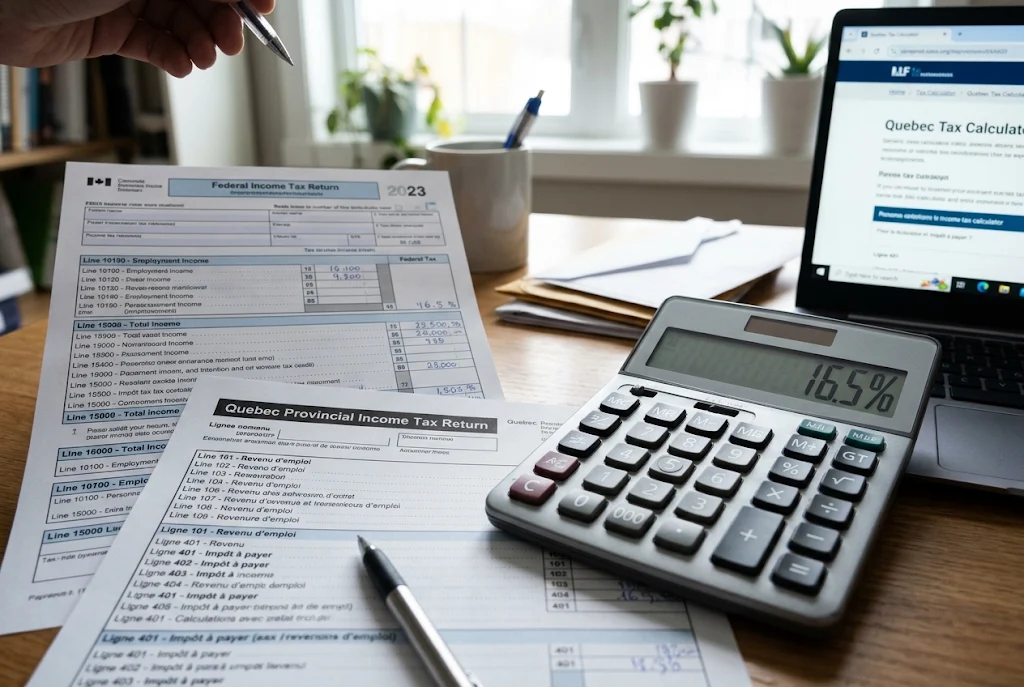
If you’ve run your salary through a Quebec tax calculator and compared it with an Ontario one, you’ve probably spotted something odd. The federal tax line for Quebec is noticeably smaller, even though the same federal brackets apply across Canada. That gap is the Quebec abatement.
Here’s the short answer. Most Quebec residents get their basic federal income tax cut by 16.5%. The money isn’t a gift. Ottawa gave Quebec that share of federal tax room decades ago, and Quebec collects it through its own, higher provincial tax. A good calculator applies the cut automatically, which is why your federal number looks low and your provincial number looks high.
Below you’ll see where the 16.5% comes from, how the math works step by step, how to check that a calculator is handling it properly, and why it has nothing to do with GST or QST.
What the Quebec Abatement Actually Is
The abatement is a reduction of your federal personal income tax. It shows up on the federal return (the T1 you file with the Canada Revenue Agency), not on your Revenu Québec return.
On the federal return it appears as line 44000, “Refundable Quebec abatement.” The word “refundable” matters. The abatement lowers your balance owing, and if you’ve already had enough tax withheld, it can add to your refund.
Where the 16.5% comes from
The number isn’t arbitrary. According to the Department of Finance Canada, it’s made of two pieces:
- 13.5 percentage points from the 1960s opting-out arrangements. Ottawa offered provinces the option to run certain shared programs, such as hospital care and social welfare, themselves. Only Quebec accepted. Ottawa lowered federal tax in Quebec, and Quebec raised its own tax by the same amount.
- 3 percentage points linked to a former youth allowances program. Quebec repays the value of these 3 points to the federal government each year, an arrangement known as the Youth Allowances Recovery.
Other provinces get the equivalent value as cash transfers. Quebec gets it as tax room instead. Finance Canada says the arrangement has no net impact on what Quebec or any other province receives.
Why it doesn’t mean Quebecers pay less tax
This is the part most people miss. The abatement lowers your federal tax, but Quebec’s provincial rates are higher to make up for it. For 2026, Quebec’s provincial brackets run from 14% to 25.75%. Ontario’s provincial rates are much lower.
So when you see a smaller federal figure in your results, don’t read it as a tax break. It’s a split of the same overall burden between two governments.
How a Quebec Tax Calculator Applies the Abatement
Behind the scenes, a well-built calculator follows the same order the federal return does. The order is important, because the abatement comes after your credits.
The calculation, step by step
- Work out federal tax on taxable income. For 2026, the federal brackets start at 14% on the first $58,523, then 20.5% up to $117,045, with higher rates above that.
- Subtract federal non-refundable tax credits. These include the basic personal amount, credits for QPP and EI contributions, and the Canada employment amount. What’s left is your basic federal tax.
- Take 16.5% of basic federal tax. That’s your abatement.
- Subtract the abatement. The result is the federal tax a Quebec resident actually pays.
- Calculate Quebec tax separately. Quebec’s own brackets and credits apply to the provincial side, which you file with Revenu Québec.
A simple worked example
Say a calculator works out your basic federal tax (after credits) at $6,000.
| Step | Amount |
|---|---|
| Basic federal tax | $6,000 |
| Quebec abatement (16.5%) | –$990 |
| Federal tax payable | $5,010 |
Someone with exactly the same income and credits in Ontario would pay the full $6,000 federally. You pay $5,010 to Ottawa, but your Quebec provincial tax will be higher than Ontario’s provincial tax would be.
These are round illustrative numbers, not a real 2026 calculation for a specific salary.
Your federal credits are worth less, too
Because the abatement is taken after credits, it shrinks their value. If a credit cuts your basic federal tax by $100, your abatement drops by $16.50 as well. So in practice, that credit saves you $83.50 in federal tax, not $100.
This is one reason why a federal credit (like the tuition amount or a donation credit) seems to save Quebec residents a bit less than it saves people in other provinces.
Low incomes: no federal tax, no abatement
The abatement is a percentage of basic federal tax. If your credits already bring your basic federal tax down to zero, 16.5% of zero is zero. So a student with a small part-time income, or a retiree whose credits cover all their federal tax, won’t see any abatement at all.
That’s normal, and it doesn’t mean the calculator is broken. It just means there was no federal tax to reduce.
Reading the results screen
Most tools split the output into several lines. Here’s what each one usually means:
- Federal tax: what you owe Ottawa, normally shown after the abatement.
- Quebec abatement: the 16.5% reduction, if the tool shows it as its own line.
- Provincial tax: what you owe Revenu Québec.
- QPP, EI and QPIP: payroll contributions, not income tax, though they come off your pay as well.
- Net income: your estimated take-home pay after all of the above.
If a Quebec tax calculator only gives you one “total tax” figure, you can’t check whether the abatement was applied. Pick a tool that shows the breakdown.
What the Abatement Does to Your Federal Tax Rates
Most quick-reference tax tables for Quebec already build the abatement in. Here’s how the 2026 federal rates look once the 16.5% reduction is applied (each rate multiplied by 0.835):
| 2026 federal bracket | Standard federal rate | Effective rate in Quebec |
|---|---|---|
| Up to $58,523 | 14% | 11.69% |
| $58,523 to $117,045 | 20.5% | 17.12% |
| $117,045 to $181,440 | 26% | 21.71% |
| $181,440 to $258,482 | 29% | 24.22% |
| Over $258,482 | 33% | 27.56% |
Add Quebec’s top 25.75% rate to the top effective federal rate and you get roughly 53.3%. That lines up with published 2026 figures for Quebec’s combined top marginal rate on regular income.
If a calculator shows a Quebec combined top rate well above that, it’s likely skipping the abatement.
Who Gets the Abatement (and Who Might Not)
The basic rule is residency. If you were a resident of Quebec on December 31 of the tax year, you’re generally eligible, as long as you didn’t have business income from a permanent establishment outside Quebec.
A few situations need extra care:
- You moved during the year. Your province on December 31 usually decides where you pay provincial tax for the whole year. Moving to Quebec in November generally means Quebec rules, abatement included, for that year.
- You live in Quebec but work for an Ontario employer. Where you live, not where your employer is, decides your province of residence. If your employer withholds as if you were in Ontario, your withholdings won’t match your Quebec returns.
- You’re self-employed with operations in more than one province. Your income may be split between provinces using Form T2203, and the abatement is calculated through that form instead.
- You’re subject to minimum tax. The abatement is based on basic federal tax or federal minimum tax, whichever is greater.
If any of these apply to you, a general online calculator may not reflect your situation accurately. That’s the point where tax software or a tax professional is the better choice.
How to Tell If a Calculator Handles the Abatement Correctly
Not every tool on the web was built with Quebec in mind. Some “Canada-wide” calculators bolt on Quebec’s provincial brackets but forget the federal side. Here’s a quick sanity check you can do in under two minutes:
- Look for an abatement line. Good tools show “Quebec abatement” or “federal tax after abatement” as a separate figure.
- Run a test number. Enter the same salary for Quebec and Ontario. If the federal tax is identical in both, the tool isn’t applying the abatement.
- Check the payroll deductions. A Quebec result should show QPP rather than CPP, plus QPIP (Quebec Parental Insurance Plan) premiums and a lower EI rate. If you see CPP for a Quebec resident, the tool is using generic rules.
- Confirm the tax year. Brackets are indexed every year. For 2026, Quebec indexed its brackets by 2.05%. A tool still showing older thresholds will be slightly off.
- Remember it’s an estimate. Calculators usually assume employment income and basic credits only. Childcare, medical expenses, RRSP contributions and investment income can all change the real result.
A common mistake with refunds
People sometimes see the abatement on their federal return and think they’ve received an unexpected refund. In most cases, for employees, the federal tax withheld from your pay has already been reduced to account for the abatement. The line on the return simply makes the final numbers add up. A refund or balance owing depends on how closely your withholding matched your actual tax, not on the abatement itself.
Income Tax Calculators vs GST, HST and QST Calculators
Because “tax calculator” covers so much ground, it’s worth separating the two. The abatement only affects income tax. It has no effect on the sales tax you pay at the till.
If you need to add tax to a price or work it back out of a receipt, you need a sales tax tool instead: a GST calculator or HST calculator, depending on the province. Here’s how 2026 rates compare for common provinces:
| Province | Sales tax | Combined rate |
|---|---|---|
| Quebec | 5% GST + 9.975% QST | 14.975% |
| Ontario | HST | 13% |
| Nova Scotia | HST | 14% |
| New Brunswick, Newfoundland and Labrador, PEI | HST | 15% |
| Alberta | GST only | 5% |
Revenu Québec publishes the official GST and QST rates going back to when each tax started.
One practical difference: in Quebec, the GST and QST are both charged on the price before tax. That’s why the total is 14.975% and not a rounder number. An HST calculator built for Ontario won’t give you the right figure for a Montreal purchase.
The Bottom Line
The 16.5% abatement is the main reason federal tax looks different for Quebec residents. It’s a lasting fiscal arrangement, not a deduction you claim or a refund you earn, and Quebec’s higher provincial tax balances it out. When you use a Quebec tax calculator, check that it shows the abatement, uses QPP and QPIP, and matches the current tax year. For anything beyond a simple salary estimate, such as a move, self-employment or investment income, use proper tax software or speak with an accountant who knows Quebec’s two-return system.
FAQ
Do I need to apply for the Quebec abatement?
No. If you’re a Quebec resident on December 31, the abatement is calculated on your federal return. Tax software does it automatically.
Does the abatement mean Quebec has the lowest taxes in Canada?
No. It lowers federal tax only. Quebec’s provincial rates are higher, so the combined tax for most incomes is not lower than in other provinces.
Is the Quebec abatement still 16.5% in 2026?
Yes. The rate has stayed at 16.5% for decades and is set out in federal law, so it doesn’t change with yearly indexation.
Why does a Quebec tax calculator show two separate tax amounts?
Quebec residents file two returns: a federal one with the CRA and a provincial one with Revenu Québec. The calculator estimates each of them separately.
Does the abatement apply to GST or QST?
No. It only applies to federal personal income tax. Sales taxes like GST, QST and HST are separate.