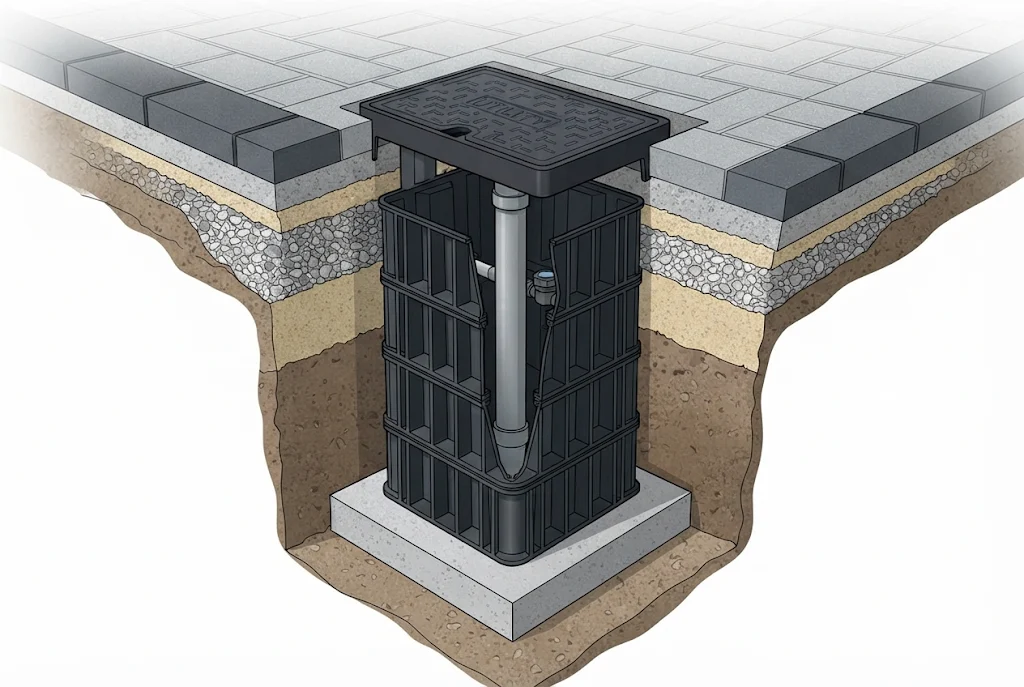
If you’ve come across an “Eco Chamber Section Top Hat 230 x 230mm” on a merchant’s site or a material schedule, it probably belongs to a modular plastic access chamber of the kind used over underground water valves, stop taps, meters and hydrants. These chambers are built by stacking square sections made from recycled plastic. The top hat is an accessory in the range, and it appears to be the piece that joins a short vertical length of twinwall pipe to the chamber.
The parts aren’t hard to understand. What causes trouble is the naming, because suppliers label these products in different ways. Below you’ll find what each part does, where the 230 x 230mm size fits, and what to check before you order.
The Short Answer
An eco chamber section is a moulded square or rectangular ring made from recycled plastic. You stack the sections on a base to build a small underground chamber, then finish it with a surface box or cover at ground level. The 230 x 230mm figure is the footprint of the section (length by width). Depth varies from section to section.
The “top hat” is a separate unit. In the best-documented range, the manufacturer lists it next to a 225mm twinwall pipe sold “for Top Hat”. That suggests its job is to connect a pipe riser to the chamber. Treat that as a working description, though, not a confirmed spec. The manufacturer’s public product page gives the part code but doesn’t explain the unit in detail.
Where the Name Comes From
You’ll see a few related names on UK merchant sites:
- ecoNOMY is Advanced Infrastructure’s modular valve and hydrant chamber system.
- Eco Valve and Ecolite are plastic chamber sections sold by merchants, with brands such as Pennine and Thomas & Burns appearing on the listings.
- “Eco chamber” is the generic shorthand trade counters and contractors tend to use for all of the above.
The ranges look similar and serve the same job, but they aren’t automatically interchangeable. If you’re adding a top hat to an existing chamber, find out which range it was built from first. Old delivery notes, a part code moulded into the plastic, or the original merchant are your best leads.
How the Modular Chamber System Works
The Sections
Each section is a single compression-moulded ring. Advanced Infrastructure describes its range as 100% recycled PVC chamber sections that are D400 tested and light enough for one person to lift. The same page lists the sizes, including a 230 x 230 x 75mm section (code ECO5).
Merchant listings from other brands show 230 x 230mm sections at depths of 75mm, 100mm and 150mm. Mixing depths lets you hit your finished height more precisely.
The Base
A matching base unit sits under the first section. The ecoNOMY range lists a dedicated base for the 230 x 230mm size (ECOBASE4). Some merchant guidance says the first section can go on a prepared concrete or Type 1 sub-base instead. The right choice depends on the job spec and the water company’s requirements.
The Top Hat and Twinwall Riser
This is the part people search for most and understand least. Advanced Infrastructure lists a Top Hat Unit (ECOTOPHAT) alongside a 225 x 600mm twinwall pipe described as being for the top hat. The pairing points to a design where a section of large-diameter pipe provides a deeper, narrower shaft, and the top hat makes the transition to the square chamber or surface fitting.
Because the manufacturer doesn’t publish a full description, ask the supplier three things before ordering:
- Which section size the top hat is designed to sit on or under.
- Whether it’s meant to be used with the 225mm twinwall riser, or can be used without it.
- Which surface boxes or covers it’s compatible with.
The Surface Box or Cover
Chamber sections don’t come with lids. On merchant listings, covers, frames and surface boxes are sold separately. Ductile iron and composite options are both common, and the ecoNOMY system says it can be supplied with either.
What the 230 x 230mm Size Is Typically Used For
The 230 x 230mm footprint sits at the small end of the range. Larger sizes go up to 430 x 280mm, 600 x 450mm and 900 x 600mm. In practice, the small size suits jobs where you only need to reach one fitting:
| Typical use | Why 230 x 230mm can suit it |
|---|---|
| Stop tap or boundary valve access | Enough room to reach a valve key down to a single valve |
| Small meter positions | Compact footprint for footpaths and driveways |
| Duct access points | Some merchants sell the same size as a duct access chamber |
| Hydrant or valve marker points | Fits under small surface boxes |
If a fitting needs hands-on work, such as unscrewing a meter, the 230mm size may be too tight. The larger rectangular sizes exist for that reason.
Why Contractors Use Plastic Sections Instead of Concrete
These systems were designed as a lighter alternative to precast concrete. Advanced Infrastructure says more than 5 million ecoNOMY units have been installed across the UK water utility network, as stated on its product page in 2026.
The practical reasons crews choose them include:
- Weight. One person can carry and place a section, which helps in tight streets and back gardens.
- Speed. Interlocking or rebated sections locate on each other without mortar between rings, according to manufacturer and merchant descriptions.
- Recycled content. The sections are marketed as being made from recycled plastic, which can help on projects with sustainability targets.
- Adjustable height. Mixing 25mm, 50mm, 75mm or 150mm depths (depending on the range) lets you fine-tune the level.
There are trade-offs too. Plastic sections rely on good bedding and backfill for their strength in the ground. A poorly compacted surround can let the chamber shift, and surface boxes can rock or sink over time.
What “D400” Means on These Products
D400 is a load class from BS EN 124, the standard for gully tops and manhole tops. Class D covers carriageways, hard shoulders and parking areas used by all types of road vehicle. The 400 is the test load in kilonewtons.
Two points that often get missed:
- A D400-tested chamber section doesn’t make the whole installation D400. The cover, the frame, the bedding and the surrounding surface all count.
- On a driveway or private path, a lower-class cover may be enough. Under a public road, the highway authority or water company will usually set the requirement.
If you’re unsure, check the job specification or ask the asset owner. Don’t assume from a product label alone.
Step-by-Step: Planning a Small 230 x 230mm Chamber
This is a general planning sequence, not a substitute for the manufacturer’s instructions or your water company’s specification.
- Confirm the depth to the fitting. Measure from finished ground level to the top of the valve or meter. This sets how many sections you need.
- Choose your range and stick to it. Get the base, sections, top hat (if used) and surface box from one compatible system.
- Work out the section mix. Add up section depths, plus the surface box height, to reach finished level. Thinner sections help you fine-tune.
- Prepare a firm base. Use the matching base unit or a compacted sub-base, as the spec requires.
- Stack and align. Seat each section fully on the one below and keep the chamber plumb.
- Fit the riser and top hat if the design uses them. Confirm the orientation with the supplier.
- Backfill in layers. Compact around the chamber evenly so it doesn’t push out of square.
- Bed and level the surface box. Set it flush with the finished surface so it doesn’t become a trip hazard or take point loads.
Common Mistakes to Avoid
- Mixing brands. Sections from different ranges may look the same but locate differently.
- Ordering without a cover. The sections come without a lid, so price the surface box at the same time.
- Ignoring the top hat question. Don’t order a top hat just because it appears in the range. Confirm that your design actually needs one.
- Undersizing for the task. A 230 x 230mm chamber is fine for a valve key but awkward for meter replacement.
- Weak backfill. Most settlement problems come from the surround, not the plastic.
Typical Pricing in the UK
Small plastic chamber sections are relatively cheap. In November 2026, one UK merchant listed a 230 x 230 x 100mm section for under £7 including VAT. The top hat unit, twinwall riser, base and surface box are separate items, and the cover often costs more than the sections. Prices vary a lot between merchants and change often, so get a full quote for the complete assembly.
Who Should Install It
On private land, a competent groundworker can install a small access chamber. Where the chamber covers a water company asset, such as a boundary stop tap or a public-side meter, the work usually falls under the water company’s own rules, and you may need their approval or their approved contractor. If you’re not sure who owns the pipe or fitting, contact your water supplier before you dig.
The Takeaway
The Eco Chamber Section Top Hat 230 x 230mm is best understood as part of a kit. You have recycled plastic sections for the walls, a base below, a cover above, and a top hat that appears to join a twinwall pipe riser to the chamber. Before you buy, confirm which range you’re working with and whether your design needs the top hat at all. Then price the full assembly, cover included, rather than the sections alone.
FAQ
Does the 230 x 230mm chamber section come with a lid?
No. Merchant listings show covers and surface boxes sold separately, so you’ll need to order a compatible one.
Can I mix Eco Valve, Ecolite and ecoNOMY sections?
It isn’t recommended unless the supplier confirms they’re compatible. Sections that look alike can locate on each other differently.
Is a D400 section suitable for a driveway?
The section’s rating is only part of the picture. The cover class, bedding and surrounding surface also need to suit the traffic load.
What is the twinwall pipe used for with the top hat?
The manufacturer lists a 225 x 600mm twinwall pipe for use with its top hat unit, which suggests a vertical riser. Confirm the exact arrangement with the supplier.
Can I install one myself?
On private land, a competent DIYer or groundworker can, but chambers over water company assets usually fall under the water company’s rules.