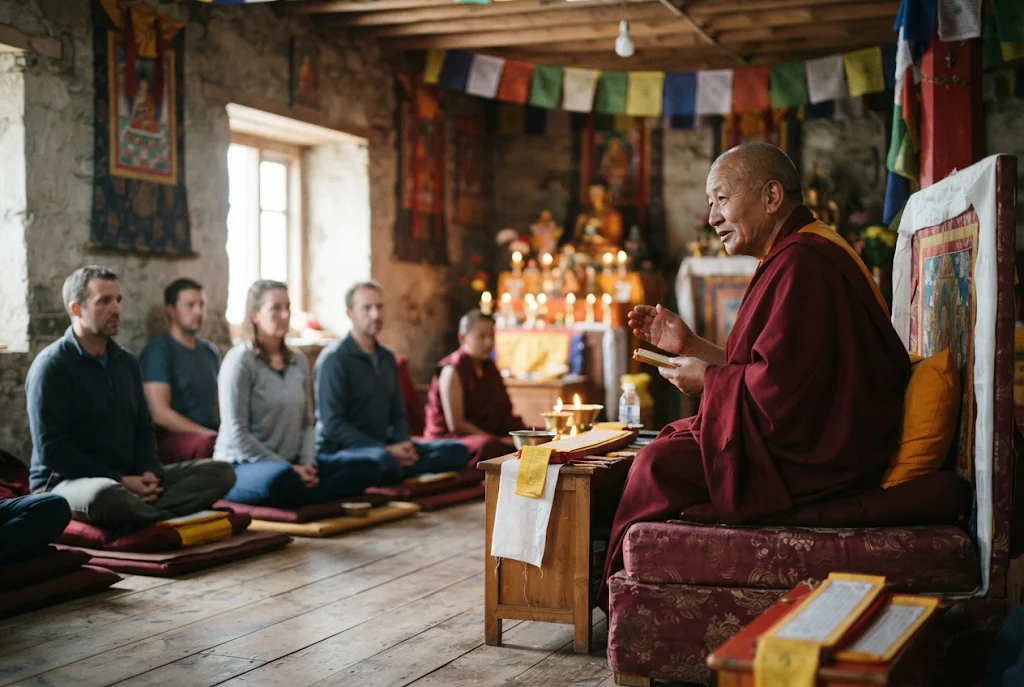
A lama is a spiritual teacher in Tibetan Buddhism. The word comes from the Tibetan bla-ma, usually translated as “superior one” or “highest”, and it was chosen centuries ago as the Tibetan equivalent of the Sanskrit word guru. A lama isn’t simply any monk. It’s a title of respect for someone recognised as able to teach and guide others on the Buddhist path.
That’s the short answer. The longer one is more interesting, because the word has been misunderstood in the West for over a century. In German it even shares its spelling with a South American animal. Below you’ll find what the title means, who can hold it, how it differs from other Tibetan titles, and how to use the word correctly.
Where the Word “Lama” Comes From
The Tibetan spelling is bla-ma. The “b” is silent, so it’s pronounced “LAH-ma”. Britannica’s entry on the title translates it as “superior one” and describes a lama as a spiritual leader in Tibetan Buddhism.
Tibetan teachers also give a more poetic reading of the two syllables:
- La is read as “highest” or “unsurpassable”
- Ma is read as “mother”
Taken together, this reading presents the teacher as someone who cares for a student the way a mother cares for a child. Some explain the word instead as a contraction of a Tibetan phrase meaning “supreme” or “unsurpassable”. Both readings agree on the core idea: a lama is someone of the highest spiritual standing, and the bond with a student is close and personal.
Why the Word Matched “Guru”
When Indian Buddhist texts were translated into Tibetan, translators needed a word for guru, the Sanskrit term for a revered teacher. They picked bla-ma, and the choice was fixed in the 8th-century Mahāvyutpatti, the official Sanskrit–Tibetan glossary. So when you read “guru” in an Indian Buddhist text, the Tibetan version will usually say “lama”.
What a Lama Actually Does
A lama is first a teacher. In practice that can involve several roles:
- Giving teachings on Buddhist philosophy, ethics and meditation
- Passing on transmissions and empowerments, the formal permissions a student needs before starting certain tantric practices
- Guiding students one-to-one, often over many years
- Leading rituals in monasteries and lay communities
- Running a monastery or centre, in the case of senior lamas
In the Vajrayana (tantric) form of Buddhism practised in Tibet, the teacher matters more than in many other Buddhist schools. Students are taught to see their teacher as an embodiment of the Buddha’s qualities. That’s why choosing a teacher is treated as a serious decision and not as something to rush.
Lama vs Monk: Not the Same Thing
This is the most common misunderstanding. Many Western travellers and early scholars used the title for every Tibetan monk, and the habit stuck. It’s not accurate.
| Monk or nun | Lama | |
|---|---|---|
| What it is | A person who has taken monastic vows | A title for a recognised teacher |
| Must be ordained? | Yes | No, some are lay practitioners |
| Can marry? | No | Lay teachers in some lineages can marry and have children |
| Can be a woman? | Yes (nun) | Yes, women can hold the title |
| How many? | Tens of thousands of Tibetan monastics | Far fewer |
So a lama can be a monk, but most monks don’t hold the title. A lay yogi with a family can hold it, and so can a woman. What counts is recognised spiritual achievement and the authority to teach, not the robes.
Two Ways to Become a Lama
Britannica describes two broad routes to the title.
Reincarnate Teachers (Tulkus)
A tulku (sprul-sku in Tibetan) is believed to be the rebirth of an earlier master who chose to return and keep teaching. When a tulku dies, senior teachers look for the child who is believed to be the next rebirth. The search can draw on:
- The previous master’s last words or written instructions
- Unusual signs at the death or at a child’s birth
- Consultation with oracles and meditation masters
- Tests in which a child picks out belongings of the late master from a group of similar objects
The recognised child then gets years of intensive monastic education. Recognition is only the start; the training is what turns the child into a working teacher.
Teachers Recognised for Their Own Practice
Other teachers earn the title in their own lifetime. Usually they’ve spent many years studying and practising, including long retreats. In some traditions, completing a three-year retreat is a well-known route to the title. Exact rules vary between the four main schools (Nyingma, Kagyu, Sakya and Gelug), and between individual monasteries.
Lama, Rinpoche, Geshe, Tulku: A Quick Guide to Tibetan Titles
These titles often appear together, and it’s easy to mix them up. Here’s what each one usually signals:
- Lama: a recognised spiritual teacher
- Tulku: a recognised reincarnation of an earlier master
- Rinpoche: literally “precious one”, an honorific used for tulkus and highly respected teachers
- Geshe: an academic degree, mainly in the Gelug school, earned after many years of monastic study and debate. The female equivalent, Geshema, is now also awarded.
- Khenpo: an abbot or a highly trained scholar, used especially in the Nyingma and Kagyu schools
One person can hold several of these at once. A teacher might be a tulku, addressed as Rinpoche, and also hold a geshe degree.
The Dalai Lama and the Panchen Lama
The two best-known titles that contain the word belong to lineages of reincarnate masters.
- The Dalai Lama heads the oldest line of the Gelug school and is regarded as a manifestation of Avalokiteshvara, the bodhisattva of compassion. Until 1959, the Dalai Lama was also Tibet’s political ruler. The current, 14th Dalai Lama has lived in exile in Dharamsala, India, since then. He turned 91 in July 2026.
- The Panchen Lama is the second-highest Gelug lineage, traditionally linked to Tashilhunpo Monastery and regarded as a manifestation of the Buddha Amitabha.
These are specific lineage titles. They aren’t ranks that any teacher can be promoted to.
Good to know: In a statement on 2 July 2025, the 14th Dalai Lama said the institution of the Dalai Lama will continue after his death. Who decides on the next one is a politically sensitive question between Tibetan leaders in exile and the Chinese government. If you write or speak about it, rely on current primary sources.
Why “Lamaism” Is an Outdated Term
Older books sometimes call Tibetan Buddhism “Lamaism” and Tibetan monasteries “lamaseries”. Both terms came from outsiders. Chinese writers spoke of a “religion of the lamas”, and 18th and 19th-century European travellers and scholars took the idea over. Many of them saw Tibetan Buddhism as a corrupted form of “real” Indian Buddhism.
Today, scholars and Tibetan Buddhists themselves generally treat these terms as incorrect, and some consider them disrespectful. If you’re writing an essay, travel blog or school project, “Tibetan Buddhism” and “monastery” are the safer choices.
Lama in German: der Lama or das Lama?
German readers face a quirk that English speakers don’t. Because German writes the animal with one “l”, the same word covers both meanings, and only the grammatical gender tells them apart. Duden lists:
- der Lama (masculine): the Tibetan Buddhist monk or teacher
- das Lama (neuter): the South American animal, borrowed via Spanish llama from Quechua, as the Duden entry for the animal shows
So “Der Lama unterrichtet in Hamburg” refers to a teacher, and “Das Lama steht im Zoo” refers to the animal. In English the two are spelled differently: lama for the teacher, llama for the animal.
That shared German spelling has a scientific background too. The animal’s genus is called Lama, and it includes the llama, the alpaca and the guanaco (some classifications also include the vicuña).
Meeting a Lama in Germany: Practical Tips
Tibetan Buddhism has an active community in Germany. The Religious Studies Media and Information Service (REMID) estimated around 300,000 Buddhists in the country in 2024, across all traditions. Tibetan centres exist in most large cities. One of the best known is the Tibethaus Deutschland in Frankfurt, a cultural institute founded at the end of 2005 under the Dalai Lama’s patronage. He opened its new building himself in 2017.
If you attend a talk by a visiting Tibetan teacher for the first time, these points will help:
- Use the right form of address. Use the name and title shown in the event listing, such as “Lama Tenzin” or “Rinpoche”. If unsure, ask the organisers.
- Stand when the teacher enters. Most people at the event will do this, so follow their lead.
- Don’t point your feet at the teacher or the altar when sitting on the floor.
- Offering a white scarf (khata) is optional. Some people offer one when greeting the teacher, but nobody expects a first-time visitor to know the custom.
- Ask before taking photos. Many centres don’t allow photos during teachings.
- Take your time choosing a teacher. Traditional texts advise students to watch a teacher carefully, sometimes for years, before committing. That advice is especially sensible today.
A Word on Checking Teachers
Because the title carries so much authority, it’s sometimes misused. Some Western Buddhist communities have faced serious misconduct allegations against teachers in recent decades. A trustworthy teacher is usually connected to an established lineage, teaches openly, and doesn’t put pressure on students for money or loyalty. If a centre belongs to a recognised umbrella body, such as the Deutsche Buddhistische Union in Germany, that’s one sensible thing to check. It doesn’t guarantee anything, though.
Common Mistakes When Using the Word
- Calling every Tibetan monk a lama. Most monks aren’t.
- Writing “llama” when you mean the teacher. In English, the teacher has one “l”.
- Assuming the teacher must be celibate or male. Neither is required in every lineage.
- Treating “Dalai Lama” as a personal name. It’s a title. The current holder’s name is Tenzin Gyatso.
- Using “Lamaism”. Say “Tibetan Buddhism” instead.
The Bottom Line
The word “lama” is a title of respect for a Tibetan Buddhist teacher. It doesn’t mean every monk, and it doesn’t refer to the animal, at least outside German, where only the article separates the two. The person holding it can be a monk, a nun or a lay practitioner. They may be recognised as a reincarnation or earn the title through decades of study and retreat. What links them all is the role of guiding students. If you plan to meet one, an open talk at a local Tibetan centre is a good first step. Take time to learn who’s teaching before you commit to anything.
Frequently Asked Questions
What does lama mean in English?
It means a spiritual teacher in Tibetan Buddhism. The Tibetan word bla-ma is usually translated as “superior one” and is the equivalent of the Sanskrit guru.
Is a lama the same as a monk?
No. A monk has taken monastic vows, while a lama is a recognised teacher. Some are monks, but many monks don’t hold the title, and some are married lay practitioners.
Can a woman be a lama?
Yes. Women can hold the title, and some female teachers are recognised tulkus. Since 2016, Tibetan nuns have also been able to earn the Geshema degree.
How do you pronounce lama?
Say “LAH-ma”. In English it sounds the same as “llama”, and the difference only shows in writing.
Is the Dalai Lama’s title a name?
No, it’s a title. The current, 14th Dalai Lama’s monastic name is Tenzin Gyatso.