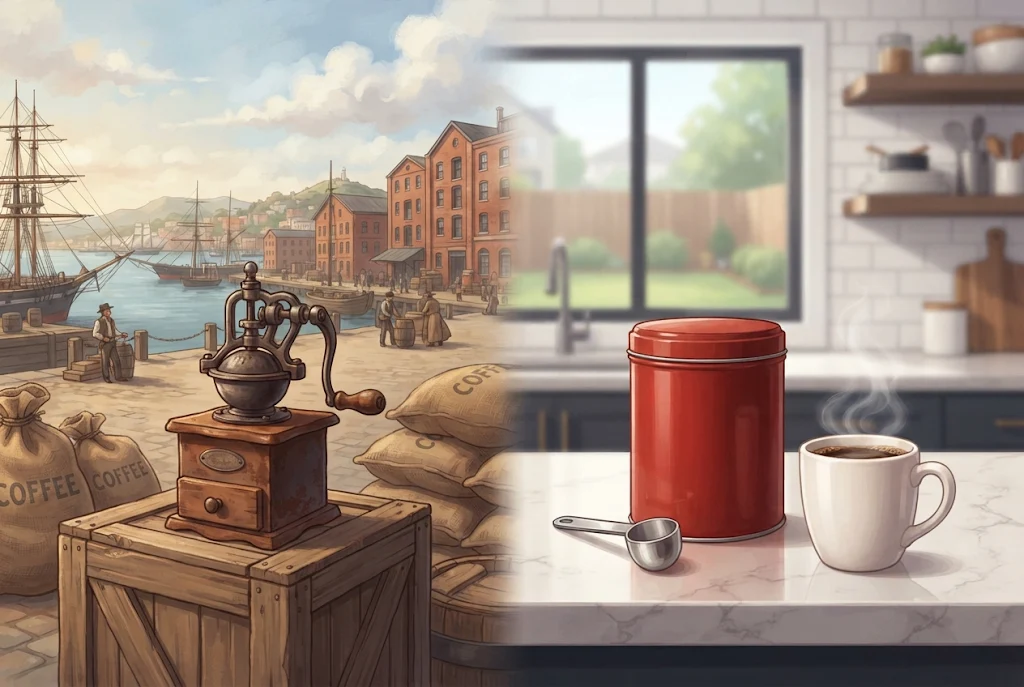
Folgers began in 1850 in San Francisco as the Pioneer Steam Coffee and Spice Mills, a business owned by William H. Bovee. A teenager from Nantucket named James A. Folger was hired to help build the mill. He later took control of the company and gave it his name. Procter & Gamble bought the brand in 1963 and made it a national name. The J.M. Smucker Company has owned it since 2008, and the coffee is now roasted in New Orleans.
That’s the short version. The long version runs through gold camps, an earthquake, a hurricane and one of the most recognized jingles in American advertising. It also explains a few things you can still see on the can in your kitchen today.
Folgers at a Glance: Key Dates
If you only want the milestones, this table covers them. The sections below explain each one.
| Year | What happened |
|---|---|
| 1850 | William H. Bovee opens a coffee and spice mill in San Francisco and hires young James A. Folger |
| 1860s–1872 | Folger becomes a partner, buys out the others and renames the business J.A. Folger & Co. |
| 1880 | The company introduces “cup-testing” to judge coffee quality |
| 1889 | James A. Folger dies; his son James A. Folger II takes over at 26 |
| 1900 | Salesman Frank P. Atha pushes the coffee into stores outside California |
| 1906 | The company building survives the San Francisco earthquake |
| 1960 | Construction starts on a large plant in New Orleans |
| 1963 | Procter & Gamble buys the company and drops the apostrophe from “Folger’s” |
| 1984 | The “best part of wakin’ up” jingle launches |
| 2005 | Hurricane Katrina damages the New Orleans plant |
| 2008 | The brand becomes part of The J.M. Smucker Company |
| 2018 | The premium 1850 line launches |
| 2025 | 175th anniversary metal can released |
| 2026 | Folgers Functional instant coffees announced for a November launch |
The Gold Rush Beginning (1850s)
Coffee You Didn’t Have to Roast Yourself
In 1850, San Francisco was full of people heading for the gold fields. Most of them bought green coffee beans, roasted them over a fire and ground them by hand. Bovee saw a gap: sell coffee that was already roasted and ground, so all a miner had to do was brew it.
That idea sounds ordinary now, because almost all supermarket coffee is sold this way. In 1850 it was a real convenience, and it’s the reason the business survived its first few years.
The Teenager From Nantucket
James A. Folger came west from Nantucket, Massachusetts, with his brothers. Sources give his age as 14 or 15 when he started working for Bovee. His brothers went to the mining camps, and he stayed in the city.
He didn’t stay off the trail for long, though. After about a year he had saved enough to buy a share of the mill. He then went to the gold country himself, carrying coffee and spice samples so he could take orders from the shops there. In other words, he was a traveling salesman before he was a business owner. That habit of selling by sample comes up again later in the story.
How the Company Became J.A. Folger & Co.
Folger came back to San Francisco in the 1860s and became a full partner. The business struggled, and accounts of this period don’t fully agree. The brand’s own timeline says it went bankrupt in 1865 and that Folger reorganized it, while other histories say he bought out the remaining partners and renamed it J.A. Folger & Co. in 1872. Either way, by the early 1870s he was running the company under his own name.
In 1880, the company started “cup-testing.” Tasters brewed and sampled coffee to judge it before it went to customers, so the coffee would taste the same every time you bought it. The coffee industry still uses a version of this, now usually called “cupping.”
James A. Folger died in 1889. His oldest son, James A. Folger II, became president at 26 and grew the business considerably over the following decades.
Moving Beyond California (1900–1950s)
Frank Atha and the In-Store Sample
Around 1900, a salesman named Frank P. Atha took the coffee east. He persuaded grocers to stock it and used in-store sample displays so shoppers could try it before buying. He also proposed and ran a plant in Texas, and the company grew quickly once it opened.
This is a lesson most short histories skip. The brand didn’t spread on advertising alone. It spread because shoppers tasted the coffee, much like young James Folger taking samples to the mining camps.
Surviving the 1906 Earthquake
The Great San Francisco Earthquake of 1906 destroyed much of the city. The company’s building survived, and the company gave free coffee to residents during the recovery. That’s still one of the stories the brand tells most often about itself.
By the middle of the century, under Peter Folger’s leadership, the company was one of the main coffee companies in North America. A 1949 ad was already telling people to try the coffee iced, decades before iced coffee was everywhere.
Why Folgers Coffee Is Roasted in New Orleans
If you check a modern can, you’ll often see that the coffee was “born in San Francisco” but is “roasted in New Orleans.” The reason is shipping.
In 1960, construction began on a plant in New Orleans. New shipping routes from Central America had made the city’s port a hub for green (unroasted) coffee. The New Orleans site became the company’s largest plant, and the city is still central to how the brand presents itself.
That connection was tested in 2005. Hurricane Katrina damaged the New Orleans plant and many employees’ homes. According to the company, it housed workers on its grounds and sold commemorative cans to raise relief money. The brand’s 2022 campaign leaned heavily on those New Orleans roots.
The Procter & Gamble Years (1963–2008)
Going National
Procter & Gamble bought the company in 1963 and dropped the apostrophe, so “Folger’s” became Folgers. With P&G’s distribution and advertising budget behind it, a strong regional coffee became a brand people knew from coast to coast.
The Ads People Still Remember
P&G’s advertising made the brand part of American popular culture:
- Mrs. Olson (1965–1986): Actress Virginia Christine played a friendly neighbor who kept recommending the coffee to struggling hosts.
- Restaurant “switch” ads (1970s–early 1980s): Diners at upscale restaurants were told afterward that their coffee had secretly been the brand’s instant.
- The jingle (1984): “The best part of wakin’ up” soon appeared in nearly every ad, and the brand marked its 30th anniversary in 2014.
- “Peter Comes Home for Christmas” (1985): This holiday ad aired every year until 1998 and came back in edited form in 2004 and 2005.
The brand also turned up in shows and films, including a Seinfeld episode in 1991 and The Big Lebowski in 1998. You don’t get that kind of exposure from shelf space alone.
The Smucker Era: 2008 to Today
A Tax-Efficient Handoff
In January 2008, P&G said it planned to spin the coffee business off as a separate company. By June it had changed course. On June 4, 2008, Smucker’s merger announcement set out an all-stock deal under which P&G shareholders would end up owning about 53.5% of Smucker.
The deal was structured as a Reverse Morris Trust, which let P&G sell the business without the tax bill a normal sale would have triggered. Smucker filings at the time put Folgers’ annual sales at more than $1.8 billion. P&G’s legal advisers described the divestiture as worth about $3.3 billion. The deal closed in November 2008.
New Products Under Smucker
Smucker has kept the classic products and added new ones:
- 1850 (2018): A premium line named after the founding year.
- Black Silk claims (2023): The company says Black Silk was preferred over Starbucks French Roast in a nationwide blind taste test of hot brewed ground coffee from grocery stores.
- 175th anniversary can (2025): A metal Classic Roast can with San Francisco touches, including the Golden Gate Bridge and a nod to “Folger’s Golden Gate,” the company’s first hit blend.
- Folgers Functional (late 2026): In September 2026, Smucker announced four instant coffees for November: Protein (10 g whey protein per serving), Focus (with L-theanine and lion’s mane), Boost (with B vitamins) and Prebiotic (3 g fiber).
Where the Brand Stands in 2026
Coffee prices have climbed sharply. Smucker raised prices several times in 2025, pointing to green coffee costs and tariffs on imports from countries such as Brazil and Vietnam. Even so, Smucker said in February 2026 that the brand was still No. 1 in total volume share among at-home coffee brands, and No. 1 in total buyers among younger consumers.
What This History Means for the Coffee in Your Kitchen
Most history pieces end in 2008. Here’s how the backstory connects to the coffee you buy today:
- The label tells part of the story. “Born in San Francisco, roasted in New Orleans” refers to the 1850 founding and the move to New Orleans that began in 1960.
- The roast names map to the eras. Classic Roast is the familiar everyday blend, Black Silk is the dark roast, and 1850 is the newer premium line. If you’ve only tried Classic, those other two show how the range has grown.
- Limited cans come and go. The 2025 anniversary can and the 2026 America’s 250th anniversary packaging are short-run designs. If you like collecting brand tins, buy them while they’re on shelves rather than counting on resale value later.
- “Functional” is a new direction. The 2026 instants carry added protein, fiber or vitamins. If you have a health condition or take supplements, read the label and check with your doctor or a dietitian before treating coffee as a nutrition source.
The Takeaway
Folgers began with one practical idea: sell coffee that’s ready to brew. A Nantucket teenager built on that idea with samples, cup-testing and steady salesmanship, P&G made it a household name, and Smucker is now pushing it into premium and functional coffee. Next time you open a can, the San Francisco and New Orleans lines on the label are a short version of the 175-year story behind it.
Frequently Asked Questions
Who founded Folgers?
The business started in 1850 as William H. Bovee’s Pioneer Steam Coffee and Spice Mills in San Francisco. James A. Folger, who joined as a teenager, later took control and gave the company his name.
Who owns Folgers now?
The J.M. Smucker Company has owned the brand since November 2008. Procter & Gamble owned it from 1963 to 2008.
Where is Folgers coffee made?
The brand says its coffee is roasted in New Orleans, where the company began building a major plant in 1960.
When did the “best part of wakin’ up” jingle start?
The jingle launched in 1984 and soon appeared in almost every ad for the brand.
Why did Folgers drop the apostrophe?
Procter & Gamble removed it after buying the company in 1963, changing “Folger’s” to Folgers.