Most California workers lose somewhere between 3% and 8% of each gross paycheck to state deductions in 2026. That money goes to two places: state income tax withholding and State Disability Insurance (SDI). A single filer earning $60,000 and paid every two weeks sees roughly $99 per check go to California, about 4.3% of gross pay. Someone earning $120,000 sees closer to $353, or about 7.6%.
If you’ve been wondering how much is California state tax on a regular paycheck, the honest answer is that it depends on four things: how much you earn, how often you’re paid, what you put on your DE 4 form, and which pre-tax benefits you use. The rest of this guide shows how each piece works, with real 2026 numbers you can check against your own pay stub.
The Two California Deductions on Every Paycheck
California takes two separate deductions from employee wages. They’re calculated differently, so it helps to look at them one at a time.
1. State Disability Insurance (SDI)
SDI funds California’s disability insurance and Paid Family Leave programs. It’s a flat percentage of your wages, with no allowances or filing status involved.
For 2026, the SDI withholding rate is 1.3%, up from 1.2% in 2025. Since January 1, 2024, there’s no wage cap, so every dollar you earn is subject to SDI. A person earning $250,000 pays 1.3% on all of it, which wasn’t true a few years ago.
Quick math for SDI:
- $1,500 paycheck: $19.50
- $2,500 paycheck: $32.50
- $5,000 paycheck: $65.00
Heads-up for next year: payroll industry reports from November 2026 say the EDD has set the 2027 SDI rate at 1.4%. Check your first paycheck in January 2027 to confirm.
2. State Personal Income Tax (PIT) Withholding
This is the bigger and more variable deduction. Your employer estimates what you’ll owe California for the year and takes a slice from each paycheck so you aren’t hit with a large bill in April.
California’s actual income tax rates run from 1% to 12.3% across nine brackets, plus an extra 1% on taxable income above $1 million (the Mental Health Services Tax). But your paycheck withholding isn’t calculated straight from those rates. Employers use separate withholding schedules published by the EDD each year, and that’s where many people get confused.
How Your Employer Calculates California Withholding
The EDD gives employers two methods: a wage bracket table (Method A) and an exact calculation (Method B). Most payroll software uses Method B. The 2026 California withholding schedules walk through it in five steps:
- Check the low-income exemption. If your gross pay for the period falls at or below a set amount, nothing is withheld. For 2026, that’s $727 per biweekly check for single filers ($1,454 for married filers claiming two or more allowances and for heads of household).
- Subtract any extra allowances for estimated deductions you claimed on your DE 4.
- Subtract the standard deduction for your pay period. For a single filer paid biweekly in 2026, that’s $219.
- Apply the tax rate table for your filing status and pay frequency.
- Subtract the allowance credit. Each regular allowance is worth $6.47 per biweekly check in 2026 ($14.03 per monthly check).
One detail most articles skip: the percentages in the withholding tables are about 10% higher than the rates on your tax return. The lowest withholding bracket is 1.1% instead of 1%, the next is 2.2% instead of 2%, and so on. State law builds in that cushion on purpose to prevent underwithholding. It’s one reason so many Californians get a small state refund even when they never touched their DE 4.
2026 Paycheck Examples: What California Actually Takes
Here’s what California would take from a biweekly paycheck (26 pay periods) for a single filer claiming one allowance with no pre-tax deductions. Figures are calculated with the 2026 EDD Method B tables and the 1.3% SDI rate.
| Annual Salary | Gross per Check | State Income Tax Withheld | SDI (1.3%) | Total to California | Share of Gross |
|---|---|---|---|---|---|
| $40,000 | $1,538.46 | $24.69 | $20.00 | $44.69 | 2.9% |
| $60,000 | $2,307.69 | $69.42 | $30.00 | $99.42 | 4.3% |
| $85,000 | $3,269.23 | $154.88 | $42.50 | $197.38 | 6.0% |
| $120,000 | $4,615.38 | $292.59 | $60.00 | $352.59 | 7.6% |
Your payroll provider may land a few cents off due to rounding, but these should be close.
Walking Through the $60,000 Example
It helps to see the math once, so you can do it yourself:
- Gross biweekly pay: $2,307.69
- Minus standard deduction ($219): $2,088.69 taxable
- That falls in the 6.6% withholding bracket, which starts at $1,594 with a base of $43.24
- $494.69 over the threshold × 6.6% = $32.65, plus $43.24 = $75.89
- Minus one allowance credit ($6.47): $69.42 income tax withheld
- SDI: $2,307.69 × 1.3% = $30.00
Total California deduction: $99.42 per paycheck, or about $2,585 over the year.
What Changes the Amount on Your Paycheck
Two people with the same salary can have quite different California deductions. These are the usual reasons.
Your DE 4 Form (Not Just Your W-4)
California doesn’t rely on the federal W-4 for state withholding allowances. If you only filled out a W-4 when you were hired, your employer may be withholding as if you’re single with zero allowances, because that’s the default the EDD tells employers to use when no DE 4 is on file.
Zero allowances means more is taken out than necessary for many people. A married worker with two kids who never submitted a DE 4 could easily be overwithholding by $20 to $40 per paycheck. You can ask HR for the form at any time. It’s short and takes about ten minutes with the worksheets.
Pay Frequency
The tables are built to give roughly the same annual result whether you’re paid weekly, biweekly, semimonthly, or monthly. Per-check amounts will differ, though, so don’t compare your biweekly deduction with a friend’s monthly one.
Filing Status
Married filers claiming two or more allowances and heads of household get a higher low-income exemption and a larger standard deduction ($439 biweekly in 2026, versus $219 for single filers). That can cut withholding noticeably at moderate incomes.
Pre-Tax Retirement Contributions
Money you put into a traditional 401(k) or 403(b) through payroll reduces the wages California uses for income tax withholding. It doesn’t reduce SDI, though. The EDD treats those salary deferrals as subject wages for SDI.
Example: our $85,000 earner contributes 5% to a 401(k), which is $163.46 per check. State income tax withholding drops from $154.88 to about $138.16, a saving of roughly $16.72 per check. SDI stays at $42.50 because it’s still calculated on the full $3,269.23.
HSA Contributions: A California Surprise
This one catches a lot of people. Federally, payroll contributions to a Health Savings Account are tax-free. California doesn’t follow that rule. Both your contributions and your employer’s HSA contributions count as California taxable wages.
So if you moved from another state and expected your HSA to lower your state withholding, it won’t. You’ll also see a difference between Box 1 (federal wages) and Box 16 (state wages) on your W-2 because of this.
Bonuses and Commissions
Supplemental pay often gets withheld at a flat rate instead of through the regular tables. California’s flat rate is 10.23% for bonuses and stock options and 6.6% for other supplemental pay like commissions and overtime paid separately. A $5,000 bonus can lose $511.50 to state withholding plus $65 to SDI before you see it.
That’s withholding, not your final tax. If your real rate is lower, the difference comes back when you file.
Common Mistakes That Throw Off Your California Withholding
These come up again and again when people compare their pay stub with what they expected:
- Never submitting a DE 4. As mentioned, you default to single with zero allowances.
- Claiming allowances on both jobs. If you hold two jobs, or you and your spouse both work, claiming full allowances at each job usually leads to underwithholding. The DE 4 instructions suggest claiming all allowances on the highest-paying job and zero on the others.
- Forgetting to update after a life change. Marriage, divorce, a new baby, or a child aging out all change what you should claim. If your allowances go down, you’re supposed to give your employer a new DE 4 within 10 days.
- Treating the refund as free money. A large state refund means you lent California money interest-free all year. A small refund or a small balance due is usually the sweet spot.
- Ignoring SDI when budgeting. People often plan around income tax and forget the 1.3% SDI line, which adds up to $780 a year on a $60,000 salary.
Paycheck Withholding vs. What You Really Owe
Your withholding is an estimate. Your actual California tax is settled when you file Form 540 the following spring. Several things only show up at filing time:
- Credits like the California Earned Income Tax Credit, the Young Child Tax Credit, and the renter’s credit
- Itemized deductions that beat the standard deduction
- Income outside your paycheck, such as freelance work, interest, or capital gains
- The extra 1% Mental Health Services Tax if taxable income tops $1 million
If you have significant side income with no withholding, you may need to make estimated payments to the Franchise Tax Board or bump up your paycheck withholding by entering an extra dollar amount on the DE 4.
How to Check Whether Your Withholding Is Right
You don’t need special software. Grab your latest pay stub and follow these steps:
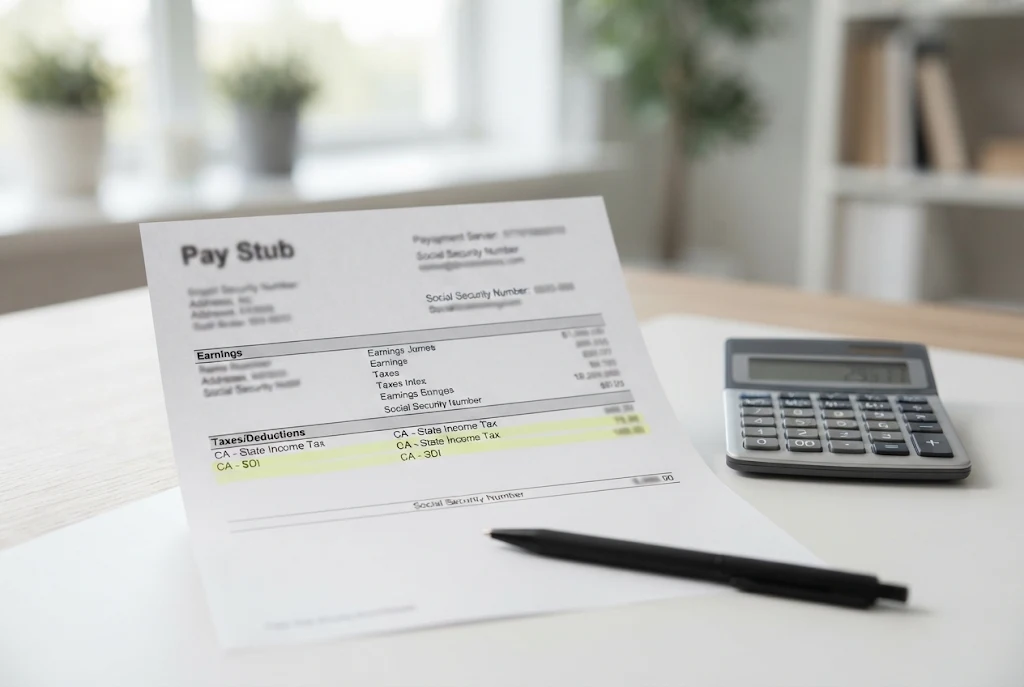
- Find the year-to-date “CA State Income Tax” (sometimes labeled CA SIT or CA PIT) and “CA SDI” lines.
- Divide the state income tax figure by the number of paychecks so far, then multiply by your total paychecks for the year.
- Compare that projection with last year’s actual California tax from your Form 540 (line 64, “total tax,” on recent versions of the form). Adjust for any big income change.
- If you’re well over, consider adding allowances on a new DE 4. If you’re under, reduce allowances or add a flat extra amount per check.
- Recheck a couple of paychecks after the change goes through.
For complicated situations, like multiple states, equity compensation, or a large one-time payout, a CPA or enrolled agent can run a proper projection.
A Quick Note on City Taxes and Moving Across State Lines
California cities don’t take a local income tax out of employee paychecks the way some cities in other states do, so the state lines on your stub plus federal taxes are generally the full picture. If you live in California but work remotely for an out-of-state company, California can still tax those wages as a resident, and your employer should be withholding California tax if it’s registered here. If it isn’t, you may need to make estimated payments yourself.
The Bottom Line
So how much is California state tax on your paycheck? For most full-time workers in 2026, expect about 3% to 8% of gross pay: a flat 1.3% for SDI plus income tax withholding that rises with your earnings. The fastest way to make that number fit your real situation is a correctly filled DE 4. After that, check a pay stub once or twice a year, especially after a raise, a bonus, or a life change.
These figures reflect the 2026 rates. The SDI rate is expected to change for 2027, so it’s worth checking your first paycheck of the new year.
Frequently Asked Questions
Does California take state tax out of every paycheck?
Yes, for most employees. SDI comes out of every paycheck. Income tax withholding also does, unless your pay for that period falls under the low-income exemption ($727 biweekly for single filers in 2026).
Why is my California withholding higher than my tax bracket suggests?
The withholding tables use rates about 10% higher than the rates on your return, and withholding is based on that period’s pay, not your final annual picture. Credits and deductions you claim at filing often bring the actual tax down.
Is SDI refundable?
Not in most cases anymore. Before 2024, people with more than one employer could claim back SDI paid above the annual wage cap on their state return. Now that there’s no cap, there’s normally no excess to claim.
Can I stop California tax withholding?
Only if you qualify for exemption under the DE 4 rules, which generally means you owed no California tax last year and expect to owe none this year. SDI isn’t optional for covered employees.
Do 401(k) contributions lower my California tax?
They lower state income tax withholding because traditional 401(k) deferrals aren’t California taxable wages. They don’t lower SDI.