For most Canadian bedrooms, a queen mattress is the safer fit. A king only makes sense if your room is about 12 by 12 feet or larger and you or your partner really need more personal space. Both beds are the same length, 80 inches (203 cm). The difference is width: a queen is 60 inches (152 cm) wide and a king is 76 inches (193 cm). Those 16 extra inches sound small on a spec sheet. In a real bedroom they can decide whether you still have room for a dresser, a walkway and a door that opens fully.
This guide compares a queen mattress and a king on the measurements, the room math, the costs people forget, and a quick way to test both sizes on your own floor before you spend anything.
Queen vs King Dimensions at a Glance
Canada uses the same standard mattress sizes as the United States, so a queen mattress bought in Toronto matches one bought in Seattle. Here’s how the two sizes compare, with the California king included because it often confuses shoppers.
| Size | Width × Length (inches) | Width × Length (cm) | Width per person (two sleepers) |
|---|---|---|---|
| Queen | 60 × 80 | 152 × 203 | 30 in (76 cm) |
| King | 76 × 80 | 193 × 203 | 38 in (97 cm) |
| California king | 72 × 84 | 183 × 213 | 36 in (91 cm) |
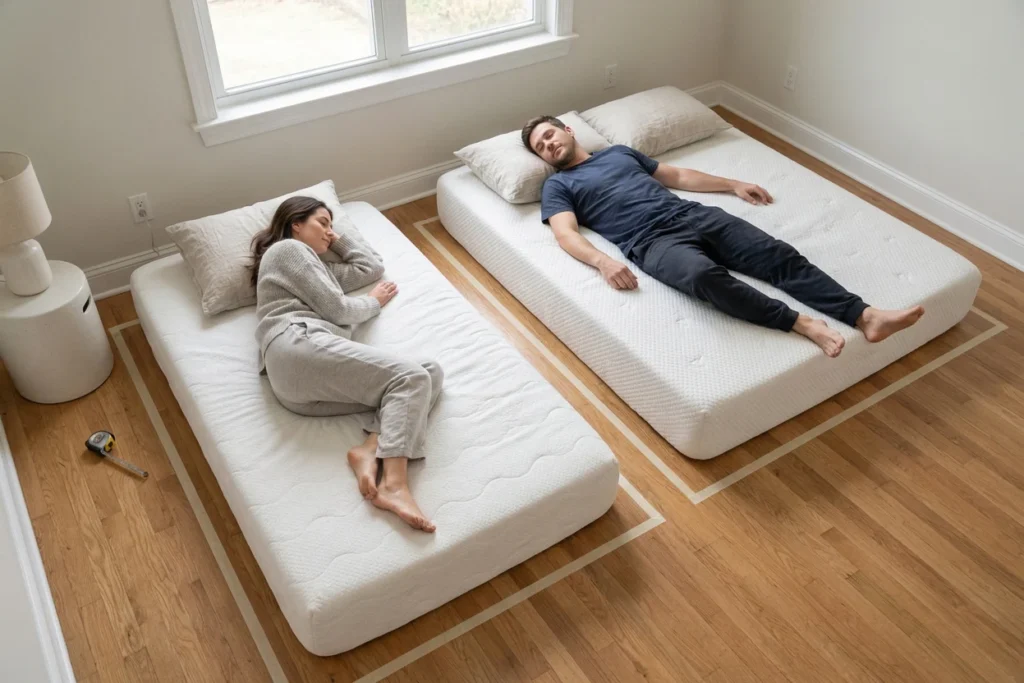
The per-person width is where the comparison gets real. On a queen mattress, each sleeper gets about 30 inches, roughly the width of a standard crib mattress. On a king, each person gets 38 inches, which is the full width of a twin bed. That’s why many couples say a king feels like “two single beds with no gap.”
A standard king is also sometimes called an Eastern king. The California king is narrower but four inches longer, so it suits tall sleepers more than wide sleepers.
What the extra width actually changes
- Elbow room: A king gives each partner 8 more inches of width, enough that a restless sleeper is far less likely to wake the other.
- Kids and pets: If a child crawls in at 3 a.m. or a dog sleeps across the bottom, a queen mattress fills up fast.
- Length stays the same: Moving from a queen to a standard king doesn’t help a 6’4″ sleeper whose feet hang off the end. For that, look at a California king.
How Much Room Do You Need for Each Size?
A mattress that technically fits isn’t the same as a bedroom that works. The rule of thumb most designers use is to leave about 24 to 30 inches (61 to 76 cm) of walking space around the sides and foot of the bed. Less than that, and you end up shuffling sideways to reach the closet.
Minimum room sizes
| Bed size | Comfortable minimum room | Better room size |
|---|---|---|
| Queen | 10 × 10 ft (about 3 × 3 m) | 10 × 12 ft or larger |
| King | 12 × 12 ft (about 3.7 × 3.7 m) | 12 × 14 ft or larger |
These are practical guidelines, not building rules. Check them against your own layout, especially if your bedroom has a sloped ceiling, a radiator or a closet door that swings into the room.
Do the math for your own room
Here’s a quick calculation you can do with a tape measure:
- Measure the wall you’ll put the headboard against.
- Subtract the bed width (60 inches for a queen, 76 for a king). Add 2 to 4 inches if your frame is wider than the mattress.
- Subtract the width of any nightstands (most are 18 to 24 inches each).
- If the leftover space is under about 24 inches on each side, the bed will feel cramped.
Example: A 132-inch (11-foot) wall with two 20-inch nightstands leaves 52 inches of side space with a queen mattress, or 26 inches per side. That’s comfortable. Put a king on the same wall and you’re down to 36 inches total, or 18 inches per side. That’s tight enough that you’d probably drop one nightstand.
Test it on the floor first
Before you shop, mark both sizes on your floor with painter’s tape. Use 60 × 80 inches for a queen and 76 × 80 inches for a king. Leave the tape down for a day or two. Open the closet, walk to the window in the dark, and see whether the dresser drawers still pull out all the way. Ten minutes of tape tells you more than any online size chart.
Will It Fit Through the Door?
This catches a lot of Canadian buyers, especially in older homes, basement suites and condos with narrow halls.
- Bed-in-a-box mattresses ship compressed and rolled, so getting either size inside is rarely a problem. They expand once you unwrap them in the room.
- Traditional innerspring and hybrid mattresses arrive full size. A king is flexible enough to bend slightly, but tight stair turns can still stop it.
- Foundations and box springs are the real issue. A one-piece king box spring is rigid and often won’t fit up a narrow staircase. Many retailers sell a split king foundation (two pieces) for exactly this reason. Ask before you order.
- Condo elevators: Check the elevator’s interior height and depth, and whether your building requires booking a freight elevator for delivery.
Cost: The Price Gap Is Bigger Than the Mattress
Canadian online mattress brands commonly list a foam queen mattress under $1,000 CAD. The same model in king usually costs roughly $100 to $300 more. With hybrids and premium models, the gap tends to grow, and some Canadian retailers say a king typically runs 25% to 35% above the queen version of the same mattress. Prices change often with sales, so treat these as ballpark figures and compare the same model in both sizes.
The mattress is only part of the bill. Going king also raises the price of everything around it.
| Item | Queen | King |
|---|---|---|
| Bed frame | Widest selection, often cheaper | Fewer budget options, usually costs more |
| Foundation | Usually one piece | Often two pieces (split) |
| Sheets and duvet | Widest choice, frequent sales | Costs more, fewer colours and styles in stock |
| Mattress protector | Lower cost | Higher cost |
| Headboard | Many styles | Fewer styles, costs more |
If your budget is fixed, a better-quality queen mattress often beats a basic king. You’ll sleep on the comfort layers every night. You won’t notice the extra width nearly as much if the mattress itself is wrong for your body.
Who Should Choose a Queen Mattress?
A queen suits more people than mattress ads suggest. The queen mattress is the most popular size in Canada for good reasons: it fits most master bedrooms, bedding is easy to find, and it costs less.
A queen mattress is probably the right call if:
- You sleep alone and want room to sprawl without giving up floor space.
- You’re a couple who sleeps fairly still, or who likes sleeping close.
- Your bedroom is under 12 × 12 feet, or the room has awkward features such as a sloped ceiling or a window on the headboard wall.
- You rent, move often, or live in a condo with tight halls and elevators.
- You’d rather spend the savings on a better mattress or good pillows.
When a queen starts to feel small
Watch for these signs. You wake up when your partner turns over. One of you regularly ends up on the edge. A pet or child sleeps with you most nights. Or one of you sleeps hot and wants more space between bodies. Any one of these is worth weighing. Two or more usually point toward a king.
Who Should Choose a King?
A king is worth it when space, not price, is the main problem you’re trying to solve.
It’s a strong fit if:
- You and your partner have very different sleep schedules or one of you tosses and turns a lot.
- Your kids, dogs or cats share the bed regularly.
- Your bedroom is at least 12 × 12 feet with room left over for storage furniture.
- You want separate comfort on each side. A split king (two twin XL mattresses side by side) lets each person pick their own firmness. It also works with adjustable bases, where each side can raise independently.
A common mistake with kings
People often buy a king for a 12-foot-wide room and then find the nightstands no longer fit. If you’re right on the line, measure the nightstands too, not just the bed. Some couples choose small wall-mounted shelves instead of nightstands to make a king work.
Safety Labels Matter for Either Size
Whether you pick a queen mattress or a king, every mattress sold in Canada is covered by the federal Mattresses Regulations under the Canada Consumer Product Safety Act. That rule sets a cigarette-ignition resistance test that mattresses must pass.
Passing doesn’t make a bed fireproof, though. Health Canada’s mattress flammability guide is clear that meeting the rule lowers the risk of ignition from a smouldering cigarette but doesn’t eliminate it. Look for clear bilingual labels and care instructions, and be cautious with very cheap imports from marketplace sellers you can’t contact.
A Quick Decision Checklist
Run through these questions in order. Most people have their answer by question four.
- Is your room smaller than 12 × 12 feet? If yes, choose a queen.
- Does anyone over about 6’2″ sleep in the bed? If yes, look at a California king for the extra length.
- Do kids or pets share the bed most nights? If yes, lean toward a king.
- Does one partner’s movement wake the other? If yes, consider a king, or a split king for separate firmness.
- Will the foundation fit through your stairs, halls and elevator? If no, order a split foundation or choose a bed-in-a-box.
- Does the total cost (frame, bedding, protector) still fit your budget? If no, choose a better queen over a basic king.
The Bottom Line
The queen vs king decision comes down to your room and your sleep habits, not which bed looks better in a showroom. A queen mattress fits most Canadian bedrooms, costs less to furnish, and gives two still sleepers enough room. A king makes sense when you have at least a 12 × 12-foot room and a real space problem, such as a restless partner, a crowded bed or different firmness needs.
Tape both sizes on your floor this week, live with them for a day, and the right answer will probably be obvious.
Frequently Asked Questions
Is a king mattress twice the size of a queen?
No. A king is 16 inches wider than a queen and exactly the same length. That’s about 27% more sleeping area, not double.
Can two adults sleep comfortably on a queen mattress?
Yes, most couples do. Each person gets about 30 inches of width, which works well for people who sleep still or like being close. Restless sleepers or larger adults may find it tight.
Do queen sheets fit a king mattress?
No. Queen fitted sheets are 16 inches too narrow for a king. Pocket depth matters too, so check that the sheet’s pocket matches your mattress height.
Is a king the same as two twin mattresses?
Two twin XL mattresses (38 × 80 inches each) placed side by side equal one standard king, which is sold as a split king. Two regular twins are 5 inches shorter, so they don’t match.
Should I choose a king or a California king?
Choose a standard king if you want more width. Choose a California king if someone in the bed is tall and needs the extra 4 inches of length, and accept that it’s 4 inches narrower.