If your muro de arrimo is cracking, leaning or weeping mud after a heavy rain, the first question is usually how much it’ll cost to put right. In Brazil, as of November 2026, retaining wall renovation cost depends far more on the material and the height than on the length of the wall.
For a rebuild or major renovation, here are the typical 2026 market ranges per square metre of wall face. Simple low walls run R$ 350 to R$ 900/m², gabion walls R$ 350 to R$ 800/m², engineered concrete block walls R$ 750 to R$ 2,200/m², and reinforced concrete R$ 800 to R$ 2,500/m². Treated wood costs the least upfront, but it’s the shortest-lived option. Small fixes, like clearing drains or patching mortar, cost far less than any of these.
Below you’ll find what drives each price, which material suits which situation, and the extra costs most quotes leave out.
Retaining Wall Renovation Cost at a Glance (Brazil, 2026)
These ranges come from Brazilian cost guides and news reports published between June and November 2026, cross-checked against the SINAPI and ORSE public reference tables. Treat them as a starting point for comparing quotes, not as a price someone owes you.
| Material | Typical range (rebuild, per m² of wall face) | Best suited to | Main weak point |
|---|---|---|---|
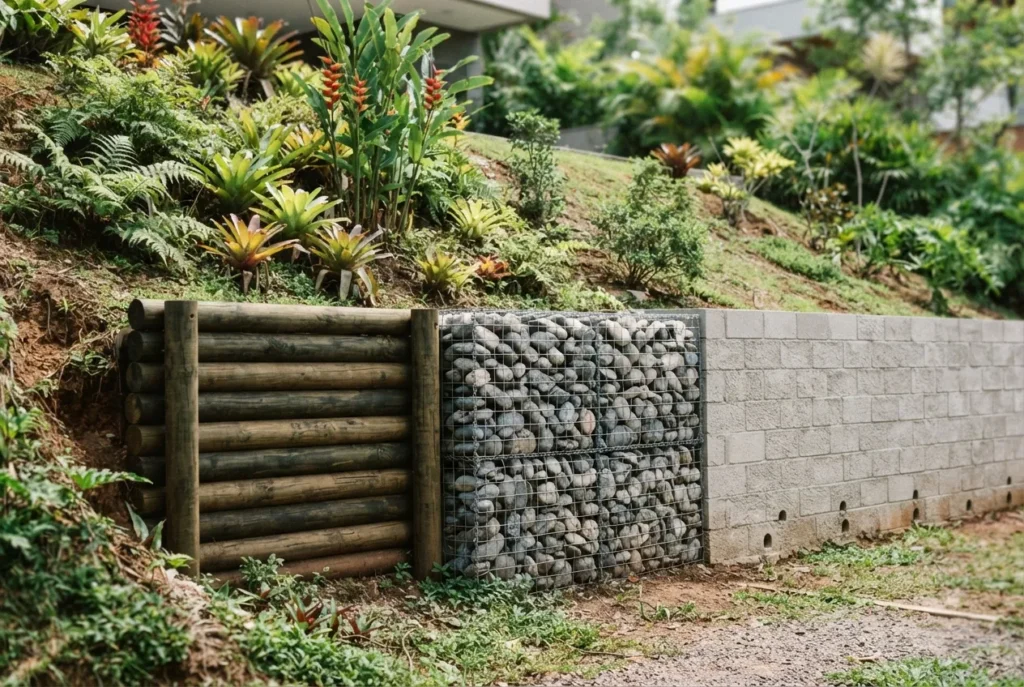
| Treated wood (eucalyptus logs, sleepers) | Lowest upfront; priced mostly per linear metre of log | Low garden terraces, temporary works | Rot and insects over time |
| Low-height block or brick wall | R$ 350 – R$ 900 | Small level changes, under about 1 m | Often built with no design or drainage |
| Gabion (gabião) | R$ 350 – R$ 800 | Slopes, sites with plenty of stone, drainage problems | Takes up more width; needs space at the base |
| Engineered concrete block | R$ 750 – R$ 2,200 | Urban lots, boundary walls, 1.5 m to 4 m cuts | Fails fast if grout, steel or drains are skipped |
| Reinforced concrete (concreto armado) | R$ 800 – R$ 2,500 | Tall walls, walls carrying a driveway or a house | Most expensive; needs formwork and a calculation |
| Mortared stone (pedra argamassada) | Priced per m³; SINAPI lists about R$ 564/m³ for the masonry alone | Gravity walls where stone is local | Heavy, slow to build, needs a wide base |
Prices vary a lot by state, by access to the site and by soil. A wall you can reach with a truck in Goiânia won’t cost the same as one at the top of a stairway in a hillside neighbourhood of Salvador.
Renovation Isn’t One Job: Three Levels of Work
The word “renovation” covers everything from a weekend of cleaning to tearing the whole thing down. Knowing which level you’re at is the quickest way to tell if a quote makes sense.
Level 1: Drainage and surface repairs
This is the cheapest level, and it’s often the one that matters most. Many problems start with clogged weep holes (barbacãs), a missing gravel drain behind the wall, or rainwater from the roof pouring straight onto the retained soil.
Costs here are mostly labour. In SINAPI’s national averages for May 2026, a mason (pedreiro) costs about R$ 35.87 an hour and a helper (servente) about R$ 31.04 an hour, including employer charges. So a two-person crew working a day or two is a realistic budget for unblocking drains and repointing joints.
One warning: if a contractor offers only new plaster and paint over cracks, ask what’s causing the cracks. Brazilian construction reporting in 2026 stressed that a renovation that only treats the plaster, paint or visible cracks can leave the real cause, usually trapped water, untouched.
Level 2: Partial rebuild
When a section has bulged or a corner has dropped, a crew may take that stretch down, fix the footing and drainage, and rebuild it. You pay for demolition, removing the rubble, new material and labour, but only for part of the wall.
Level 3: Full replacement
If the wall is leaning along its length, the footing has failed, or it was never designed to hold back that much soil, a full rebuild is usually the honest answer. That’s when the per-m² ranges in the table above apply. The cost of waiting can be high: one case reported in September 2026 involved a new wall that leaned toward the neighbour’s lot after a storm, and the rebuild estimate topped R$ 45,000.
Material-by-Material Breakdown
Treated wood (eucalyptus and sleepers)
Wood is the entry point. Treated eucalyptus logs and sleepers are easy to find across the South and Southeast, and a small crew can install them quickly. A current ORSE reference prices supplying and placing a treated eucalyptus log 25 to 30 cm in diameter at roughly R$ 267 per linear metre.
The catch is durability. Wood in constant contact with damp soil eventually rots or attracts termites. Renovating a timber wall often means swapping out the worst pieces, and after a while you’re paying to replace the whole thing. Wood walls with steel posts still need a design and proper drainage to resist the soil pressure, so they aren’t a way around hiring an engineer.
Good fit: garden beds and terraces under about a metre, or a stopgap while you save for a permanent wall.
Concrete block (structural block)
This is the most common choice in Brazilian cities. A properly built block retaining wall isn’t just stacked blocks. It needs a reinforced footing, vertical steel bars, cores filled with grout (graute), and a gravel-and-geotextile drain with weep holes along its length.
That’s why the masonry figure alone is misleading. SINAPI’s May 2026 composition for 14 cm structural concrete block masonry is about R$ 138.84/m², but that’s only the blocks and mortar. Once you add the footing, steel, grout, drainage and engineering, 2026 guides put a safe block retaining wall at R$ 750 to R$ 2,200/m². One example published this year had an engineer pricing a 2 m tall block wall at about R$ 1,650 per linear metre.
Good fit: boundary walls and cuts from about 1.5 m to 4 m where space is tight.
Reinforced concrete
Poured concrete with steel gives you the most strength in the least width, which is why engineers specify it for tall walls, walls supporting a driveway, or walls close to a house’s foundation. It’s also the priciest option at R$ 800 to R$ 2,500/m², because you’re paying for formwork, steel, concrete and a full structural calculation.
When renovating an existing concrete wall, the work often focuses on exposed or rusting rebar, honeycombed concrete and blocked drains. Those repairs can be far cheaper than a rebuild, but they need an engineer’s diagnosis first, because rust stains on the surface can mean corrosion deeper inside.
Good fit: high walls and walls carrying loads from vehicles or buildings.
Gabion
Gabions are wire cages packed with stone. They’re heavy enough to hold soil back by their own weight, and since water drains straight through, they’re very forgiving on wet slopes. Market ranges in 2026 sit around R$ 350 to R$ 800/m².
SINAPI’s May 2026 reference lists the zinc-aluminium gabion box cage itself at about R$ 465 per m³, and hand-sized quarry stone (pedra de mão) at about R$ 82 per m³ before freight. Freight matters a lot here. If there’s a quarry nearby, gabions can beat block walls on price. If the stone has to come from far away, the advantage disappears.
Good fit: rural lots, hillside gardens, stream banks and anywhere water is the main enemy.
Mortared stone
Stone laid in cement mortar is the traditional gravity wall in many older Brazilian towns. SINAPI’s May 2026 composition for mortared stone masonry is about R$ 564 per m³, covering stone, mortar and labour, but not excavation, the footing or drainage.
Because gravity walls rely on mass, they’re thick at the base, so you’ll pay for volume rather than face area. Renovating an old stone wall often means repointing loose joints and adding weep holes that were never built in. It’s work that suits a mason who knows the material, and it can keep a sound old wall going for years.
Good fit: restoring existing stone walls, or new low-to-medium walls where stone is cheap locally.
The Costs That Don’t Show Up in the Price per m²
Most surprises come from items outside the wall itself. Ask whether each one is included before you compare quotes:
- Structural design and ART. An engineer’s design and Technical Responsibility Annotation (ART) are part of a proper retaining wall, not an optional extra.
- Soil investigation. On taller walls or doubtful ground, a soil test (sondagem) may be needed before anyone can size the footing.
- Demolition and rubble removal. Breaking out an old wall and paying for skips or truck trips adds up quickly on tight urban sites.
- Drainage. Gravel, geotextile, drain pipes and weep holes. Skipping these is the most common reason walls fail.
- Access. If materials have to be carried by hand up steps or across a neighbour’s lot, labour hours climb.
- Finishing. Plaster, waterproofing on the soil side and paint are often quoted separately.
What’s Pushing Prices in 2026
Labour is rising faster than materials. According to the IBGE SINAPI October 2026 report, construction labour costs rose 8.38% over the twelve months to October, compared with 5.70% for materials.
That gap hits retaining walls hard, because so much of the job is digging, setting steel and placing stone by hand. A quote from late 2025 is probably out of date, so ask for a fresh one.
For context, SINAPI put the national average cost of standard residential construction at R$ 2,005.57 per m² in October 2026. That figure is for houses, not walls, so don’t use it to price your wall. It’s simply a useful signal of where general building costs are heading.
A Worked Example: 10 Metres Long, 2 Metres High
A 10 m × 2 m wall has 20 m² of face. Using the ranges above:
| Material | Rough rebuild estimate |
|---|---|
| Gabion | R$ 7,000 – R$ 16,000 |
| Engineered concrete block | R$ 15,000 – R$ 44,000 |
| Reinforced concrete | R$ 16,000 – R$ 50,000 |
A 2026 market analysis put a 10 m × 2 m contention wall in the R$ 18,000 to R$ 45,000 range, which matches the block and concrete figures. The wide spread is normal. Soil, drainage and access can easily double the price of the same-sized wall.
Notice what that range means in practice: two quotes for “the same wall” can differ by R$ 20,000 and both be honest. Compare what each quote includes, not just the total.
How to Choose the Right Material
Skip the question “what’s cheapest?” and ask these instead:
- How tall is the soil you’re holding back? Under about 1 m, wood, low masonry or small gabions often work. Above about 1.5 m, you’re in engineered territory whatever the material.
- What sits on top? A lawn is one thing. A driveway, a pool or the corner of your house calls for concrete or engineered block.
- Is water the problem? If the old wall failed because it kept getting soaked, gabions or a rebuilt drainage system deserve serious consideration.
- How much width do you have? Gravity walls (stone, gabion) need a wide base. Tight boundary lines favour block or concrete.
- How long do you plan to stay? Wood saves money now and costs more later. If you’re staying ten years or more, a permanent material usually works out cheaper.
Mistakes That Make Renovation More Expensive
- Patching the face and ignoring the back. New plaster won’t stop a wall that’s being pushed by trapped water.
- Hiring by price per m² alone. A low number often means no footing steel, no drain or no engineer.
- Waiting through another rainy season. Small bulges become full rebuilds.
- Skipping the conversation with the neighbour. If the wall sits on or near the boundary, agree on access, responsibility and cost-sharing in writing before work starts. Rules vary, so ask a lawyer if there’s any dispute.
- Reusing a failed design. Rebuilding exactly what fell down usually produces the same result.
Before You Sign a Contract
Run through this short checklist:
- Ask for a written diagnosis of why the wall is failing.
- Get at least two or three itemised quotes covering demolition, footing, steel, drainage and finishing.
- Confirm who the responsible engineer is. Under Brazil’s federal ART requirement, created by Law 6,496/1977, the ART formally names who is technically responsible for engineering works.
- Check that the design refers to the relevant ABNT standards, such as NBR 11682 for slope stability or NBR 16920-1 for reinforced soil walls.
- Agree on a payment schedule tied to stages, not a large upfront deposit.
Safety note: if a wall starts bulging, cracking quickly or shedding soil during heavy rain, keep people away from it and contact your city’s Defesa Civil before arranging repairs.
The Bottom Line
The cheapest wall to build is rarely the cheapest wall to own. For low garden terraces, wood or a small gabion can be a sensible, affordable choice. For anything holding up a driveway, a boundary or a house, budget for engineered block or reinforced concrete, along with the drainage and design that go with them.
Your next step: get a diagnosis first, then ask for itemised quotes, so your retaining wall renovation cost pays for fixing the cause rather than just covering it up.
FAQ
Is it cheaper to repair or rebuild a retaining wall?
Repair is cheaper when the wall is basically sound and the problem is drainage, loose joints or a small damaged section. If the footing has failed or the wall leans along its whole length, repairs tend to be money spent twice, and a rebuild is the better value.
Do I need an engineer to renovate a small retaining wall?
For very low garden walls, many owners hire an experienced mason directly. Once a wall holds back significant soil, sits near a boundary or supports anything heavy, an engineer’s design and an ART are strongly recommended, and in practice they’re expected.
Which retaining wall material lasts longest?
Well-built reinforced concrete, engineered block, mortared stone and gabions can all last for decades if the drainage works. Treated wood has the shortest life because of moisture and insects.
Why do quotes for the same wall vary so much?
Quotes differ in what they include: footing size, steel, drainage, demolition, access and finishing. Line the quotes up item by item before deciding which is really cheaper.