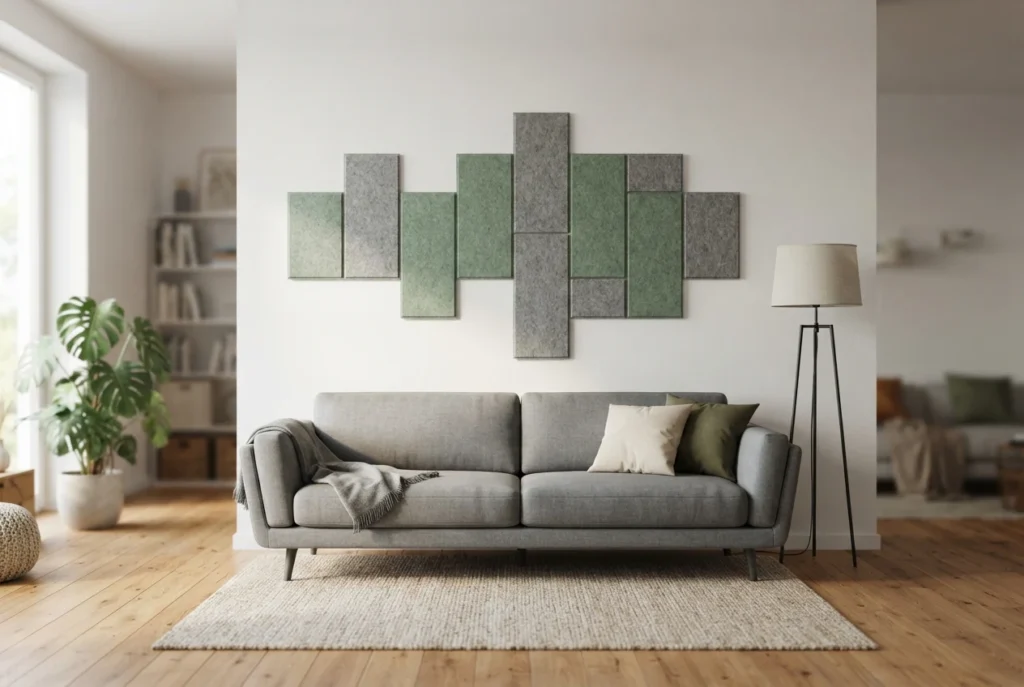
You sit down on a new sofa, say something across the room, and your voice comes back thin and slightly delayed. Modern German living rooms often sound like this, with laminate or tiles, big windows, bare white walls and very little fabric.
So, wie wirken Filz Wandpaneele im Wohnzimmer akustisch? Felt wall panels are porous absorbers. Sound waves enter the fibres, lose energy as friction, and turn into tiny amounts of heat instead of bouncing back. That shortens the reverberation (Nachhall) and stops flutter echo between bare walls, so speech gets clearer and the TV and music sound less harsh. What felt panels don’t do is block sound from neighbours. That’s a different problem with a different fix.
This guide explains what happens to sound in your room, how much felt it takes to hear a difference, where to put it and which mistakes waste money.
Echo, Reverberation and Flutter: What You’re Actually Hearing
Most people say “echo”, but in a living room it usually means one of two things.
Reverberation (Nachhall) is the general “boomy” or “hollow” sound. Every word keeps bouncing off the floor, ceiling and walls and overlaps the next word. Acousticians measure it as the reverberation time, the time it takes sound to drop by 60 dB after the source stops.
Flutter echo (Flatterecho) is a fast, metallic “zing” you hear when you clap between two parallel, hard walls. Sound ping-pongs back and forth and is easy to pick out.
Felt helps with both, but in different ways:
- For reverberation, what matters is the total amount of absorbing surface in the room.
- For flutter echo, placement matters more than quantity. Breaking up one of the two parallel hard surfaces is often enough.
A quick test before you buy anything
Stand in the middle of the room and clap once, sharply.
- A long, soft tail that fades slowly means too much reverberation. You need more absorbing area overall.
- A rattling, buzzy repeat means flutter echo. Find the two parallel bare walls and treat one of them.
- If it sounds fine with one person but loud and tiring with guests or a TV on, mid and high frequencies are the issue. That’s exactly where felt works best.
Repeat the clap after you install panels. It’s a rough test, but the before-and-after difference is usually clear.
How Felt Panels Absorb Sound
Acoustic felt panels are usually made from pressed polyester fibres (PET felt), often with a high share of recycled plastic bottles. Some products state around 60 percent recycled PET content.
The fibres form a dense maze with lots of air inside. When a sound wave hits the panel, air moves through that maze and rubs against the fibres. Part of the sound energy is lost as friction, so less sound reflects back into the room.
How well a material does this is described by its absorption coefficient α, from 0 (reflects everything) to 1 (absorbs everything). Product sheets often summarise it as:
- αw, the weighted absorption value used in Europe, often with an absorber class from A (best) to E
- NRC (Noise Reduction Coefficient), an average across speech frequencies, common on international product sheets
Why thickness and air gap matter so much
This is the point most product pages skip: lab values are measured with specific mounting. The same felt can perform very differently on your wall.
One manufacturer lists 9 mm PET felt at NRC 0.40 when mounted flat, rising to 0.80 with a 50 mm air gap behind it. Its 24 mm felt reaches 0.75 without a gap. A premium 25 mm felt panel from another brand claims αw up to 1.0, but that figure is calculated with a 20 cm cavity behind it, which you’d rarely have at home.
The practical takeaway:
- Thin felt (5–12 mm) glued flat to the wall mainly absorbs higher frequencies: clatter, sibilant speech, sharp TV dialogue.
- Thicker felt (20–40 mm) or felt with a small air gap absorbs more of the mid range, where most speech sits.
- Deep bass (footsteps, subwoofer boom) is hard for any thin panel. That needs much thicker absorbers or bass traps.
So before buying, read the datasheet and check how the panel was mounted in the test. A “class A” result with a big cavity doesn’t tell you much about the same panel glued flat behind your sofa.
Felt slats vs pure felt panels
The wood slat panels in German DIY stores (oak veneer slats on black felt) are a popular look. The felt backing does the absorbing, and the slats cover a large part of the surface. They still help, especially for mid and high frequencies, because sound reaches the felt through the gaps and is partly trapped in the grooves. A full felt surface of the same thickness usually absorbs more per square metre. Choose slats for the look and plain felt for maximum effect per euro.
How Much Felt Does a Living Room Need?
There’s no legal rule for living room acoustics in Germany. The best-known standard, DIN 18041 (“Hörsamkeit in Räumen”), is written mainly for rooms where speech matters, like classrooms, offices and meeting rooms. Its values still give useful orientation, because a good living room is also a room for conversation.
For speech rooms such as classrooms and lecture halls, recommended reverberation times are usually given at around 0.6–0.8 seconds, with shorter times for people with hearing impairments. Living rooms are smaller, and most people find a calm, natural sound somewhere below that.
A worked example
You can estimate the effect with Sabine’s formula, which links reverberation time to room volume and total absorption:
T ≈ 0.161 × V ÷ A
V is the room volume in m³, and A is the “equivalent absorption area” in m² (each surface’s area multiplied by its α, added up).
Take a typical living room in a new-build flat:
| Detail | Value |
|---|---|
| Size | 5 m × 4.5 m, 2.6 m ceiling |
| Volume (V) | about 58.5 m³ |
| Current reverberation (estimated from the clap test or an app) | about 0.9 s |
| Current absorption (A = 0.161 × 58.5 ÷ 0.9) | about 10.5 m² |
| Target reverberation | about 0.6 s |
| Absorption needed (0.161 × 58.5 ÷ 0.6) | about 15.7 m² |
| Extra absorption needed | about 5.2 m² |
If your felt panels have an α of about 0.7 at speech frequencies, you need roughly 7–7.5 m² of panel area, not counting furniture you add at the same time. That’s about two or three tall panels (60 × 240 cm) plus a smaller group, or one wall section behind the sofa and one opposite.
Two honest caveats:
- These are estimates. The real result depends on frequency, the exact product and where it goes.
- A thick rug, heavy curtains or a fabric sofa also add absorption. Count them in, and you may need fewer panels than the formula suggests.
For a more careful check, the German Social Accident Insurance (DGUV) offers a free tool. Its IFA room acoustics calculator works out reverberation in octave bands from 125 to 4000 Hz based on DIN 18041:2016. It was built for classrooms, but the maths works for any room.
Where to Put Felt Panels for the Best Effect
Placement can matter as much as quantity. Here’s where felt does the most work in a typical living room.
1. The first reflection points near your seat
Sit on the sofa and imagine a mirror on the side walls. The spots where you’d see the TV or speakers in that mirror are where sound reflects straight to your ears. Treating them makes dialogue clearer.
2. One of two parallel bare walls
If the clap test showed flutter echo, treat one of the two facing walls. You don’t need to cover both. Staggering panels (left wall front half, right wall back half) also works well.
3. Behind the sofa, at head height
You don’t need to cover the whole wall. A strip behind the sofa or along the upper part of the wall already makes the room sound calmer. Panels at head height (seated and standing) work harder for conversation than panels near the floor.
4. The ceiling, if the walls are full
In open-plan rooms with lots of glass, the ceiling is often the largest bare surface. Ceiling felt panels or rafts can do a lot here, but plan the mounting carefully or get help.
Spread it, don’t cluster it
Five panels spread over three surfaces usually sound better than five panels in one tight block on a single wall. Sound reflects in all directions, so absorption works best when it’s distributed.
Common Mistakes That Waste Money
- Expecting soundproofing. Felt reduces echo inside the room. It doesn’t stop your neighbour’s TV or the noise from the stairwell. That needs mass, sealing and decoupling, not absorbers.
- Buying the thinnest panels to save money. Very thin felt glued flat mostly handles high frequencies. If your problem is boomy speech, 9 mm decor tiles will disappoint.
- Ignoring the test conditions. Compare αw or NRC values only when the mounting is similar.
- Covering only the TV wall. It looks neat, but it often leaves the main reflections from side walls and the ceiling untouched.
- Forgetting soft furnishings. A large rug on a hard floor is cheap, effective absorption. Use it alongside panels, not instead of thinking about them.
- Skipping the fire class. For home use, look for a stated fire classification on the datasheet. Some PET felt products are rated B-s1, d0, meaning flame-retardant with little smoke and no burning droplets. Check before you buy, especially for ceilings.
Installation and Care: What to Expect
Most felt panels at home go up with one of three methods:
- Mounting adhesive: quick, but hard to remove in a rented flat.
- Screws or rails: more work, but you can add a small air gap with battens, which improves absorption.
- Hanging systems or freestanding panels: renter-friendly, easy to move, and a small gap forms naturally behind the panel.
For renters, check your lease before gluing anything to the wall. A hanging system or panels mounted on a thin wooden frame are usually easier to take down when you move.
Felt is low-maintenance. Vacuum it now and then with a brush attachment. Most PET felt doesn’t like heavy wet cleaning, so dab spots lightly and check the manufacturer’s care instructions. Don’t paint felt. Paint closes the pores and destroys most of the acoustic effect.
The Bottom Line
So, wie wirken Filz Wandpaneele im Wohnzimmer akustisch? They trap sound energy in their fibres, which shortens reverberation and kills flutter echo. The room sounds calmer, voices get clearer and the TV gets easier to follow at lower volume. The effect is real but depends on thickness, mounting, total area and placement.
Start with the clap test, estimate how much absorption your room is missing, then spread panels over the reflection points, one of the parallel walls and the area behind the sofa. Add a rug and curtains for extra effect. If neighbour noise is the real problem, look into proper sound insulation instead.
FAQ
Do felt wall panels block noise from neighbours?
No. They reduce reflections inside your room but barely change how much sound passes through a wall. Blocking noise needs heavy, sealed and decoupled constructions.
How thick should felt panels be for a living room?
For noticeably clearer speech, aim for roughly 20 mm or more, or thinner felt with a small air gap behind it. Thin decorative felt (under 10 mm) mostly tames high frequencies.
Are wood slat panels with felt as good as plain felt?
They help, especially for mid and high tones, and many people prefer the look. Per square metre, a full felt surface of similar thickness usually absorbs more.
Will felt panels make my living room sound “dead”?
Only if you overdo it. A living room needs some liveliness. Treat the problem areas, spread the panels out and check with the clap test as you go.