A Teleskopstange (telescopic pole) is only as good as three things: how far it reaches, what it’s made of, and how well it holds its length once you’ve set it. Get those three right and the brand matters far less than most shop pages suggest.
Here’s the short answer. For most homes in Germany, a two- or three-section aluminium pole that extends to around 3 to 4 metres, with a lock you can operate wearing gloves, covers windows, ceilings, gutters and smoke detectors. Go lighter (carbon or glass fibre) only if you’ll hold the pole overhead for long stretches or need to go well beyond 5 metres. Check the tip thread before anything else, because a pole that doesn’t fit your tools is useless.
The rest of this guide explains how to make each of those calls for your own house, garden or job.
Start With the Job, Not the Pole
People usually buy a pole for one task and then find five more uses for it. That’s fine, but the first task should set the specs. A pole for painting a 2.5 m living room ceiling is a very different tool from one meant for cleaning a first-floor conservatory roof.
Some typical jobs and what they usually need:
| Job | Typical reach needed | What matters most |
|---|---|---|
| Painting ceilings with a roller | 1.2 to 2 m | Stiffness, a secure thread |
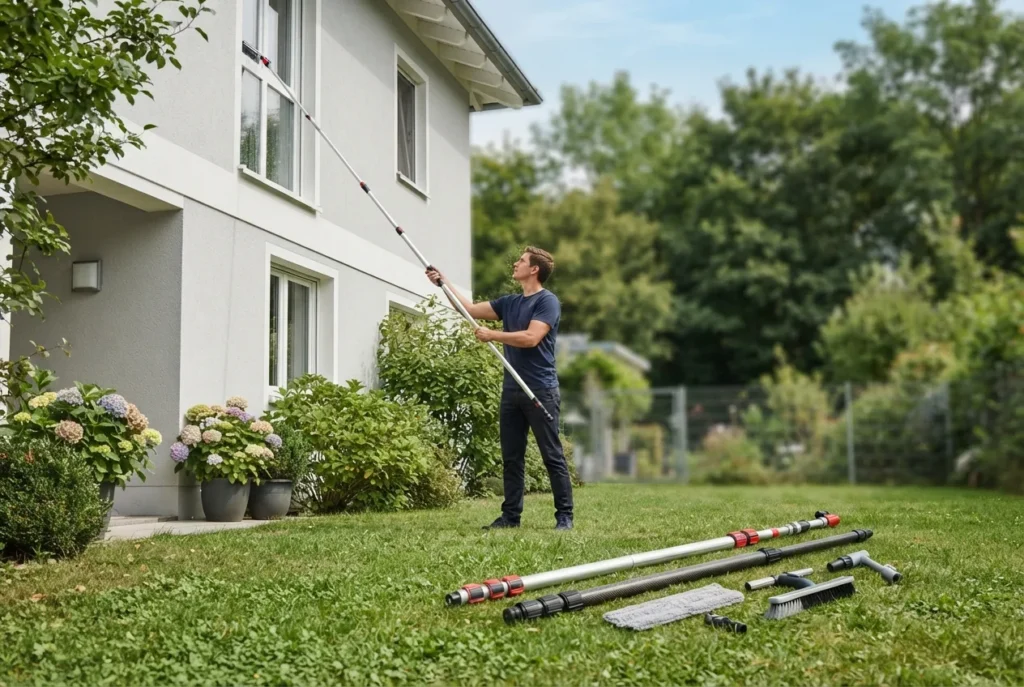
| Window cleaning, ground floor | 2 to 3 m | Low weight, quick adjustment |
| Window cleaning, first floor | 4 to 6 m | Rigidity, grip, balance |
| Pool net or vacuum | 1.8 to 5 m | Corrosion resistance, the right clip system |
| Testing smoke detectors | 3 to 4.5 m | Compatible tester cup |
| Laser level or line laser mount | Up to about 3.2 m | Clamping force, a stable base |
| Tarp or sun sail | 1.7 to 2.5 m | A firm lock under load, ground spikes |
Pool poles are a good example of how specific this gets. Hardware stores in German-speaking countries sell aluminium pool poles that extend from about 0.6 to 1.8 m and are made to fit manual pool vacuums and skimmer nets. A pole like that is great by the pool and too short for almost anything else.
How Much Length Does Your Teleskopstange Need?
This is where most buyers go wrong. They either buy the longest pole they can find or guess based on ceiling height alone.
Do the reach maths
Your reach is roughly your own height plus about 30 to 40 cm for your raised arm, plus the pole and the attached tool. If you’re 1.75 m tall, you can comfortably reach about 2.1 m without a pole. To clean a window whose top edge sits at 5 m, you need about 3 m of pole plus the length of the squeegee or brush head.
Add a small buffer of 30 to 50 cm. You rarely work standing directly under the target. You’ll stand back a step or two, which makes the pole angle and eats into your reach.
Longer isn’t always better
A pole extended to its last few centimetres flexes more and feels heavier, because the weight moves further from your hands. It’s often better to buy a pole that does the job at about two-thirds of its maximum length. A 4 m pole used at 3 m feels far steadier than a 3 m pole pulled all the way out.
Collapsed length counts too
Look at the transport length, not just the extended one. A three-section pole collapses shorter than a two-section pole with the same maximum length, so it fits in a car boot or a hallway cupboard. The trade-off is one more joint, and every joint is a spot that can wobble or slip.
Aluminium, Glass Fibre or Carbon: Which Material Suits You?
Material decides how heavy the pole feels, how much it bends and how much you pay.
Aluminium
This is the default for home use, and for good reason. It’s durable, takes knocks, and costs the least. Window-cleaning suppliers describe aluminium as hard-wearing and rigid, but note that it’s heavier than the alternatives and gets cold in your hands in winter. A foam or rubber grip fixes the cold problem, so it’s worth checking for one.
For painting, gutter work and occasional window cleaning up to around 4 m, aluminium is usually the sensible choice.
Glass fibre (GFK)
Glass fibre poles are often lighter and cheaper than carbon. They’re a middle ground for people who want less weight without paying carbon prices. They flex more than aluminium at full length, which you’ll notice when you push a scrubbing brush against a wall.
Carbon and carbon composite
Carbon poles are the lightest and stiffest, and they’re priced to match. Professional window cleaners use them because they hold a pole overhead for hours a day. Unger, for example, says its carbon nLITE poles let users clean windows and façades up to 16 metres from the ground. For a homeowner cleaning a few windows twice a year, that’s usually far more pole than needed.
A safety note on conductivity
Aluminium and carbon both conduct electricity. Never use any pole near overhead power lines, including lines that run to a house or across a garden. Germany’s construction-industry accident insurer, BG BAU, warns that even poorly conducting materials can arc when wet, so “non-conductive” glass fibre is not a safety guarantee either. If a job brings you anywhere near a line, stop and contact the network operator or a qualified electrician.
Teleskopstange Lock Types and Why They Fail
The lock is the part you’ll notice most in daily use. A great material with a weak lock means a pole that slowly slides shut while you’re painting.
Twist lock (internal or collar)
You twist the sections against each other, or turn a collar nut (Überwurfmutter), to tighten. Twist locks are cheap, slim and common on aluminium poles. Their weak spot is dirt and paint: once grit gets into the thread or the internal expander, the lock can spin without gripping. They also loosen if the pole rotates during use, for example when you’re scrubbing in circles.
Flip or clamp lock (external lever)
A lever on the outside snaps shut around the tube. You can see at a glance whether it’s locked, and it doesn’t loosen when the pole rotates. Clamp locks are easier to use with wet hands or gloves. Most can be adjusted with a small screw when they wear, which is a big plus.
Push-button or snap lock
A spring-loaded button clicks into pre-drilled holes. It’s fast and very secure, but you only get fixed lengths. That’s fine for a ceiling-painting pole and less ideal for window cleaning, where you want to fine-tune the reach.
A quick in-store test
If you can, test the pole before buying:
- Extend each section fully and lock it.
- Lean on the tip at an angle with moderate pressure.
- Twist the lower section while holding the upper one.
If any section slips or turns, it will be worse after a season of use.
The Tip Thread: The Detail Most Buyers Miss
The tip is where the pole meets the tool, and incompatibility here is the most common reason people return a Teleskopstange.
Common connection types
- Standard (Acme) thread: The coarse thread found on most paint rollers, brooms and many cleaning tools. It’s widely used, but cheaper tools can wobble on it.
- Cone or taper fit: Common with professional window-cleaning tools. The tool pushes on and is locked with a clip or button.
- Brand-specific systems: Many manufacturers use their own adapters. Kärcher’s professional range, for example, uses a MultiLink adapter on its 21 mm aluminium poles.
- Pool clips: Pool equipment usually uses a button clip that fits a standard tube diameter.
How to avoid a mismatch
Check your existing tools before ordering. If you already own a set of squeegees or a paint roller frame, buy a pole made for that system or get an adapter at the same time. Metal threads last longer than plastic ones, especially on a roller you’ll press against a ceiling.
Features That Are Worth Paying For
Some extras make a real difference. Others are just marketing.
Worth it:
- A comfortable, non-slip grip on the bottom section
- Length markings on the tube, so you can set the same reach every time
- An adjustable angle adapter for windows and gutters, which saves you from twisting your wrist
- A metal thread rather than plastic
Usually not needed for home use:
- More than three sections unless you need a very short collapsed length
- Extension modules beyond 6 m
- Water-fed systems, unless you clean large glass areas regularly
Specialist Poles: When a General Pole Isn’t Enough
A few jobs are better served by a dedicated pole.
Laser levels: Tool makers sell clamping poles that wedge between floor and ceiling. Bosch’s TP 320, for example, positions levelling devices at heights from 0.1 to 3.2 m. A cleaning pole can’t do that, because it has no floor-to-ceiling clamp.
Smoke detectors: In Germany, smoke detectors are required in homes and need regular checks. A pole with a tester cup or detector removal head saves you from standing on a ladder or chair. Some professional poles for this job reach 4.5 m and are priced well above home cleaning poles, so landlords and property managers are the main buyers.
Tents and tarps: Camping poles for sun sails and tarps are usually sold in pairs with guy lines and pegs. They need a firm lock under sideways wind load more than they need extra length.
Common Buying Mistakes
- Buying on maximum length alone. Reach at two-thirds extension is the more useful number.
- Ignoring the weight at full extension. A pole that feels light in the shop feels very different held overhead for 20 minutes.
- Forgetting about storage. Measure your cupboard or car boot before choosing between two and three sections.
- Using one pole for everything. A paint-covered pole makes a poor window-cleaning pole. Many people end up with a cheap one for messy jobs and a better one for cleaning.
- Skipping maintenance. Rinse the pole after painting or pool use, dry it fully, and store it collapsed but unlocked so the lock doesn’t stay under tension.
Where to Buy a Teleskopstange in Germany
Hardware chains such as Bauhaus, OBI, Hornbach and toom stock basic aluminium poles for painting and cleaning, often with roller frames or squeegees from the same brand. Specialist cleaning suppliers and the manufacturers’ own shops carry professional carbon poles and adapter systems. Online marketplaces offer the widest range, but check the thread type and the real (not marketing) extended length in the product data before you order.
Prices change often and vary a lot between materials, so compare current listings rather than relying on old price guides. As a rough rule, carbon costs several times as much as an aluminium pole of similar length.
Making Your Choice
Pick the job first, work out the reach with a small buffer, and choose a pole that does it at about two-thirds of its full length. For most households that means aluminium, two or three sections, a clamp lock and a metal thread that fits the tools you already own. Spend more on carbon only if you’ll use the pole overhead for long periods or need serious height.
If you’re still unsure, take your tallest window or ceiling as the benchmark. Measure it once, do the reach maths above, and you’ll know exactly which Teleskopstange to put in the basket.
FAQ
What length of Teleskopstange do I need for ceilings?
For a standard German ceiling height of around 2.5 m, a pole that extends to between 1.2 and 2 m is usually enough when used with a roller frame. Higher ceilings in older buildings (Altbau) may need 2 to 3 m.
Is an aluminium or carbon telescopic pole better?
Aluminium is cheaper, tougher and fine for most home jobs. Carbon is lighter and stiffer, so it’s better if you work overhead for long periods or need more than 5 to 6 m of reach.
Why does my telescopic pole keep slipping?
Usually because the lock is dirty, worn or not tight enough. Clean twist locks and dry them fully. On clamp locks, tighten the adjustment screw. If the problem continues, the lock parts may need replacing.
Can I use any tool with any pole?
No. Poles use different tip systems, such as standard threads, cone fits or brand-specific adapters. Check that your tools match the pole, or buy an adapter.