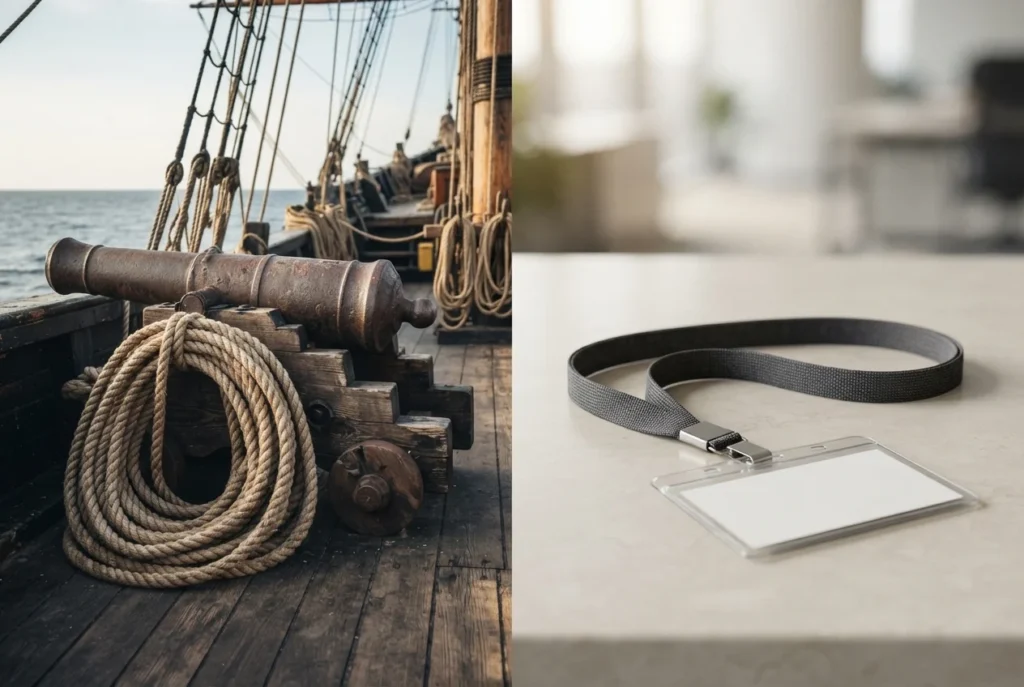
The lanyard started out as a short working rope on sailing ships. Sailors used it to fasten rigging, tie down tools and, from the 18th century on, to fire a cannon from a safe distance. The word comes from the Old French laniere, meaning a strap or thong. Over roughly five centuries the same simple cord moved from ships to soldiers’ uniforms, children’s craft tables, cameras, office ID cards, smartphones and, most recently, the green sunflower strap that helps travellers with hidden disabilities at German airports.
That’s the short version. The longer story is more interesting, because each step explains why the strap around your neck looks the way it does today.
The History at a Glance
| Period | What happened |
|---|---|
| 12th century | Old French lasniere (“strap”) is recorded, the root of the modern word |
| Late 14th century | Middle English lanyer means a strap for fastening armour or clothing |
| 1626 | First known English use in the nautical sense, according to Merriam-Webster |
| 18th century | Royal Navy gun crews fire cannon with gunlocks pulled by a cord; Prussia awards marksmanship cords |
| Late 19th century | The Royal Artillery’s white cord, first used to carry a fuse key |
| Late 1950s | The Scoubidou knotting craft takes off in France |
| 1965 | The Bundeswehr’s Schützenschnur takes its current form |
| After 2001 | ID badges and keycards spread through offices |
| May 2016 | The Hidden Disabilities Sunflower lanyard launches at London Gatwick |
| 2023 to 2026 | Berlin, Munich, Düsseldorf and Frankfurt airports join the Sunflower programme |
Where the Word Comes From
The English word goes back to Old French laniere, a strap, whip or leather thong. That came from the 12th-century lasniere, and linguists trace it further back to a Frankish word with the same Germanic root as the German Nestel, a lace or string. So the English term has a distant German cousin, even though most Germans today simply say Schlüsselband or Umhängeband.
In late medieval English, a lanyer was a strap used to fasten armour, shields and clothing. During the 17th century the ending changed to “-yard”, probably influenced by the sailing word yard, the spar that holds a sail. Merriam-Webster dates the first known nautical use to 1626.
Life at Sea: Rigging, Tools and Cannon
Rigging and small tools
On a sailing ship, a lanyard was a short piece of line for fastening something, especially the lines threaded through deadeyes to tighten the shrouds and stays that held the masts up. Thousands of these short ropes did small, essential jobs all over the deck.
Sailors also tied cord loops to their tools. Bosun’s pipes, marlinspikes and small knives often had a cord finished with a decorative diamond knot. The loop stopped them falling overboard and gave a better grip on a small handle. Literature picked up on the habit too: in Treasure Island (1883), Robert Louis Stevenson has Long John Silver carry his crutch by a lanyard round his neck.
The firing cord
The strongest link to cannon is the gunlock. Earlier guns were fired with a linstock, a staff holding smouldering match that the gunner pressed to the touch hole. The gunlock was a large flintlock mechanism fixed to the gun and triggered by pulling a cord.
That change mattered. The gun captain could stand behind the gun, clear of its recoil, sight along the barrel and fire as the ship’s roll brought it onto the target. British crews adopted gunlocks much faster than the French, who still hadn’t taken them up widely by Trafalgar in 1805. The same idea lives on in artillery, where firing cords are still standard kit.
What about the gunpowder story?
Royal Navy ratings still wear a white cord with their No. 1 uniform. The explanation you’ll most often read is that the cord was first used to carry a pouch of gunpowder for the guns. Treat that as naval tradition rather than settled fact. The firing lanyard is a documented piece of equipment, while the gunpowder-pouch story is the popular account of how a ceremonial cord began, and it’s hard to trace to an early primary source.
From Working Cord to Uniform Honour
On land, armies found their own uses. The French military used cords to keep a pistol, sword or signal whistle attached to the uniform. In mounted regiments the cord was worn on the left, so a rider could pull a whistle from the left tunic pocket while holding the reins.
Over time, practical cords became symbols. The Royal Artillery’s white cord first carried a key for setting shell fuses, then turned into a braided, whitened cord that marked a soldier as a Gunner. It has been part of the uniform since the late 19th century, and women of the Auxiliary Territorial Service attached to artillery units wore it during the Second World War.
Germany’s Schützenschnur
German readers have a famous example close to home. The Schützenschnur, a braided marksmanship cord worn from the shoulder across the chest, goes back to early 18th-century Prussia, when Frederick William I began awarding a cord as a decoration. The Bundesgrenzschutz introduced its own version in 1957.
According to the Bundeswehr’s official uniform pages, the current Schützenschnur dates from 1965 and comes in bronze, silver and gold. Only non-commissioned officers and enlisted soldiers wear it. Officers can earn it but don’t wear it on their uniform. It’s also popular with allied troops: US soldiers stationed in Germany regularly qualify for it on Bundeswehr ranges.
Summer Camps and the Scoubidou Craze
For many people, “lanyard” doesn’t mean a ship or a uniform at all. It means the flat, brightly coloured plastic strips that children braid into key rings and bracelets. That craft started in France, where it became a fad in the late 1950s. It’s named after “Scoubidou”, the 1958 song by Sacha Distel.
The craft never fully disappeared. It came back into fashion in the UK in 2004 and 2005, and in North America it’s a fixture of summer camps, where it’s called gimp or boondoggle. If someone remembers making a box stitch key ring as a child, they’re remembering this branch of the family.
Gadgets: Cameras, MP3 Players and USB Sticks
Portable electronics gave the cord a new job. Wrist and neck straps became standard on cameras, MP3 players and USB flash drives, attached through a small hole in the device with a simple cow hitch knot. The wrist strap on the Nintendo Wii Remote works on the same principle.
Japan took the idea further with the keitai strap, a decorative charm hung from the strap hole that most Japanese mobile phones used to have. Phone charms went from Japan to the United States and then Europe, and they’ve come back in the 2020s alongside the Y2K fashion revival.
The ID Badge Era
The office lanyard is the version most people picture today, and it’s relatively recent. ID badges began as paper name tags at events and workplaces, then gained magnetic stripes and barcodes in the 1970s and 1980s.
The big change came after September 11, 2001. Swiping into an office happened in some places before then, but not in most. Afterwards, keycards and photo ID badges spread quickly, starting in the United States. Badges had to be visible and close at hand, and a cord around the neck was the cheapest way to do both.
Why many badge cords now break away
A long cord around the neck is a safety risk if it catches on something. Many badge straps now have a breakaway closure that releases when pulled. You’ll see them most in hospitals, clinics, schools, care homes, childcare settings and factories.
A Cord That Speaks: The Sunflower Lanyard in Germany
The latest chapter turned the humble neck strap into a signal. The Hidden Disabilities Sunflower began at London Gatwick in May 2016, as a way for passengers with non-visible disabilities to show that they might need extra help, time or patience.
Germany came later. Berlin Brandenburg (BER) became the first German airport to offer the Sunflower lanyard in February 2023. Munich Airport and Lufthansa followed, and Düsseldorf hands the green strap out free at its information desks. Frankfurt Airport joined the programme on 1 January 2026.
A few practical points for travellers in Germany:
- It’s free. At Munich, for example, you can get one without showing proof of a disability.
- It’s voluntary. You decide whether and when to wear it during the trip.
- Look for trained staff. In Frankfurt, staff who know the programme wear a Sunflower pin or a white supporter lanyard.
- Wear it only if it applies to you. The organisation says it’s meant for people who consider themselves to have a hidden disability, diagnosed or not.
By the scheme’s own count in its tenth anniversary year (2026), the Sunflower is recognised in more than 95 countries and around 13 million staff have been trained worldwide.
Phones: The Newest Chapter
Smartphones lost the strap holes that older phones had, so the strap moved to the case. Many current phone straps use a thin “strap card” that sits between the phone and its case, with a loop sticking out at the bottom. Consumer testers have taken them seriously: Which? was still testing phone straps and lanyards from brands such as Mous, Otterbox, Peak Design and Casetify in August 2026. More than 500 years on, the job is the same as on a sailing ship: don’t drop the thing you need.
One Word, Very Different Objects
Part of the confusion around the word is that it covers things that have little in common today. Here’s a quick way to tell them apart:
| Type | Where it came from | What it does now |
|---|---|---|
| Nautical lanyard | Sailing-ship rigging | Short line for tightening or securing gear |
| Firing or activation lanyard | Naval gunlocks | Fires artillery or arms a device when pulled |
| Uniform cord | Whistle and fuse-key cords | Ceremonial dress, unit identity, awards like the Schützenschnur |
| Craft lanyard | French Scoubidou fad | Braided plastic key rings and bracelets |
| ID or badge lanyard | Office and event security | Holds a pass or keycard, often with a breakaway clip |
| Safety lanyard | Industrial and climbing gear | Part of fall-protection equipment (certified PPE, not an accessory) |
| Sunflower lanyard | Gatwick, 2016 | Discreetly signals a hidden disability |
The safety lanyard deserves a special mention. Fall-protection gear of this kind used on construction sites are certified protective equipment with strict rules on use and inspection. Don’t confuse them with a promotional neck strap, and always follow your employer’s safety instructions or a qualified safety professional’s advice.
The Takeaway
The lanyard began as a humble piece of ship’s rope, became a firing cord, a soldier’s honour and a child’s craft project, and ended up as the everyday holder for passes, keys and phones. If you’re ordering or wearing a lanyard today, that history has a practical lesson: pick the type that fits the job. Choose breakaway clips where a cord could snag, keep ceremonial cords and safety gear separate from everyday ones, and treat the sunflower design as a signal that belongs to the people who need it.
Frequently Asked Questions
Where does the word “lanyard” come from?
It comes from the Old French laniere, meaning a strap or thong. The English ending changed to “-yard” in the 17th century, probably under the influence of the sailing word yard.
Why did sailors use lanyards?
To fasten rigging, secure tools like knives and bosun’s pipes, and later to fire cannon. Pulling the cord on a gunlock let the gun captain fire from behind the gun, clear of the recoil.
Did lanyards really carry gunpowder?
That’s the traditional explanation for the Royal Navy’s white uniform cord, but it isn’t well documented. The use of cords to fire naval guns is much better supported by the historical record.
What is a lanyard called in German?
Usually Schlüsselband or Umhängeband. The sunflower version is often called the Sonnenblumen-Schlüsselband.
When did German airports start using the sunflower lanyard?
Berlin Brandenburg was first, in February 2023. Munich, Düsseldorf and Frankfurt (from 1 January 2026) have joined since.