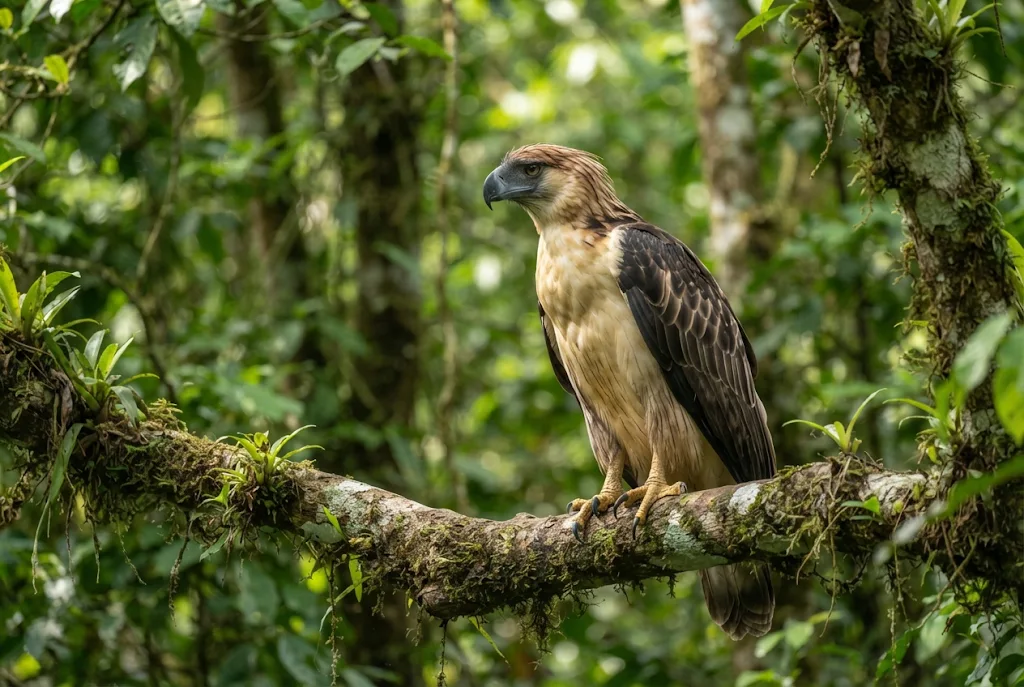
Most people picture the bald eagle when they think of eagles, and that bird is now doing well. Many of the world’s other 60-plus eagle species are not. Some survive in numbers smaller than a high school graduating class.
Quick answer: By current BirdLife International estimates, the rarest eagle is the Great Nicobar serpent eagle, at about 150 to 180 mature birds. Next come the Madagascar fish eagle at about 240 adults, then the Philippine eagle at 180 to 500. The rest of the top 10 is made up of island hawk-eagles, a Solomon Islands sea eagle and one European success story.
This guide ranks all ten, explains how eagle rarity is actually measured, and covers why different sources name different “rarest” eagles.
How Eagle Rarity Is Measured
When scientists talk about eagle rarity, they aren’t counting every eagle on Earth. That would be impossible for birds living in remote rainforest canopies. They estimate instead.
The figure that matters most is mature individuals, meaning adult birds able to breed. Chicks and young eagles don’t count toward it, because they may not survive long enough to raise young of their own.
For birds, BirdLife International sets the IUCN Red List categories. The three that matter here are:
- Critically Endangered (CR): extremely high risk of extinction in the wild
- Endangered (EN): very high risk
- Vulnerable (VU): high risk
Why “rarest eagle” lists disagree
You’ll see the Philippine eagle called the rarest eagle in one article and the Madagascar fish eagle in the next. Both can be defended, because the estimates come as ranges, and those ranges overlap.
The Philippine eagle shows how wide the gap can be. BirdLife’s official range is 180 to 500 mature birds. A 2023 habitat-mapping study found the Philippines’ remaining forest could support about 392 breeding pairs. In 2025, scientists writing in the Journal of Raptor Research debated whether that figure reflects how many eagles are really there or just how many the forest could hold.
How this ranking works: species are ordered by the upper end of BirdLife’s current mature-individual estimate, the most optimistic count. Ties go to the species with the lower bottom figure. Because this method uses the best-case number, every bird on the list really is scarce.
Eagle Rarity at a Glance: Comparison Table
| Rank | Species | Mature birds (estimate) | Red List status | Where it lives |
|---|---|---|---|---|
| 1 | Great Nicobar serpent eagle | 150–180 | Endangered | Nicobar Islands, India |
| 2 | Madagascar fish eagle | ~240 | Critically Endangered | Western Madagascar |
| 3 | Philippine eagle | 180–500 | Critically Endangered | Philippines |
| 4 | Javan hawk-eagle | 300–500 | Endangered | Java, Indonesia |
| 5 | Madagascar serpent eagle | 250–999 | Endangered | Northeastern Madagascar |
| 6 | Sanford’s sea eagle | 400–999 | Vulnerable | Solomon Islands, Bougainville |
| 7 | Spanish imperial eagle | 1,060–1,080 | Vulnerable | Spain and Portugal |
| 8 | Flores hawk-eagle | 320–1,500 | Endangered | Lesser Sunda Islands, Indonesia |
| 9 | Pinsker’s hawk-eagle | 1,300–3,600 | Endangered | Southern Philippines |
| 10 | Black-and-chestnut eagle | 1,400–4,200 | Endangered | Andes, South America |
Figures are BirdLife International factsheet estimates current as of the 2024 assessments. Some date back to older field surveys, as noted below.
The 10 Rarest Eagles, One by One
1. Great Nicobar Serpent Eagle
This little raptor is probably the smallest eagle in the world, weighing about a pound. It lives only in forests on Great Nicobar and a few nearby islands, an Indian territory in the Bay of Bengal.
As of 2021, its whole range covered only about 915 square kilometers of forest. BirdLife’s 2022 estimate is just 150 to 180 mature birds, and it lists the species as Endangered as a precaution, since nobody can survey the island thoroughly. Large development plans for Great Nicobar are a major concern.
2. Madagascar Fish Eagle
This is the largest bird of prey in Madagascar, and it lives only along the island’s western coast, lakes and mangroves. BirdLife estimates about 240 mature individuals, roughly 120 breeding pairs, and it considers the population to be one single group in decline.
That single group is what makes it fragile. One disease outbreak or a few bad breeding seasons could hit every fish eagle alive. Slow breeding adds to the risk, since BirdLife puts the species’ generation length at about 17 years.
3. Philippine Eagle
The Philippine eagle is the national bird of the Philippines and one of the largest eagles on the planet, with a wingspan of more than seven feet. It lives in forests on Mindanao, Luzon, Samar and Leyte.
Shooting is still a real threat. Rescuers in 2024 dealt with several eagles hit by improvised guns, along with steady forest loss. A pair usually raises just one chick every two years, so each adult lost sets the population back years.
4. Javan Hawk-Eagle
Indonesia’s national bird lives only on Java, one of the most densely populated islands on Earth. BirdLife’s official figure is still 300 to 500 mature birds, based on an older estimate.
There’s some better news, though. A 2023 study in the Journal of Raptor Research estimated 511 breeding pairs, up from 325 pairs in 2009, spread across 74 forest patches. Illegal trade is the second-biggest threat after habitat loss. Expect the official estimate to be revised.
5. Madagascar Serpent Eagle
This forest hunter was once feared lost. It went decades without a confirmed record before it was found again in 1993. It lives in the rainforests of northeastern Madagascar and hunts chameleons, geckos and frogs.
BirdLife places it in the 250 to 999 mature-individual band. The wide range shows how hard it is to study a bird that rarely leaves the forest canopy.
6. Sanford’s Sea Eagle
Found only in the Solomon Islands and nearby Bougainville, this rusty-brown sea eagle patrols coastlines and forest edges. BirdLife’s 2022 estimate assumes about one pair for every 20 to 30 square kilometers of coastal habitat. That gives roughly 455 to 683 adults, placed in a 400 to 999 band.
It’s listed as Vulnerable rather than Endangered. Even so, few Americans have heard of it, and its numbers are suspected to be falling.
7. Spanish Imperial Eagle
Here’s the hopeful entry. In 1974, only 38 breeding pairs were left. Thanks to decades of work in Spain and Portugal, including safer power lines and work to boost numbers of its main prey, the European rabbit, BirdLife now estimates 530 to 540 pairs.
It’s still rare enough to make this list, and droughts in Doñana National Park have hurt some local groups. Still, it shows that a recovery program with steady funding can work.
8. Flores Hawk-Eagle
In 2024, this Indonesian island species moved from Critically Endangered down to Endangered. That wasn’t because it bounced back. Researchers found pairs may need smaller home ranges than assumed, which raised the upper estimate to 1,500 mature birds.
The lower estimate is still just 320, and a full population survey has never been done. Pairs produce only one chick every two years. Conflict with villagers over chickens adds to the pressure.
9. Pinsker’s Hawk-Eagle
This crested hawk-eagle lives in the forests of the southern Philippines, including Mindanao, Leyte, Samar and Bohol. It was once grouped with the Philippine hawk-eagle, and it still gets far less attention than the famous Philippine eagle.
The 2024 IUCN assessment places it at about 1,300 to 3,600 mature birds. In 2012, the Philippine Eagle Foundation bred one in captivity for the first time, a useful backup for a species scientists know little about.
10. Black-and-Chestnut Eagle
This is the only South American bird in the top 10. It lives in the cloud forests of the Andes, from Venezuela to Argentina. BirdLife combines several national estimates for a global range of 1,400 to 4,200 mature birds.
Some national populations are tiny. Bolivia likely holds fewer than 250 adults. Farmers sometimes shoot these eagles because they take poultry, which happens more as forest loss pushes them toward villages.
Close Calls That Just Missed the Top 10
Steller’s sea eagle often shows up on “rarest eagle” lists. It’s huge and striking, but BirdLife estimates 3,600 to 4,670 mature birds, just above our cutoff. It’s still Vulnerable and declining.
The Chaco eagle (crowned solitary eagle) of South America is another one to watch. It’s listed as Endangered, but its population numbers are so uncertain that researchers can’t agree on them. That’s why it isn’t ranked here.
What the Rarest Eagles Have in Common
Look across the table and a few patterns stand out. They explain eagle rarity better than any single statistic.
- Island life: Eight of the ten live only on islands. Islands limit how far a population can spread, and lost forest isn’t easily replaced.
- Slow breeding: Many large eagles raise one chick every year or two. Populations can’t rebound quickly after losses.
- Big space needs: One pair of forest eagles may need a territory measured in dozens of square kilometers.
- Human conflict: Shooting, trapping and poultry disputes come up again and again, especially for the Philippine, Flores and black-and-chestnut eagles.
- Thin data: For several species, the biggest problem is that nobody knows the real numbers. You can’t protect a population well if you don’t know where it is.
What About Eagles in the USA?
American readers can take some comfort here. The bald eagle hit an all-time low of 417 known nesting pairs in 1963. A 2020 U.S. Fish and Wildlife Service report estimated 316,700 bald eagles in the lower 48, including more than 71,400 nesting pairs.
That recovery came from banning DDT, legal protection and decades of nest monitoring. The Spanish imperial eagle is now following a similar path. Both stories suggest eagle rarity doesn’t have to be permanent. The eagles on this list aren’t beyond saving, if they get enough time and funding.
Practical Ways to Help From Home
You don’t need to fly to Mindanao to make a difference. A few realistic steps:
- Log your sightings. Records you submit to citizen-science apps like eBird have helped wildlife agencies estimate eagle numbers, including the bald eagle count above.
- Report injured raptors. In the US, call your state wildlife agency or a licensed wildlife rehabilitator. Don’t try to handle an eagle yourself.
- Leave feathers where they fall. Federal law restricts possessing bald and golden eagle feathers and parts. Check the US Fish and Wildlife Service rules before picking anything up.
- Choose ethical wildlife tours. If you travel to see rare raptors, book with local guides who keep their distance from nests.
- Support groups doing fieldwork. Organizations like the Philippine Eagle Foundation and The Peregrine Fund run long-term monitoring and breeding programs.
The Takeaway
Eagle rarity is less about one record holder and more about a group of species, mostly on islands, each with fewer adults than a small town has residents. The Great Nicobar serpent eagle, Madagascar fish eagle and Philippine eagle sit at the top, but several others on this list could swap places as new surveys come in.
If you want to track how eagle rarity changes over time, follow the Philippine eagle or the Javan hawk-eagle. Both have active research teams publishing new estimates.
Frequently Asked Questions
What is the rarest eagle in the world?
Using BirdLife International’s current estimates, the Great Nicobar serpent eagle has the smallest population, at about 150 to 180 mature birds. The Madagascar fish eagle, at about 240 adults, is often named instead, including by Guinness World Records.
Is the Philippine eagle the rarest eagle?
It’s one of the rarest, and it’s Critically Endangered. Its estimate ranges from 180 to 500 mature birds, so depending on the figure used, it can rank first, second or third.
Are bald eagles rare?
Not anymore. Bald eagles were removed from the federal endangered species list in 2007, and US government estimates now put them above 300,000 birds in the lower 48 states.
Why are most of the rarest eagles found on islands?
Island life drives much of eagle rarity. Islands hold small, isolated populations with limited habitat. When forest is cleared or birds are shot, there’s no nearby population to refill the gap.