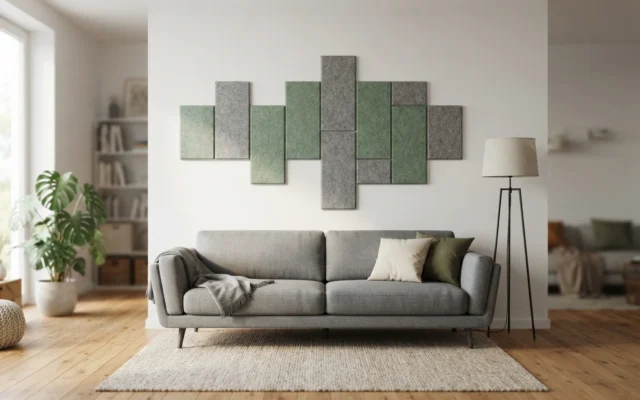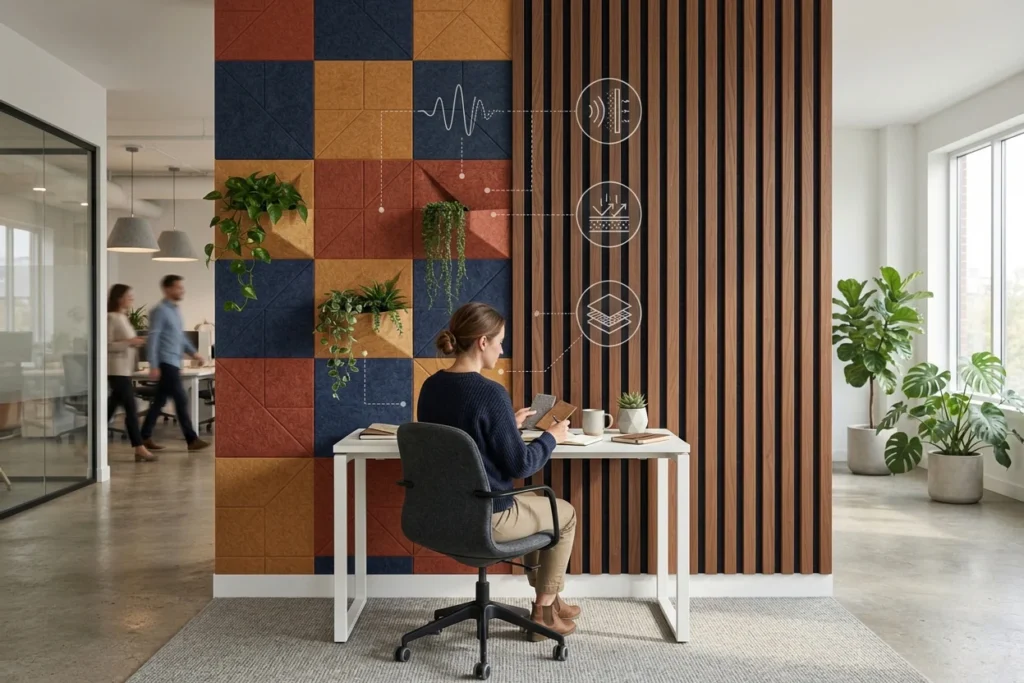
If your office echoes every phone call and meeting, you’ve probably narrowed it down to two options: plain felt panels or those popular wood slats on a felt backing. Here’s the short answer to the question behind Beste Wandbekleidung Aus Filz Fürs Büro: pure PET felt usually gives you more sound absorption per euro and is easier to get in a flame-retardant version, while wood slat panels win on looks and feel. That said, how you mount either one changes the result more than the material itself.
Below you’ll find what German workplace rules ask for, real absorption and fire ratings from manufacturer datasheets, current price ranges and a simple way to work out how much wall you need to cover.
Quick Verdict: Felt or Wood Slats?
| Factor | Pure PET felt panels | Wood slat panels (felt backing) |
|---|---|---|
| Sound absorption | Often class A–B, depending on thickness and mounting | Class A to D, very dependent on mounting |
| Fire rating | B-s1,d0 versions widely available | Many wood products sit around D-s2,d0 |
| Look | Flat, colourful, modern | Warm, natural, “designer” feel |
| Weight | Light | Heavier (MDF or solid wood slats) |
| Price per m² | Generally lower | Wide range, veneer costs more |
| Best for | Open-plan offices, meeting rooms, tight budgets | Reception areas, executive offices, home offices |
Neither is “better” across the board. The right choice depends on how bad the echo is, what the room is used for and whether fire safety rules apply to your building.
What German Office Rules Actually Expect
Before comparing products, it helps to know the target. In Germany, the Technical Rule for Workplaces ASR A3.7 “Lärm” sets maximum reverberation times for offices. Under section 5.2 of ASR A3.7, an unoccupied office should not exceed these values in the 250 to 2,000 Hz octave bands:
- Call centre: 0.5 seconds
- Multi-person and open-plan office: 0.6 seconds
- Single and two-person office: 0.8 seconds
Reverberation time is simply how long sound takes to fade away after it stops. A bare room with a concrete ceiling, glass and hard floors can easily sit well above one second, which is why conversations feel tiring.
The current version of ASR A3.7 dates from March 2021. It’s worth checking the latest text before planning a commercial fit-out, since technical rules do get revised.
Walls are only one part of the picture
The German Social Accident Insurance (DGUV) points out that a baseline of acoustic ceiling and carpet comes first in multi-person offices, with further measures adapted to the work done in each room. Wall panels are a great add-on, especially in rented spaces where you can’t touch the ceiling. Just don’t expect a few decorative slats to fix a large open-plan floor on their own.
How Each Option Works
Pure felt panels
These are boards of compressed PET felt, usually made with a high share of recycled plastic bottles. Common thicknesses are 9 mm, 12 mm and 25 mm. The felt itself absorbs sound energy, so the whole surface works as an absorber.
They come in dozens of colours, can be cut into shapes and are light enough to glue or clip to a wall. Some ranges are self-supporting, meaning they can also hang as baffles or room dividers.
Wood slat panels
Here, slats of MDF (often with real wood veneer) or solid wood are glued to a felt base, typically 8 to 9 mm thick. The slats reflect and scatter some sound, while the gaps let the rest reach the felt behind them.
The result looks like a piece of furniture rather than a technical fix, which is a big part of why they’ve become so popular in homes and offices.
Sound Absorption: Mounting Matters More Than Material
Acoustic products in Europe are rated with the weighted sound absorption coefficient (αw) and an absorption class from A to E under EN ISO 11654:
| Class | αw range | What it means |
|---|---|---|
| A | 0.90–1.00 | Very high absorption |
| B | 0.80–0.85 | High absorption |
| C | 0.60–0.75 | Medium absorption |
| D | 0.30–0.55 | Low absorption |
| E | 0.15–0.25 | Very low absorption |
Here’s the detail most shop listings leave out. One oak-veneer slat panel datasheet (F&P GmbH, sold via planeo.de) lists three different classes for the same product:
- Class A when fixed on 45 mm battens with mineral wool behind
- Class C on 35 mm battens with no insulation
- Class D when screwed straight onto the wall
Felt behaves the same way. XAL’s 9 mm FELT panel reaches αw up to 0.85 (class B), but that figure is calculated with a 20 cm cavity behind it. Glue it flat to plaster and you’ll get less.
So when you compare products, always ask: “Which class, and with what mounting?” A felt panel glued flat and a slat panel on battens with insulation can end up performing in the opposite order to what you’d expect.
Fire Safety: The Spec Many Buyers Skip
In a private home office, fire ratings are rarely checked. In a commercial office, escape route or building open to the public, they matter, and your landlord, insurer or fire safety officer may ask for proof.
European fire classes follow EN 13501-1. Two examples from current datasheets show the gap:
- PET felt: EASYfelt’s 9 mm panel is tested to B-s1,d0 (low flammability, low smoke, no burning droplets).
- Wood-based acoustic panels: Admonter’s acoustic wood element is rated D-s2,d0, which is a normal level of flammability.
Be careful though: not every felt panel is flame-retardant. XAL, for example, sells its 9 mm felt in both a standard and a flame-retardant version. Always check the exact variant on the datasheet, not just the product family.
This is a safety question, so for any commercial fit-out, confirm the required class with your fire safety officer or building authority before ordering.
Cost Per Square Metre
Prices change constantly, so treat these as examples from German retailers seen in November 2026, not fixed prices:
- Budget wood slat sets (MDF, foil finish): around €33 per m² on marketplace listings
- Mid-range slat panels with veneer: roughly €50–65 per m²
- Premium veneered slat panels: one walnut-veneer panel at a large DIY chain was listed at about €115 per m²
Pure PET felt panels vary just as much by thickness, colour and fire rating. Flame-retardant and thicker boards cost more.
The smarter comparison isn’t price per m² of panel. It’s price per unit of absorption. A cheap panel with class D performance may need twice the wall area of a class B panel, which can wipe out the saving.
How Much Wall Do You Actually Need? A Worked Example
You can get a rough estimate with Sabine’s formula, the standard starting point in room acoustics:
T = 0.163 × V ÷ A
T is the reverberation time in seconds, V is room volume in m³ and A is the total equivalent absorption area in m².
Take a two-person office of 4 × 5 m with a 3 m ceiling:
- Volume: 60 m³
- Target (ASR A3.7): 0.8 seconds
- Absorption needed: 0.163 × 60 ÷ 0.8 ≈ 12.2 m²
- Existing absorption: if all 94 m² of hard surfaces absorb around 5% (an assumption for plaster, glass and hard flooring), that’s about 4.7 m²
- Gap to close: roughly 7.5 m²
Now compare:
- Panels at αw 0.85 need about 8.8 m² of coverage.
- Panels at αw 0.45 (class D, typical of slats screwed straight to the wall) need about 16.7 m², almost a third of the total wall area.
This is a simplified estimate. Furniture, shelves full of books, curtains and people all add absorption, and αw is a single averaged number. For larger or open-plan offices, an acoustician’s measurement is money well spent.
Looks, Weight and Everyday Use
Felt panels suit modern, colourful offices and can double as pinboards in some ranges. They’re light, so a large surface won’t put much load on a partition wall.
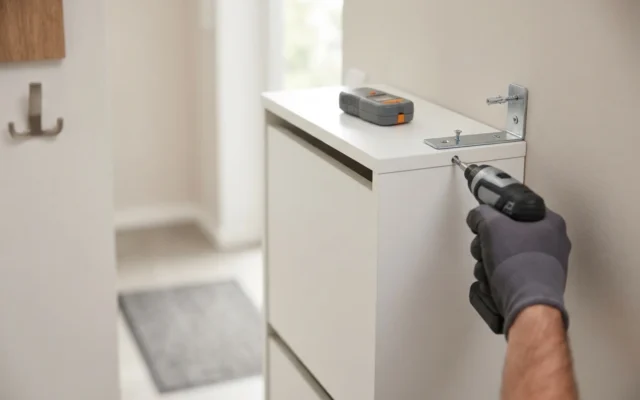
Wood slats bring warmth and look more premium in client-facing rooms. They’re heavier, though. A set of four 120 × 60 cm panels can weigh over 5 kg, so plan proper fixings on drywall.
A few practical points for both:
- Not for wet areas: wood slat panels such as Meister’s AcousticSense line are not intended for bathrooms or saunas, and untreated felt doesn’t belong in damp rooms either.
- Cleaning: check the maker’s care sheet. Dust settles in slat gaps, so a soft brush attachment on your vacuum is handy for both types.
- Cutting: slats need a fine-tooth saw, while felt backing and felt boards cut with a sharp utility knife.
Which One Suits Your Office?
Single or two-person office
Either works. If you like the look of wood, slats on battens with insulation give you both style and solid absorption. On a tight budget, a few large felt panels on the wall facing your desk are the efficient choice.
Open-plan office
Start with the ceiling and floor if you can. On the walls, felt panels usually make more sense because you can cover large areas affordably, and freestanding felt dividers help between desk groups.
Meeting rooms
Echo hurts speech clarity most here, especially on video calls. Felt on the wall opposite the screen plus one slat feature wall is a good mix of performance and looks.
Rented office or home office
Avoid heavy screw-mounted battens if you’ll need to restore the walls. Lightweight felt panels with removable mounting are kinder to your deposit.
How to Choose the Beste Wandbekleidung Aus Filz Fürs Büro: 6 Checks
- Define the problem. Is it echo (reverberation), noise from neighbours (that’s sound insulation, which panels barely help) or both?
- Measure the room and estimate the absorption needed with the formula above.
- Ask for the datasheet. Look for αw, the absorption class and the mounting it was tested with.
- Check the fire class against what your building requires.
- Compare cost per unit of absorption, not just price per m².
- Order samples to check colour, texture and slat finish in your actual lighting.
Common Mistakes to Avoid
- Expecting wall panels to stop noise coming through a wall. Absorbers reduce echo inside a room; they don’t block sound between rooms.
- Gluing slat panels flat to the wall and expecting the “up to 95%” absorption claims from product photos.
- Buying a non-flame-retardant panel for a commercial space.
- Clustering all panels on one wall. Spreading them across opposite walls usually works better against flutter echo.
The Bottom Line
If performance and budget matter most, pure PET felt is usually the best wall covering for an office. If looks come first, wood slats are a great choice, as long as you mount them on battens with insulation so they actually do their job. Whichever you pick, the beste Wandbekleidung aus Filz fürs Büro is the one with a datasheet that matches your mounting, your fire rules and the absorption your room needs. Next step: measure your room, run the quick calculation and request two or three samples before you order.
FAQ
Are wood slat panels as effective as pure felt panels?
They can be, but only with the right mounting. On battens with mineral wool, some slat panels reach class A. Screwed flat to the wall, the same panel may only reach class D.
Is PET felt safe to use in offices?
Many PET felt panels are tested to B-s1,d0 under EN 13501-1, which suits most office uses. Not every product has this rating, so check the specific variant.
Do acoustic panels stop noise from the next office?
No. They reduce echo inside the room. Blocking sound between rooms needs sound insulation, such as heavier walls, sealed doors or better partitions.
How many panels do I need for my office?
It depends on room volume, the target reverberation time and the panel’s αw. A 60 m³ two-person office might need around 9 m² of class B panels, but larger rooms are best measured by a professional.