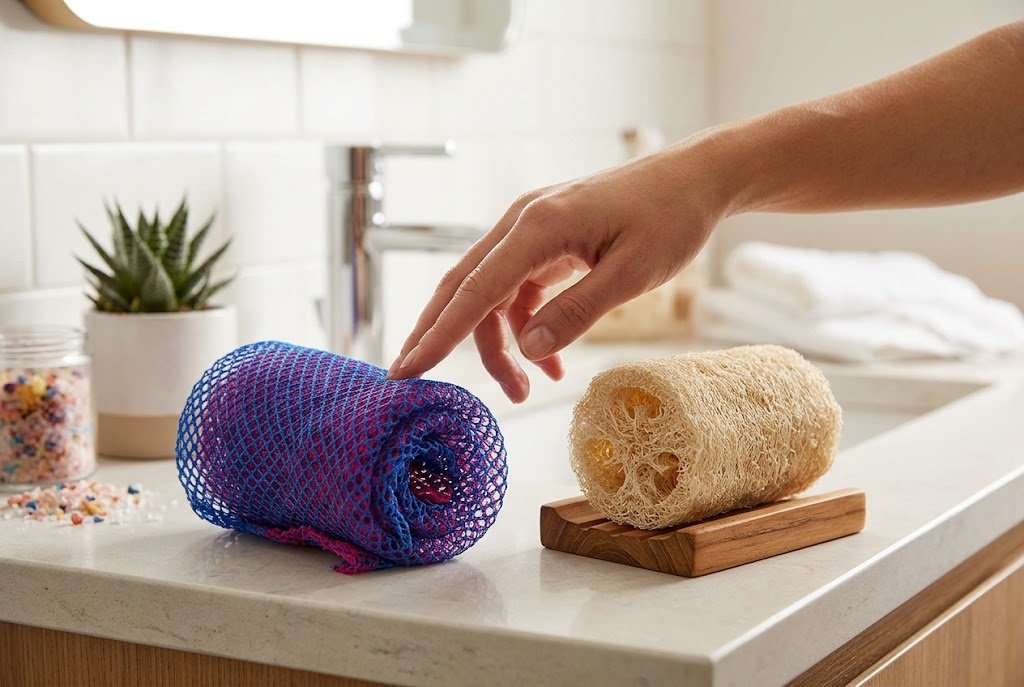
For most people, the African net sponge is the better everyday choice. It dries much faster than a loofah, holds up for months instead of weeks, and stretches long enough to scrub your whole back. A loofah still has a place if you want a softer, cushioned feel, but it traps water and dead skin, so it needs more care and more frequent replacing.
The catch: “better” depends on your skin. If yours is sensitive, very dry, or prone to dark marks after irritation, how you use either tool matters more than which one you pick. Below is a straight comparison of hygiene, exfoliation, cost and care, plus who should choose which.
Quick Answer: Which One Should You Pick?
- Choose the net sponge if you want a long-lasting, quick-drying scrubber that reaches your back and builds lots of lather.
- Choose a loofah or bath pouf if you prefer a softer feel, use a scrubber only occasionally, and don’t mind replacing it often.
- Choose neither (use a soft washcloth or your hands) if your skin is currently irritated, broken, sunburned, or flaring.
What Each One Actually Is
The African net sponge
It’s a long strip of stretchy nylon mesh, traditionally used across West Africa. You’ll see it called sapo in Nigeria and sometimes sapor in Ghana. Unstretched, it looks like a folded net. Pulled out, many are 30 to 45 inches or longer, so you can hold one end in each hand and scrub your back like you’d dry it with a towel.
One thing to clear up: some websites describe it as a marine sponge or sea creature. It isn’t. The bath version is a manufactured nylon product.
The loofah
A natural loofah is the dried, fibrous inside of a gourd from the cucumber family. It’s firm and scratchy when dry and softens when wet. Many products sold as “loofahs” today are actually plastic mesh poufs, which feel softer than natural loofahs and the net sponge.
So when people compare an African net sponge to a loofah, they usually mean one of two things: the natural gourd or the round plastic pouf. The differences below cover both.
Side-by-Side Comparison
| Feature | African net sponge | Natural loofah | Plastic bath pouf |
|---|---|---|---|
| Material | Nylon mesh | Dried plant fiber | Plastic mesh |
| Exfoliation | Moderate to strong (depends on pressure) | Moderate to strong | Mild |
| Drying speed | Fast, open weave | Slow, absorbs water | Medium, dense center |
| Back reach | Excellent | Poor without a handle | Poor without a handle |
| Lather | High | Low to medium | High |
| Typical lifespan | Months or longer with care | A few weeks | A couple of months |
| Machine washable | Usually (check the label) | No | Sometimes |
| Biodegradable | No | Yes | No |
Lifespans are typical ranges, not guarantees. They depend heavily on how well each tool dries between showers.
Hygiene: The Biggest Real Difference
This is where the net sponge earns most of its reputation.
Bath scrubbers sit in a warm, wet room and collect dead skin cells. That’s an easy food source for bacteria. Lab research on natural loofahs found they supported the growth of several bacterial species, including Pseudomonas. Skin cells trapped in the fibers made that worse. A case of skin infection (folliculitis) was even traced back to a contaminated loofah.
The net sponge’s open mesh doesn’t hold water the way plant fiber or a dense pouf does. Wring it out, hang it up, and it’s usually dry within hours. Drying out is the main thing that limits bacterial growth.
To be fair, nylon isn’t germ-proof. Studies on bath sponges have found contamination on synthetic sponges too. The advantage is that a net sponge is easier to keep clean, not immune to germs. If you leave one balled up on a shower shelf, you lose most of that benefit.
Which Is Gentler on Your Skin?
Neither tool is automatically gentler. Pressure and frequency matter more than the material.
- Net sponge: When it’s stretched tight and pulled hard across your back, it scrubs aggressively. Loosely bunched in your hand with plenty of soap, it’s much milder.
- Natural loofah: It’s rough when dry or barely wet. Soak it well before use.
- Plastic pouf: It’s the softest of the three, which is why it suits people who just want lather without much exfoliation.
Dermatologists generally advise choosing exfoliation methods based on your skin type, using light strokes, and not over-exfoliating, since that can leave skin red and irritated. A few practical points follow from that:
- Sensitive or dry skin: use the net sponge loosely, with light pressure, and not every day.
- Darker skin tones: aggressive scrubbing can leave dark marks behind on some people, so go gentle.
- Eczema, psoriasis, or active rashes: check with a dermatologist before using any physical exfoliator.
- Freshly shaved or waxed skin, sunburn, cuts: skip scrubbing that area for now.
Which One Fits Your Situation?
You have a small, humid bathroom with no window. Go with the net sponge. Anything that stays damp for a day is a problem, and the loofah will struggle.
You struggle to reach your back. Net sponge, easily. The length is the whole point.
You want an eco-friendly option. A natural loofah is plant-based and compostable. The trade-off is replacing it more often.
You exfoliate once or twice a week and want something soft daily. Use a pouf or washcloth daily and a net sponge for scrub days.
You share a bathroom. Fine either way, but give everyone their own. Sharing any bath scrubber spreads whatever is living on it.
How to Use an African Net Sponge Without Overdoing It
- Soak it in warm water first. The nylon softens a little when wet.
- Add body wash or soap. A small amount goes far, since the mesh foams it up quickly.
- Scrunch it to lather. Rub it between your hands for a few seconds.
- Scrub with light to moderate pressure. For your back, hold an end in each hand and pull it back and forth diagonally.
- Keep it below the neck. It’s too coarse for most people’s faces.
- Rinse it, wring it, hang it to dry, ideally outside the shower stall.
Start with two or three uses a week. If your skin feels fine, you can use it more often. If it feels tight, stings, or looks red, cut back or use less pressure.
How to Care for Each One
African net sponge
- After each use: rinse out the soap, wring it, and hang it fully stretched.
- Every week or two: wash it in the machine on a gentle cycle if the label allows, or hand-wash it in hot, soapy water.
- Replace it if it smells musty, discolors, or stays slimy after washing.
Natural loofah
- After each use: squeeze it out and dry it outside the shower.
- Every week: clean it regularly. Researchers have suggested periodic disinfection with diluted bleach. Rinse thoroughly afterward.
- Replace it every few weeks. Do it sooner if it darkens, smells, or starts to mold.
Common Mistakes to Avoid
- Storing it bunched up on a shelf or hook. Spread it out so air can reach every part.
- Scrubbing harder to get “cleaner.” More pressure means more irritation, not better results.
- Using it right after shaving. Fresh razor nicks plus abrasive mesh is a bad mix.
- Buying the longest one available without checking. Extra-long sponges can be awkward in a small shower. Around 30 to 40 inches stretched suits most adults.
- Never washing the scrubber itself. Rinsing out soap isn’t the same as cleaning it.
The Verdict
For everyday use, the African net sponge is the more practical choice for most people. It dries faster, lasts longer, reaches your back, and is easier to keep clean. A natural loofah makes sense if biodegradability matters most to you, and a soft pouf suits people who want lather without much scrub. Whichever you choose, keep the pressure light, let it dry completely between showers, and give your skin a break if it looks irritated.
FAQ
Is an African net sponge more hygienic than a loofah?
Generally, yes, because its open mesh dries much faster. It can still harbor bacteria if it stays damp, so hang it to dry and wash it regularly.
Can I use an African net sponge every day?
Some people with tougher skin do, but it’s best to start with two or three times a week and adjust based on how your skin reacts.
Can I use it on my face?
It isn’t recommended. The mesh is designed for body skin and is usually too abrasive for the face.
How long does an African net sponge last?
With regular drying and washing, many last for months. Replace yours if it smells, discolors, or stays slimy after cleaning.
Is it good for sensitive skin?
It can work if used loosely and gently, but people with eczema or other skin conditions should ask a dermatologist first.