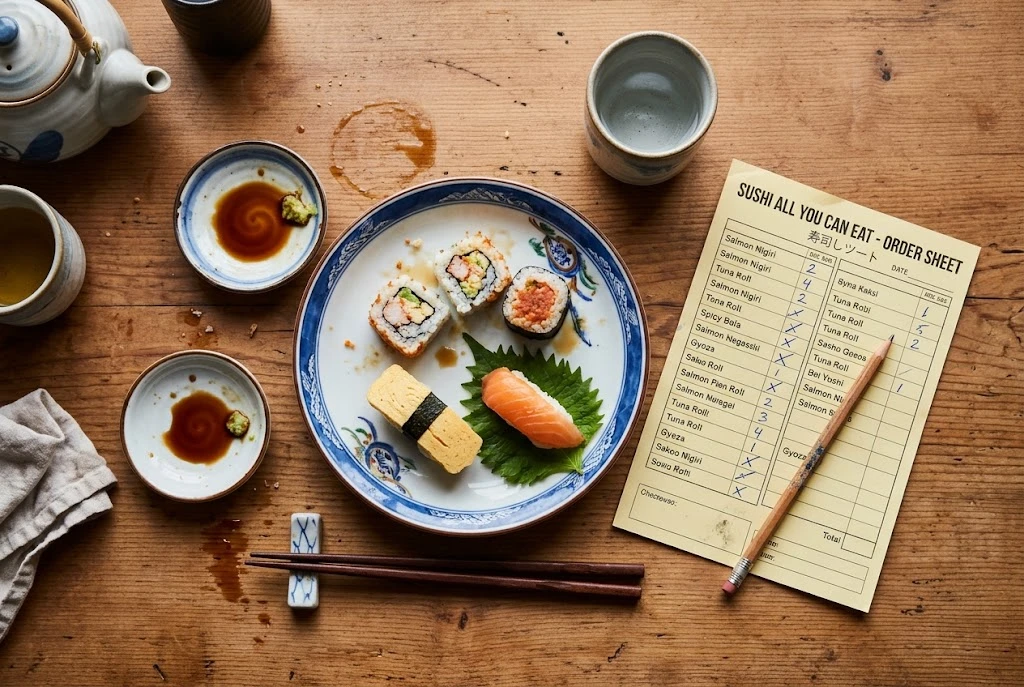
Yes, some all you can eat sushi restaurants charge extra for food you order but don’t finish. The fee is usually billed per leftover piece, as the item’s regular menu price, or as a percentage of your bill. There’s no standard Canadian rate, so the amount depends on the restaurant.
The rule normally appears on the menu, order sheet or tablet, though it’s sometimes in small print. Some restaurants enforce it strictly, while others only use it when a table leaves a lot behind. Below, you’ll see how each type of charge works, what it can add to a bill, how to avoid it, and what to do if a charge seems unfair.
What Is a Leftover Fee at All You Can Eat Sushi?
A leftover fee is an extra charge for food that was ordered and made for your table but not eaten. You may also see it called a waste fee, an uneaten food charge or a wasted food charge.
It’s different from the flat price you pay to dine. That price covers what you eat, as long as you stay within the restaurant’s rules. The fee only applies when food comes back to the kitchen.
Most sit-down all you can eat sushi restaurants work in rounds. You mark an order sheet or tap a tablet, the kitchen prepares the food, and you can order again. Because the food is made for you, an over-order is hard to reuse, and that’s where the fee comes in.
How All You Can Eat Sushi Leftover Charges Are Calculated
All you can eat sushi policies vary a lot. These are the main models, with real examples from restaurant menus and local reporting. Most of the specific figures come from US restaurants, because the Canadian wording we found mentions a charge without giving an amount.
| Charge type | How it works | Published example | Who it hits hardest |
|---|---|---|---|
| Per piece | A set amount for each piece left | 50 cents a piece at one St. Louis restaurant | Tables with many small leftovers |
| Per item type | Different rates for rolls and nigiri | 50 cents per roll, $1 per nigiri or special roll | Diners leaving premium items |
| Menu price | Leftovers billed at the listed price | A California restaurant charges the “original price” on its order sheet | Anyone leaving specialty rolls |
| Percentage of bill | A percentage added after a set limit | 15% once a table leaves more than three pieces | Large groups |
| Discretionary | “Charges may apply,” with no amount | A Calgary restaurant’s AYCE page uses this wording | Anyone who doesn’t ask first |
The St. Louis examples come from St. Louis Magazine’s look at local AYCE sushi rules. The article also notes that one owner rarely enforced the charge, which shows how far the written rule and the real practice can drift apart.
What Usually Counts as a Leftover
This is where diners get caught out. A restaurant may count more than whole, untouched pieces. Depending on the house rules, a leftover can include:
- Single pieces of a roll you’ve stopped eating
- Rice left behind after you’ve eaten the fish from nigiri
- Sashimi or hot dishes you ordered as part of the AYCE menu
Rice is the common sticking point. Several published policies specifically mention it, including a Washington State restaurant that warns against stripping rice off rolls and an Arizona restaurant that listed “including rice” in its leftover rule. Garnishes such as ginger and wasabi are less clear, so ask if you’re not sure.
Why All You Can Eat Sushi Restaurants Charge for Uneaten Food
The all you can eat sushi model only works if diners order roughly what they’ll eat. Each piece carries the cost of the fish, the rice and the labour to make it. If it’s left on the plate, the restaurant usually can’t serve it to anyone else.
Restaurants that explain their policy tend to give the same reasons: they want to cut waste and discourage over-ordering. Some also point directly to food costs. One California order sheet asks diners to avoid waste because “food costs are soaring.”
Food waste is also a wider concern in Canada. A 2024 Second Harvest report estimated that about $58 billion worth of food is thrown out each year across the country, although the figures reported in the press didn’t single out restaurants.
Diners sometimes argue that a fee doesn’t fit the words “all you can eat sushi.” It’s a fair complaint. Still, the fee is really aimed at what you order and leave, not what you eat. It helps to read the offer as “eat as much as you like, as long as you finish what you order.”
What a Leftover Fee Can Add to Your All You Can Eat Sushi Bill
Here’s a made-up example to show why the type of charge matters. Say a table of four pays $40 each for an all you can eat sushi dinner, so the bill is $160 before tax and tip. At the end, the table has eight pieces left.
| Policy | Calculation | Added charge |
|---|---|---|
| $1 per piece | 8 × $1 | $8 |
| 15% of the bill | 15% × $160 | $24 |
| Menu price, all eight from a $14 roll | One roll at $14 | $14 |
| Discretionary | Staff decide | $0 or an unknown amount |
The takeaway is that the same pile of leftovers can cost very different amounts. A percentage fee grows with the size of your group, so it’s the one to watch at birthdays and team dinners.
Where to Find the All You Can Eat Sushi Leftover Rule
Don’t wait for the bill. Check these places first:
- The restaurant’s website or AYCE menu page. Look for words such as “leftover,” “waste” or “uneaten.”
- The order sheet. The rules are often printed along the bottom or on the back.
- The tablet. Check the welcome screen or terms before tapping through to the menu.
- Your server. Ask, “How do you charge for leftovers?” If the menu only says charges may apply, ask for the amount.
While you’re at it, ask about the time limit. Rules differ here too. One Calgary restaurant allows 90 minutes from your first order, and a late, oversized round is a common way to end up with leftovers when time runs out.
How to Avoid a Leftover Fee at All You Can Eat Sushi
Avoiding the fee mostly comes down to pacing. These habits help the most:
- Start small. Order two or three items each in your first round. You can always order again, and the first round tells you how big the pieces are.
- Order nigiri by the piece when you can. A whole roll is a bigger commitment, particularly when you’re near your limit.
- Be careful with rice-heavy and fried rolls. Tempura pieces and sauced specialty rolls can fill you up quickly.
- Finish one round before ordering the next. Food may arrive in stages, so a second round placed too early can stack up on the table.
- Share at the table if the rules allow it. A friend with room left can usually help, as long as everyone is on the AYCE menu. Some restaurants require the whole table to order it.
- Slow down near the end. A final round is where most over-ordering happens. Skip it if you’re on the fence.
- Tell staff about dietary needs early. Ask what’s in a roll before ordering so you don’t end up with something you can’t eat.
Don’t hide food in a napkin or a bag, even though viral videos make it look like a harmless trick. It’s dishonest, and it isn’t worth the awkward moment for a few dollars. Many restaurants also won’t let you take leftovers home, so it’s worth asking before assuming you can box them up.
If Something Is Wrong With the Food
There’s a difference between leaving food because you’re full and leaving it because something’s wrong. If a piece tastes off or isn’t what you ordered, tell your server right away, while the plate is still on the table. Raising it at the time gives staff a chance to fix it, and it’s much harder to dispute a charge after you’ve paid.
Are All You Can Eat Sushi Leftover Fees Allowed in Canada?
We couldn’t find a Canadian law or court decision that deals specifically with leftover fees at all you can eat sushi restaurants. Generally, the key questions are whether the charge was clearly disclosed and whether the restaurant’s advertising was misleading. The rules vary by province, so treat this section as general information, not legal advice.
Federally, the Competition Bureau treats drip pricing as illegal. That means advertising a low price and then adding mandatory fees, other than government charges such as sales tax. A leftover fee looks a little different, because it isn’t mandatory for everyone and you can usually avoid it. That doesn’t settle every situation, but it’s why the leftover fee isn’t an obvious match for a drip pricing complaint.
Provincial consumer protection laws also matter. Ontario’s Consumer Protection Act, 2002, for example, bans false, misleading or deceptive representations. In a 2026 decision, Weinstein v. Sirius XM Canada Inc., an Ontario court refused to certify a class action over pricing, finding that an advertised base price with a qualifier wasn’t a misrepresentation where the full price was reasonably disclosed. That case wasn’t about restaurants, but it shows that fine print can carry weight.
In practice, a fee printed on the menu is much easier for a restaurant to defend than one you only hear about at the till. If you have a large disputed charge or think a business is misleading customers, a legal clinic or lawyer in your province can give advice for your situation.
What to Do If an All You Can Eat Sushi Charge Seems Unfair
Stay calm and start at the table. Most disputes over a few dollars get settled there.
- Ask to see the policy. Politely ask where the charge is listed and how it was worked out.
- Check the numbers. Compare the leftovers with what you were billed. Honest mistakes happen.
- Explain any food issue. If you told staff about a problem during the meal, say so.
- Speak to a manager. Keep it factual and ask for the charge to be removed or reduced.
- Keep your records. Save your receipt and take a photo of the rule, if there is one.
- Follow up in writing. If nothing changes, email the restaurant with the details and what you want done.
- Contact your provincial consumer office. Ontario’s ministry, for instance, tells people to contact the business first and then file a complaint if it isn’t resolved. You can find your office through the federal directory of consumer affairs offices.
A credit card chargeback should be your last resort. These disputes generally cover problems such as billing errors, incorrect amounts, duplicate charges or fraud. Disagreeing with a fee that was clearly disclosed may not qualify, and your card issuer will usually expect you to try the restaurant first.
The Bottom Line
Leftover fees at all you can eat sushi restaurants are easy to avoid once you know how they work. Before ordering, find out how the fee is calculated, what counts as a leftover and how long you have to eat. After that, order in small rounds and stop a little before you think you need to.
Next time you’re booking a group dinner, call ahead and ask about the leftover policy. It takes a minute and could save everyone an awkward conversation when the bill comes.
Frequently Asked Questions
Can an all you can eat sushi restaurant charge me for leftovers?
Often, yes, particularly when the rule is clearly shown on the menu or order sheet. Whether a specific charge is fair or enforceable depends on what was disclosed and on your province’s consumer laws.
How much is the leftover fee at all you can eat sushi?
There’s no standard amount. Published examples range from 50 cents a piece to the full menu price of an item or a percentage of the bill. Many menus don’t list a number, so ask your server.
Do I have to pay for rice I leave behind?
You might. Some restaurants specifically include rice in their leftover rules, especially when diners eat the fish and leave the rest. If you’re trying to cut back on rice, ask for sashimi or smaller items, if they’re on the AYCE menu.
Can I take my leftovers home instead of paying?
Usually not. Many all you can eat sushi restaurants don’t allow it, and some state that on the menu. Ask before you order, because the rule varies.
Are leftover fees illegal in Canada?
We couldn’t find a Canadian law that bans them outright, and the answer can vary by province and situation. Clear disclosure matters. For advice on a specific charge, contact your provincial consumer office or a legal professional.