If you have both astigmatism and dry eyes, the best contacts for dry eyes are usually daily disposable toric lenses made from silicone hydrogel. Good examples are Dailies Total1 for Astigmatism, Acuvue Oasys 1-Day for Astigmatism and MyDay toric. If you’d rather use a monthly lens, Biofinity Toric and Air Optix plus HydraGlyde for Astigmatism are the ones eye doctors most often start with. If no soft lens stays comfortable, a scleral lens is the next step, and it handles both problems at the same time.
That’s the short answer. The longer answer is that astigmatism changes the rules, and a lens that works for your friend’s dry eyes may not work for yours. Here’s why, and how to work out which option fits you.
Why Astigmatism Makes Dry Eye Harder to Manage
Astigmatism means your cornea (or the lens inside your eye) is shaped more like a football than a basketball. Light focuses unevenly, so things look blurry or stretched at every distance.
Toric lenses fix this by having two different powers built into one lens, each lined up with a particular angle (the “axis”) on your eye. That’s where the trouble starts for dry eyes:
- The lens has to stay put. A regular spherical lens can spin a little and you’d never notice. A toric lens that rotates even a few degrees makes your vision go blurry.
- Stabilization adds thickness. Toric lenses use weighted or thicker zones to stay in position. Thicker areas can feel more noticeable on a dry eye.
- Dryness causes rotation. When your tear film thins out late in the day, the lens can stick, drag or shift with each blink. So dryness hurts on two fronts: comfort and clear vision.
This is why many people with astigmatism say they’re fine at 9 a.m., then blurry and scratchy by 3 p.m. It’s often not a prescription problem. It’s a tear film problem showing up as a vision problem.
Alcon has estimated that 47% of people who need vision correction have astigmatism, and that 42% of astigmatic lens wearers report lens-related dryness. Those figures come from a manufacturer, so read them as rough indicators rather than independent research, but they match what eye doctors see every day.
What Makes a Toric Lens Good for Dry Eyes
Before looking at brands, it helps to know which features actually matter. When you compare lenses, look for these four things.
1. Replacement schedule
Daily disposables are the usual first choice for dry eyes. A fresh lens each morning means no build-up of proteins and oils, and no solution touching your eyes. The FDA’s definition of daily disposables is strict: a true daily lens is worn once and thrown away, even if some sellers use “disposable” more loosely.
2. Lens material
Silicone hydrogel lets far more oxygen through than older hydrogel lenses. Most of the strongest dry eye options today use it. A higher water content isn’t automatically better, because a very watery lens can pull moisture from your tear film as the day goes on.
3. Surface moisture technology
Each brand has its own approach: Alcon’s Water Gradient, Johnson & Johnson’s HydraLuxe, CooperVision’s Smart Silicone. The names are marketing, but the goal is real: to keep the lens surface slippery and wettable so it doesn’t dry out between blinks.
4. Stabilization design
This is the toric-specific part. Designs such as Acuvue’s Blink Stabilized and Alcon’s Precision Balance 8|4 are meant to settle the lens quickly and keep it at the right angle. A lens that settles fast and stays still will feel and see better on a dry eye.
Best Contacts for Dry Eyes: Daily Toric Picks
These are the daily lenses eye doctors most often reach for when someone has both conditions. All of them need a prescription and a fitting.
Dailies Total1 for Astigmatism (Alcon)
This lens launched in the US in March 2022 and is a premium daily toric built on Alcon’s Water Gradient material. The water content rises toward the surface, so the part touching your eye is almost entirely water. It uses the Precision Balance 8|4 design, which Alcon says settles the lens in about 37 seconds on average.
There’s also some useful research here. A 2023 study in Clinical Ophthalmology refit people who were already uncomfortable in reusable toric lenses into this lens. After two weeks, 78.9% reported little to no eye discomfort, compared with 51.7% in their old lenses. It was a small, open-label study with no control group, so treat it as encouraging rather than conclusive.
Best for: people who’ve already tried other torics and still feel dry by afternoon.
Acuvue Oasys 1-Day for Astigmatism (Johnson & Johnson)
This is one of the most widely prescribed daily torics in the US. It uses a senofilcon A silicone hydrogel with HydraLuxe, a tear-like moisture network built into the lens. Its Blink Stabilized design uses the pressure of your eyelids to keep the lens lined up, so it doesn’t rely on a weighted bottom edge.
Best for: long screen days, when you blink less and need the lens to hold steady.
MyDay Toric (CooperVision)
MyDay toric takes the design of the monthly Biofinity Toric and puts it into a daily lens. CooperVision says it allows up to four times more oxygen than 1-day hydrogel lenses and covers a wider prescription range than competing daily torics.
Best for: stronger or less common astigmatism prescriptions, where other dailies may not come in your exact power and axis.
Precision1 for Astigmatism and Dailies AquaComfort Plus Toric (Alcon)
These two are good mid-range and budget dailies. Precision1 for Astigmatism uses a moisture-holding surface and the same 8|4 stabilization design. Dailies AquaComfort Plus Toric is an older hydrogel lens that releases moisture as you blink. It’s affordable, but it has less oxygen flow than silicone hydrogel lenses.
Best for: mild dryness when cost matters.
The Best Monthly Toric Lenses for Dry Eyes
Daily lenses aren’t right for everyone. They cost more per year, and some prescriptions are only made in reusable lenses. A monthly lens can still work well for dry eyes if you’re careful with cleaning.
Biofinity Toric and Biofinity XR Toric (CooperVision)
Biofinity Toric is one of the most prescribed monthly torics. It’s a silicone hydrogel lens that holds moisture naturally rather than relying on a surface coating. The XR version extends the prescription range for higher astigmatism.
Air Optix plus HydraGlyde for Astigmatism (Alcon)
This lens pairs a plasma-treated surface designed to resist deposits with HydraGlyde moisture technology. It’s a solid choice if build-up is part of why your lenses feel dry.
Total30 for Astigmatism (Alcon)
Total30 for Astigmatism brings the Water Gradient idea to a monthly lens. Alcon released it after Dailies Total1 for Astigmatism. Ask your eye doctor whether it’s available in your prescription.
Quick Comparison Table
| Lens | Replacement | Material | Moisture / stability feature | Good fit for |
|---|---|---|---|---|
| Dailies Total1 for Astigmatism | Daily | Silicone hydrogel | Water Gradient, Precision Balance 8|4 | Persistent dryness |
| Acuvue Oasys 1-Day for Astigmatism | Daily | Silicone hydrogel | HydraLuxe, Blink Stabilized | Screen-heavy days |
| MyDay Toric | Daily | Silicone hydrogel | Smart Silicone | Wider prescription range |
| Precision1 for Astigmatism | Daily | Silicone hydrogel | Moisture surface, 8|4 design | Mid-range budget |
| Dailies AquaComfort Plus Toric | Daily | Hydrogel | Blink-activated moisture | Lowest daily cost |
| Biofinity Toric / XR Toric | Monthly | Silicone hydrogel | Built-in wettability | Higher astigmatism |
| Air Optix plus HydraGlyde for Astigmatism | Monthly | Silicone hydrogel | Deposit-resistant surface | Build-up issues |
Prices, parameter ranges and availability change often and vary by retailer and insurance plan. Ask your eye doctor or vision plan for current figures.
When Soft Toric Lenses Aren’t Enough
Soft torics have limits. They work best for low to moderate astigmatism, and most stop at roughly -5.75 cylinder. If your astigmatism is high or irregular, or your dry eye is moderate to severe, two other options are worth asking about.
Rigid gas permeable (RGP) lenses
The American Academy of Ophthalmology notes that hard RGP lenses usually give sharper vision than soft lenses when the cornea is unevenly curved. Because they keep their shape, the lens corrects the astigmatism on its own, and they don’t soak up moisture the way soft lenses can. The trade-off is that they take a few weeks to get used to.
Scleral lenses
Scleral lenses are large rigid lenses that vault over the cornea and rest on the white of the eye. The space under the dome is filled with saline before you put the lens in, so your cornea sits in a pool of fluid all day. For many people with significant dry eye and astigmatism, this is the option that finally works. They need a specialist fitting and usually cost more up front, but they can also replace years of trial and error with soft lenses.
How to Choose: A Simple Decision Path
Use this as a guide for the conversation with your eye doctor about the best contacts for dry eyes in your situation, not as a self-prescription.
- Mild dryness, mild to moderate astigmatism: start with a silicone hydrogel daily toric.
- Dryness that keeps coming back late in the day in your current lens: ask about switching to a lens with a different surface technology. Moving from one brand’s moisture system to another’s can make a real difference.
- Budget is the main limit: a monthly silicone hydrogel toric with a strict cleaning routine, or a lower-cost daily.
- High or irregular astigmatism: ask about RGP lenses or extended-range torics like Biofinity XR Toric.
- Moderate to severe dry eye, or nothing soft has worked: ask for a scleral lens consultation.
Common Mistakes That Make Toric Lenses Feel Drier
Even the right lens can feel bad if a few habits work against it. These come up often:
- Wearing lenses past their replacement date. Deposits build up and the lens surface stops wetting properly.
- Sleeping in lenses. The CDC has reported that sleeping in contacts raises the risk of eye infection six to eight times. It also leaves your eyes drier in the morning.
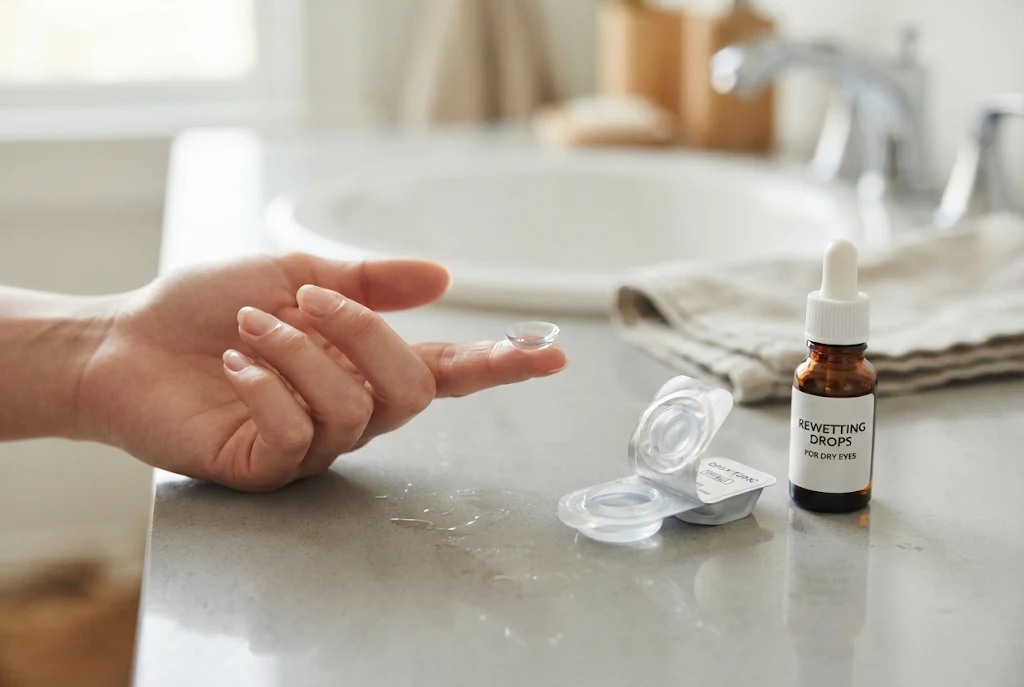
- Using any drop you find in the cabinet. Some eye drops aren’t meant for use with contacts. Use only rewetting drops labeled as safe for contact lenses.
- Assuming blur means a new prescription. With torics, late-day blur is often rotation caused by dryness. Mention the timing to your doctor.
- Skipping follow-up visits. Your doctor can check how the lens sits and rotates on your eye, which you can’t see yourself.
What to Ask at Your Contact Lens Fitting
Bring these questions so the appointment covers what matters for both conditions:
- Is my dry eye mild, moderate or severe, and is it caused by my lenses or something else?
- Is my astigmatism regular enough for a soft toric, or should I consider RGP or scleral lenses?
- Can I try two different daily torics as trial pairs before I commit to a box?
- How far does this lens rotate on my eye, and how fast does it settle?
- Which rewetting drops are compatible with this lens?
If you’ve never worn contacts, get a full eye exam first. Dry eye can be linked to other health conditions and medications, and some people with severe dry eye are advised not to wear contacts at all.
Final Takeaway
The best contacts for dry eyes with astigmatism balance two things: a surface that stays wet and a design that stays put. For most people, that means a daily silicone hydrogel toric. A monthly lens works if you’re careful with cleaning, and scleral lenses are the backup when soft lenses can’t keep up. Book a fitting, ask for trial pairs of two different brands, and pay attention to how your eyes feel and see at the end of the day, not just at the start.
FAQ
Can I wear contacts if I have both dry eyes and astigmatism?
Usually, yes. Modern silicone hydrogel daily torics and scleral lenses let many people wear contacts comfortably with both conditions. Your eye doctor will confirm whether your dry eye is mild enough.
Are daily or monthly toric lenses better for dry eyes?
Daily lenses are usually better because there’s no build-up and no solution involved. Monthly silicone hydrogel torics can still work well if you clean them and replace them on schedule.
Why does my toric lens get blurry late in the day?
Your tear film thins as the day goes on, so the lens can rotate off its axis, which blurs your vision. A lens with better moisture or a different stabilization design often helps.
Are scleral lenses good for astigmatism and dry eye?
They can be very effective. They correct astigmatism and keep a layer of saline over the cornea all day. They need a specialist fitting and usually cost more.
Can I buy toric contacts without an eye exam?
No. In the US, contact lenses need a valid prescription, and toric lenses need a precise power and axis that only a fitting can measure.