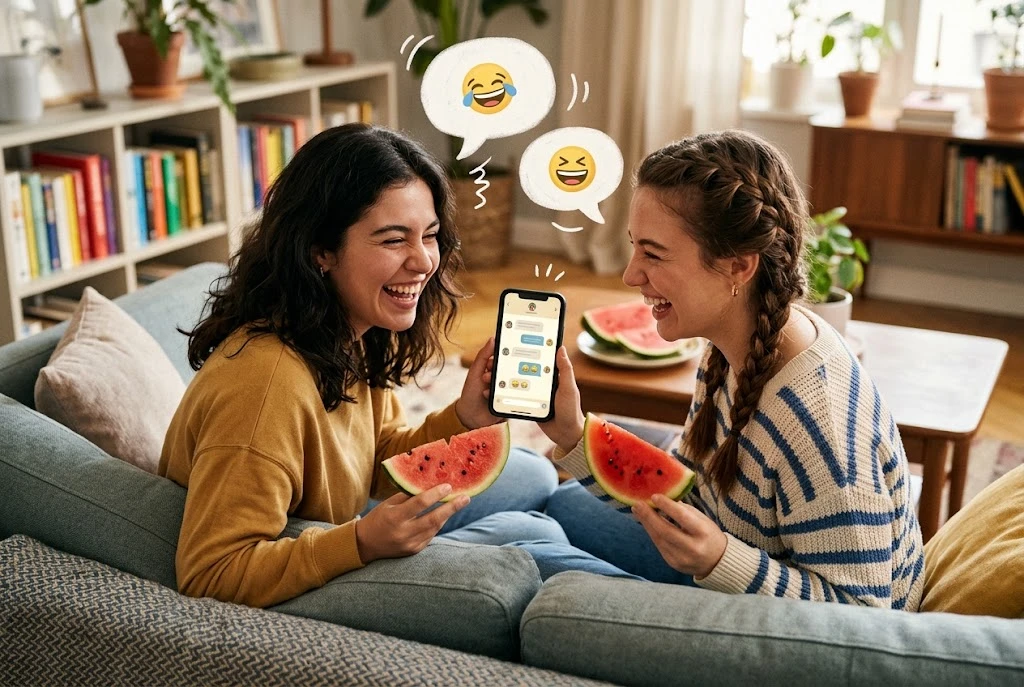
Your Chinese coworker drops a watermelon emoji into the group chat right after someone mentions a messy office breakup. Nobody’s talking about fruit. Chigua (吃瓜, pronounced roughly “chrr gwah”) literally means “eating melon,” but in Chinese internet slang it means watching gossip or drama from the sidelines. Think of it as the Chinese version of grabbing the popcorn.
You may also have reached this term through 51CG, a shorthand you’ll see online for a Chinese gossip brand. We’ll explain that connection further down, along with why you should be careful with search results that use the name. First, the slang itself, which is a lot more fun.
What Does Chigua Mean in Plain English?
Chigua describes being a spectator to something juicy. A celebrity split, a company feud, a nasty argument in the comments: if you’re following along without being part of it, you’re eating melon.
The word has two sides. As a verb, it means following the drama. The related noun, gua (瓜), means the gossip itself, so a scandal becomes “a melon” that people pass around and bite into.
Three things separate chigua from ordinary gossiping:
- You’re an outsider. The story doesn’t involve you, and you’ve got no stake in how it ends.
- You’re entertained. There’s usually a playful, slightly guilty enjoyment in it.
- You don’t have the full picture. Part of the joke is admitting you only know what’s floating around online.
That last point matters. Wiktionary describes the group version of the term as humorous and often used about oneself, and that’s how it usually lands. Saying “I’m just here eating melon” is a small joke at your own expense.
How to Pronounce and Write Chigua
The pinyin is chī guā, and both syllables take the high, level first tone. English speakers tend to read “chi” like the start of “cheese,” which is the most common slip. It’s closer to “chrr,” with the tongue curled back slightly. “Gua” sounds like “gwah.”
You’ll see it written several ways in English: chigua, chi gua and “eating melon.” The Chinese characters are the same in simplified and traditional writing, although the longer phrase differs slightly: 吃瓜群众 in simplified and 吃瓜群眾 in traditional.
Where Did the Melon-Eating Slang Come From?
Nobody can point to one definite origin, and anyone who claims otherwise is guessing. Here’s what’s reasonably well documented.
According to The World of Chinese, the term seems to have taken off around 2016. Online forum users were writing phrases about eating, or selling, melon seeds in the front row. The image is easy to picture: a crowd settling in with snacks because a good show is about to start. English-language forums did something very similar with popcorn GIFs.
From there, the phrase shortened and shifted from seeds to melons. “Melon-eating masses” (吃瓜群众, chī guā qúnzhòng) emerged as a label for people who watch public events without saying much. The same source says it made the magazine Yaowen Jiaozi’s list of top 10 buzzwords for 2016.
The Origin Stories You’ll Hear
Some popular explanations are entertaining but unproven, so treat them as folklore:
- The roadside witness: After a traffic accident, a bystander supposedly told TV reporters they knew nothing because they’d been eating a watermelon at the time.
- The ancient text: Some people trace the idea to the Book of Rites, which describes different classes eating melon in different ways. It’s a neat theory, but nobody has proven it.
- The sound-alike: The Chinese word for gossip, bagua (八卦), ends in a similar sound. Some learners’ resources suggest wordplay helped the slang spread, although the tones differ (guà versus guā).
The snack explanation is the most practical one. Melon seeds have long been a common thing to nibble while chatting or watching a show, so the jump from “snack” to “spectator” isn’t much of a jump at all.
Common Chigua Phrases and What They Mean
Once you know the base word, related phrases are easy to pick up. These are the ones you’re most likely to run into.
| Chinese | Pinyin | Literal meaning | What people mean |
|---|---|---|---|
| 吃瓜 | chī guā | Eat melon | Follow gossip or drama as a bystander |
| 吃瓜群众 | chī guā qúnzhòng | Melon-eating masses | The online crowd of onlookers |
| 不明真相的吃瓜群众 | bùmíng zhēnxiàng de chī guā qúnzhòng | Melon-eating masses who don’t know the truth | Spectators reacting without the facts, sometimes said with a wink |
| 大瓜 | dà guā | Big melon | A major scandal or a huge piece of news |
| 这瓜保熟吗 | zhè guā bǎo shú ma | Is this melon guaranteed ripe? | Is this gossip actually reliable? |
The longer “don’t know the truth” version has real bite. A University of British Columbia course wiki on the term explains that it can mock people who swallow gossip without caring whether it’s accurate. People also use it about themselves, which softens the sting.
How People Use Chigua in Real Conversations
The word turns up in plenty of everyday situations. Here are a few realistic examples:
- In a friend group chat: Someone hints that two friends have fallen out. A reply might simply be 🍉, or “I’ve brought my stool and I’m ready to eat melon.” Translation: go on, tell us everything.
- On social media: A trending story breaks and commenters announce they’re “here for the melon.” They aren’t offering an opinion yet. They’re just signalling that they’re watching.
- At work: A colleague might ask, “Any melon today?” It’s a joking way to ask for the latest office news, and it’s best kept to people who know each other well.
- Staying out of it: “I’m only eating melon” can be a polite way to say you don’t have a side. If two friends are arguing online, this phrase lets you admit you’ve seen it without joining in.
That last use is underrated. Chigua isn’t only about loving drama. It also gives people an easy way to stay neutral.
Is Chigua Rude or Harmless?
Mostly harmless, but context changes everything. For a reality show feud or a silly celebrity spat, it’s lighthearted. It reads very differently when the “melon” is a person’s real pain, like an assault allegation, a death or a family tragedy.
There’s also a real critique behind the joke. A Duke University essay on melon-eating culture connects the habit to a wider tendency to observe rather than step in. It’s the same discomfort English speakers feel about rubbernecking at a car crash. So if you’re learning the slang, a simple rule helps: if the people involved are truly suffering, don’t use it.
The term has reached literature too. Novelist Liu Zhenyun used it in a book title, 吃瓜时代的儿女们, which roughly means “Children of the Melon-Eating Era.” The fact that a serious author picked it up shows how far the phrase has travelled from forum humour.
When Melon-Eaters Stop Just Watching
The stereotype says melon-eaters are passive, but that isn’t always true. The UBC wiki notes that chigua is also linked to citizen journalism, with users working together to dig out the truth behind a story.
So one crowd can do two opposite things. It can spread a shaky rumour within an hour, or it can compare posts and timelines until a false story falls apart. That split is probably why the term has lasted: it describes a real tension in how people behave online, and not only in China.
How Chigua Compares to English Slang
No English expression matches it perfectly, but a few get close. Each one carries a slightly different flavour.
| English expression | How close is it? | Key difference |
|---|---|---|
| Grabbing the popcorn | Very close | Focuses on the act of watching, just like chigua |
| Spilling the tea | Partly | “Tea” is about sharing gossip, while chigua is mainly about receiving it |
| Peanut gallery | Fairly close | Suggests heckling and is usually less affectionate |
| Rubbernecking | Partly | Carries more shame and usually refers to a real accident |
| Lurking | Partly | Means reading without posting, but with no hint of drama |
If you need a one-line translation, “grabbing the popcorn” is the safest choice for most sentences. For the noun version, “the peanut gallery” or simply “onlookers” works, depending on the tone.
What Does 51CG Mean, and How Is It Connected to Chigua?
This is where the slang meets a much less charming corner of the internet. The “CG” in 51CG lines up with the pinyin initials of chi gua, and the name is commonly used for 51吃瓜, a Chinese-language gossip and leaks brand. In other words, the brand built its name on the slang.
The word itself and this brand aren’t the same thing. Chigua is ordinary everyday slang. A search for 51CG, on the other hand, can lead you into a messy set of lookalike sites, and that’s why we aren’t linking to any of them.
Security scanners have flagged a number of domains that use the name or similar names. Reports from the reputation checker Gridinsoft have classed some as phishing or scam sites, and others are tied to adult content or online gambling. Those flags apply to specific domains, and they can change over time. Still, the pattern is enough to justify caution.
Staying Safe If You’ve Seen the Name
If a link, social post or search result sends you toward one of these sites, a few basic habits will protect you:
- Don’t install apps or APK files from the site or from links shared in chat groups.
- Don’t enter passwords, card details or personal information on an unfamiliar site.
- Be wary of “new address” or “backup link” messages. Constantly shifting domains make it hard to know who’s running a site.
- Run suspicious links through a reputable URL scanner before opening them, but remember that a clean result isn’t a guarantee.
- Check content rules before opening links on a shared or work device. Adult material can appear unexpectedly on gossip sites.
If you’re in Canada and think you’ve been targeted, or you’ve already entered your details, contact your bank or card provider if money is involved. You can also report it to the Canadian Anti-Fraud Centre. For anything serious or involving a financial loss, your local police can advise you on what to do next.
Common Mistakes When Using Chigua
A few slips can make the slang fall flat:
- Taking it literally. A friend saying “I’m eating melon” in a heated chat almost certainly isn’t having a snack.
- Using it about someone’s tragedy. The joke only works when the stakes are low.
- Treating it as a formal word. It belongs in casual chats and social posts, not in a report or a condolence message.
- Assuming every melon is true. Being entertained by a rumour isn’t the same as verifying it, and the phrase “is this melon ripe?” exists for a reason.
The Takeaway
Chigua is one of those rare slang words that translates almost instantly once someone explains it. Everyone knows the feeling of settling in to watch a drama that has nothing to do with them. The Chinese internet simply gave that feeling a snack.
Use it with friends, keep it away from real tragedies and enjoy spotting the watermelon emoji in your group chats. If you run into 51CG while searching, remember that it’s a brand name built on the slang, and it isn’t something you need to visit to understand the word.
Frequently Asked Questions
What does the watermelon emoji mean in Chinese chats?
It often signals chigua, meaning the person is watching the drama or is curious to hear more. It can have other meanings online, so read the context before assuming.
Is chigua the same as gossiping?
Not quite. Gossiping usually means actively passing stories along, while chigua leans toward watching and enjoying them from a distance. People can do both, of course.
Is chigua an offensive word?
No. It’s casual and playful. However, the tone can feel unkind when it’s used about someone’s real suffering, and the longer “don’t know the truth” phrase can be used to mock people.
What does 51CG stand for?
It’s commonly used as shorthand for 51吃瓜, a Chinese gossip brand, with “CG” lining up with chi gua. Search results for the name can include risky lookalike sites, so be careful.
Can I use chigua with Chinese friends if I’m not fluent?
Yes, and it’ll probably earn a laugh. Keep it to relaxed conversations about low-stakes news, and a simple watermelon emoji works if you aren’t confident about the pronunciation.