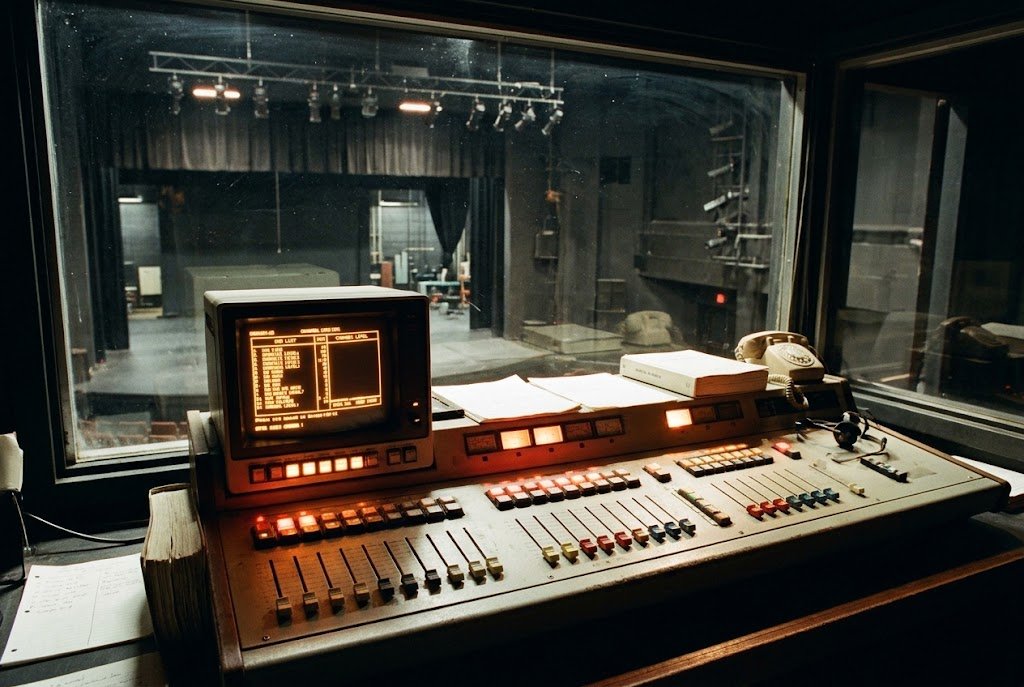
Electronics Diversified, usually shortened to EDI, was an American maker of stage lighting dimmers and control systems. It incorporated in 1967, built its factory near Portland, Oregon, and is best remembered for the LS-8, the first computerised memory lighting console used on Broadway. It sold technology and distribution rights to Cooper Controls in 2009, and its Oregon factory is reported to have closed in 2011.
That’s the short version. The longer story covers a rugged touring dimmer, a prototype flown to New York for one of the biggest musicals ever staged, and a move into offices, churches and government buildings. It also shows why you might still find EDI equipment in a working venue today.
Who Was Electronics Diversified?
Electronics Diversified started with a practical problem. Stage dimmers of the time were heavy, and touring productions needed something tough enough to survive constant loading in and out.
According to company history preserved by the UK’s Backstage Heritage Collection, Electronics Diversified incorporated in 1967 to build a solid-state dimming system. The work was led by Don Cameron, who brought the theatre experience, and Arthur P. Horne, who brought the electrical know-how.
Their product was the SCRimmer, a name formed from “SCR dimmer”. An SCR, or silicon controlled rectifier, is a semiconductor switch that controls how much mains power reaches a lamp. It does the job electronically, so there’s no need for a bulky resistance dimmer that burns off the unwanted power as heat.
What EDI Actually Invented
EDI didn’t invent the SCR dimmer. Live Design records the first SCR dimmer system going into the Dallas Theater Center in 1959, eight years before EDI existed.
The claim made by Electronics Diversified was narrower and more interesting: it said it built the first reliable solid-state dimmers for touring, and that it was the first to use opto-isolators in a dimmer. An opto-isolator passes a control signal using light, keeping the delicate control electronics separated from the high-voltage side. In a portable rack that gets plugged in somewhere new every week, that protection matters.
Most of these “firsts” come from EDI’s own company history, so treat them as the firm’s account, not an independent ruling. The LS-8’s place in Broadway history is a different matter, as it’s backed up by people who were there.
The LS-8 and A Chorus Line
Until 1975, Broadway lighting was run on piano boards. These were wooden cases of about a dozen resistance dimmers, roughly the size of a large upright piano, and each one needed an electrician working levers by hand during the show. A complicated cue could mean several people moving in strict coordination.
Then came A Chorus Line. Lighting designer Tharon Musser had run the show from a preset board at New York’s Public Theater, and she knew that setup wouldn’t transfer to Broadway. When the Shubert Organization agreed to give the transfer what it needed, she asked for a memory console.
A Rushed Prototype
Her first choice, from Strand, wasn’t ready. The alternative was barely ready either.
Gordon Pearlman had designed the LS-8 while teaching lighting at the University of North Carolina, then sold the concept to Electronics Diversified. As Rob Halliday tells it in Lighting & Sound International, EDI hadn’t built a single unit when the order arrived, so Pearlman and a prototype were put on a plane to New York. He later served as vice president of EDI, according to his USITT Fellows profile.
The console was built around a DEC PDP-8 minicomputer with 16K of core memory. For a modern reader, that’s a tiny fraction of the memory in a cheap phone. Musser’s team nicknamed it Sam.
Did the LS-8 Work?
Mostly, yes, though it wasn’t painless. One industry veteran recalled visiting the Shubert Theatre in 1975 to see the new console, only to find it had failed outright with some accompanying smoke. Early computers were temperamental, and the show still had to go on.
What the LS-8 proved was more important than any single bad day. A show could store its cues and recall them exactly, night after night. Halliday’s account says the console ran for all but about the last three years of the show’s 15-year Broadway run, and that within five years of its debut the piano board had gone.
The Backstage Heritage Collection gives a sense of how specialised the LS-8 was: around 100 channels, a price of about $100,000 in 1975 money, and just three units sold. So its importance doesn’t come from sales. Pearlman took what he’d learned to Kliegl, where he developed the Performer consoles, and the wider industry moved to computer control.
Electronics Diversified itself didn’t carry the idea forward for long. Halliday reports that the company lost interest after a patent dispute over using video displays in lighting controls.
The original machine survived. It went to the Computer Museum in Boston, and the Computer History Museum catalogue now lists the console as the first computer lighting controller on Broadway.
From Touring Racks to Office Buildings
While the LS-8 got the headlines, the steady business at Electronics Diversified was hardware. The company moved to an industrial park about 10 miles west of Portland in 1973 and eventually occupied more than 50,000 square feet.
It also did something unusual for the sector, handling metalwork, finishing, assembly and testing in-house. EDI described itself as almost alone among performance equipment makers in doing all of that under one roof.
Here are the main milestones:
| Year | Milestone | Why it mattered |
|---|---|---|
| 1967 | Company incorporates; SCRimmer follows | Lightweight, solid-state dimming for touring |
| 1973 | Moves to its site west of Portland | Brings manufacturing in-house |
| 1975 | LS-8 used on A Chorus Line | Computer memory control reaches Broadway |
| 1975 | Mass-produced dimmer-per-circuit banks | Each lighting circuit gets its own dimmer |
| 1982 | Expands into architectural lighting control | Takes theatre methods into everyday buildings |
| 1992 | EnAct console launches | Controls up to 4,000 dimmers and 2,000 channels |
| 1994 | Twilite control stations launch | High-end wall controls for architectural projects |
| 2009 | Agreement with Cooper Controls | Cooper takes IP and North American distribution |
| 2011 | Factory reported closed | EDI’s manufacturing life ends |
Why Dimmer-Per-Circuit Mattered
Dimmer-per-circuit sounds dull, but it changed how theatres were wired. In older setups, a limited number of dimmers were patched to whichever circuits a show needed. Give every circuit its own dimmer and that patching work largely disappears, because the routing can be handled at the desk.
Rob Halliday’s point about piano boards applies here too: the change wasn’t instant, as venues and hire companies had plenty of older stock. But by the company’s own account, Electronics Diversified was mass-producing these banks for theatres from 1975.
The Move Into Architecture
In 1982, Electronics Diversified took what it had learned on tour and applied it to restaurants, ballrooms, churches, offices and lecture halls. The range could dim incandescent, fluorescent, cold cathode and neon lamps, and offered more than 40 wallplate styles.
The same year brought two features aimed at reliability: a 100,000 AIC rating on a performance dimmer bank, which describes how large a fault current the equipment can safely interrupt, and analogue backup on digital dimming systems. If the digital control failed, the lights didn’t have to.
The company’s later Omega Show Controller, built for theme parks and museums, used fibre-optic digital control. EDI also said its Twilite LCD stations were installed in US Senate office buildings and the House of Representatives, a long way from a touring rack in a truck.
What Happened to Electronics Diversified?
The final chapter is the least well documented. By 2009 the company was operating as Electronics Diversified, LLC. That July, Cooper Controls, part of Cooper Industries, announced a technology and marketing agreement. Terms weren’t disclosed, but Cooper acquired various IP and technology assets and became exclusive North American distributor.
Production was meant to stay in Hillsboro, with sales and marketing moving to Cooper’s offices in Peachtree City, Georgia. Cooper’s stated aim was to pair EDI’s dimming and power products with its Zero 88 consoles, a brand British technicians will know well.
It didn’t last. Industry sources say the Oregon factory closed in 2011 and that EDI went out of business that year. Cooper itself was bought by Eaton in 2012.
There’s no detailed public account of why Electronics Diversified closed, at least not in the trade sources checked for this article, so be wary of any piece that states a neat cause. Rivals such as ETC, founded in 1975, had meanwhile become some of North America’s largest control makers.
Is EDI Equipment Still Around?
Yes. EDI’s own history said many original SCRimmer units were still running in the 2000s, and forum posts from technicians show EDI dimmers turning up in venues such as church halls and older theatres.
If you’ve inherited some, here’s a sensible order of work:
- Identify it. Note the model name, such as Mark VII or MX, and photograph the labels.
- Find the manual. PAR Lights, a US lighting company, has hosted a library of EDI user manuals, and technicians at forums such as ControlBooth often know the older kit.
- Check the supply. Electronics Diversified was a US manufacturer, and some of its kit was specified for 120V supplies. Don’t connect a unit to a UK 230V supply without proper engineering advice.
- Get it inspected. Old dimmers involve mains voltage and ageing components. A qualified electrician with theatre experience should check them before anything else happens.
- Decide on repair or retrofit. US dealers such as Knight Sound & Lighting still advertise EDI service and upgrades. In the UK, your best first call is usually a theatre lighting installer.
The common mistake is assuming old kit is fine because it powered up last time. Age affects wiring and connectors as much as the electronics, and new parts may be hard to source.
Don’t Confuse These Names
The Electronics Diversified name causes more search confusion than you’d expect:
- Diversified Electronics, Inc. is a separate business in Marietta, Georgia, working in two-way radio and public safety communications.
- Electronic Theatre Controls (ETC) is a separate lighting company that’s still trading.
- EDI also stands for electronic data interchange, a business data standard with no link to stage lighting.
Why the Company Still Matters
Electronics Diversified was never the biggest name in theatre lighting, and it doesn’t survive as a brand. Its legacy is more specific than that. It helped make solid-state dimming tough enough for the road, and it took a risk on an unfinished computer console that changed how Broadway shows were run.
If you want to go further, start with the Backstage Heritage Collection’s EDI archive and the Computer History Museum’s LS-8 record. And if you’ve got an EDI rack in your venue, take a photo of the label before you do anything else.
Frequently Asked Questions
What does EDI stand for in stage lighting?
In stage lighting, EDI usually means Electronics Diversified, Inc., the Oregon manufacturer of dimmers and control systems.
What was the LS-8?
The LS-8 was a computerised memory lighting console designed by Gordon Pearlman and built for EDI. It was the first of its kind used on Broadway, on A Chorus Line in 1975.
Is Electronics Diversified still in business?
No. Industry sources report that its Oregon factory closed in 2011 and that the company went out of business that year.
Who bought Electronics Diversified?
Cooper Controls acquired IP and technology assets and North American distribution rights in 2009. One forum source describes this as a 2010 purchase, but the 2009 announcement describes an agreement, not a full takeover.
Can you still get EDI dimmers repaired?
Often, yes, though parts availability varies. Some US dealers still advertise EDI service, while UK owners should speak to a theatre lighting specialist or qualified electrician.



1 comment