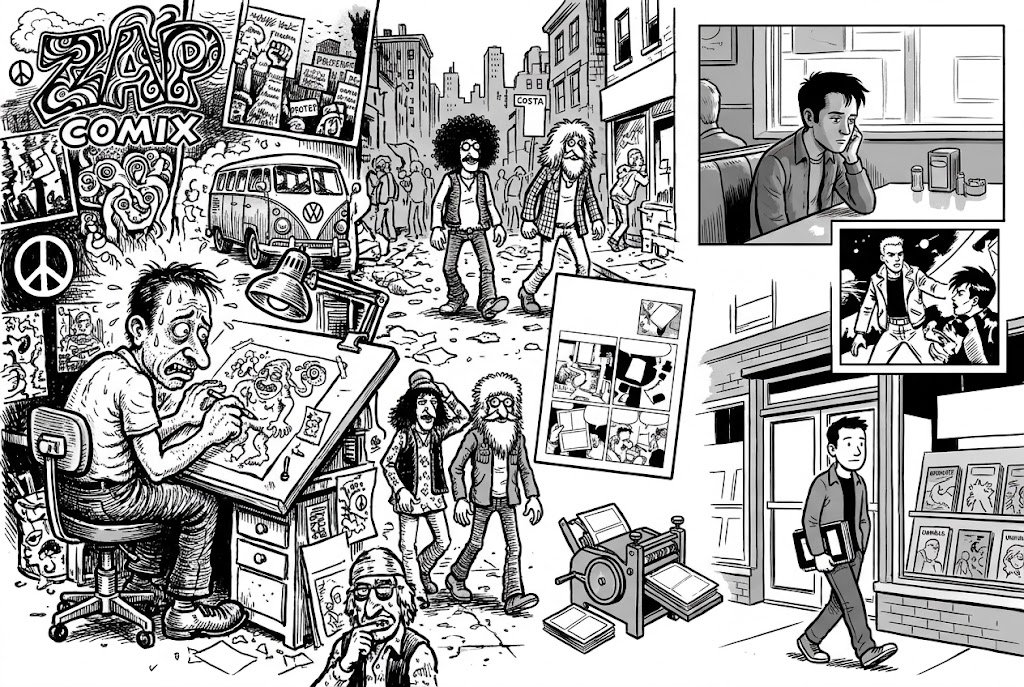
Underground comix were cheap, self-published comic books made by young artists in the late 1960s and early 1970s. They ignored the Comics Code, the industry’s self-censorship rulebook, and wrote openly about politics, drugs, sex, war, and everyday frustration. The movement took off in San Francisco with Robert Crumb’s Zap Comix #1 in February 1968, peaked around 1972, and faded by the mid-1970s.
It didn’t really die, though. The artists, small publishers, and do-it-yourself habits it created fed straight into the alternative comics of the 1980s, including RAW, Weirdo, Love and Rockets, and Art Spiegelman’s Maus. Today’s graphic novel shelf at your local library owes a lot to a handful of rough black-and-white pamphlets sold in head shops.
Here’s how that happened, step by step, and why the “x” in comix still matters.
What Came Before Zap: Why Comix Needed to Exist
To understand comix, you have to start with what mainstream comics had become by the late 1950s.
The Comics Code Shut the Door
In 1954, psychiatrist Fredric Wertham’s book Seduction of the Innocent argued that crime and horror comics harmed kids. A US Senate subcommittee held hearings on juvenile delinquency that same year, and publishers rushed to regulate themselves before the government did it for them. The result was the Comics Code Authority.
The Code banned graphic violence, sympathetic criminals, disrespect toward authority, and anything close to sexual content. Most newsstands wouldn’t carry a comic without its stamp. For about a decade, American comic books were mostly safe superheroes, funny animals, and teen romance.
Mad Magazine Showed Another Way
One publication slipped around the rules. Harvey Kurtzman’s Mad switched from comic book to magazine format in 1955, which put it outside the Code’s reach. Its parodies of ads, movies, and other comics taught a generation of kids that cartoons could mock the adult world.
Kurtzman’s later humor magazine Help! went further. It printed early work from young cartoonists, including Robert Crumb and Gilbert Shelton.
The First Underground Comics
Before 1968, underground comics appeared in scattered places: college humor magazines, the alternative weekly press, and tiny self-funded print runs. A few early examples:
- Gilbert Shelton’s Wonder Wart-Hog, a superhero parody, first appeared in a Texas college magazine in the early 1960s.
- Frank Stack’s The Adventures of Jesus (early 1960s) is often credited as one of the very first underground comics.
- Jack Jackson’s God Nose (1964) was a self-published comic book from Austin, Texas.
- Underground newspapers such as the East Village Other and the Los Angeles Free Press ran comic strips that no mainstream paper would touch.
These were sparks rather than a scene. What they lacked was a central place, a regular outlet, and a hit.
Zap Comix #1 and the San Francisco Explosion (1968)
The hit came from Robert Crumb. He’d moved to San Francisco in 1967, just as the Haight-Ashbury counterculture was at its loudest.
Crumb drew an entire comic book by himself. A small outfit called Apex Novelties printed it, and the original Zap series began when Zap Comix #1 went on sale in February 1968 with a 25-cent cover price. The outfit was run by poet Charles Plymell and Don Donahue.
The distribution story is part of the legend. With no newsstand willing to carry an un-Coded comic, the first copies were sold by hand on Haight Street. That scrappy start mattered less than what came next: people bought it, passed it around, and wanted more.
Why Zap Worked
- It looked like a regular comic book. It had the same size and format as the kids’ comics people grew up with, which made its adult content feel even more subversive.
- It was funny. Crumb’s characters, like the fake guru Mr. Natural, poked fun at hippies as much as at the straight world.
- The artists kept control. There was no editor and no Code, and creators owned their work.
Zap Becomes a Collective
By Zap #2, Crumb had opened the book to other artists: S. Clay Wilson, Victor Moscoso, and Rick Griffin. Spain Rodriguez, Gilbert Shelton, and Robert Williams joined soon after.
Moscoso and Griffin were already famous for psychedelic rock posters. That turned Zap into a meeting point between comics and San Francisco’s poster art scene.
The mix set the template for what followed: a loose group of artists, a small publisher, and a book that changed format, tone, and contributors whenever it felt like it.
How Underground Comix Spread: Head Shops, Publishers, and Key Titles
Between 1968 and about 1973, hundreds of underground titles appeared. They spread through a distribution network that had nothing to do with the comics industry.
Head Shops Replaced Newsstands
Comix were sold mainly in head shops, record stores, and alternative bookstores, the same places that sold rolling papers, posters, and incense. Shops bought copies outright, and popular issues were reprinted again and again.
That’s why early Zap issues exist in many printings with different cover prices. Collectors still use that detail to tell a first printing from a later one.
The underground press helped too. Papers like the East Village Other reprinted strips and even launched comix supplements, which pushed artists’ names far beyond San Francisco.
The Publishers That Made It a Business
| Publisher | Base | Started | Known For |
|---|---|---|---|
| Print Mint | Berkeley, CA | Late 1960s (as a poster shop) | Took over Zap from issue #2 |
| Rip Off Press | San Francisco, CA | 1969 | The Fabulous Furry Freak Brothers |
| Kitchen Sink Press | Wisconsin | 1969 | Midwest comix, later mainstream reprints |
| Last Gasp | San Francisco, CA | 1970 | Long-running comix and counterculture books |
These weren’t big companies. They were small, artist-friendly operations, and several were founded or run by cartoonists themselves. Their biggest innovation was simple: artists kept the rights to their own characters, something almost unheard of at Marvel or DC back then.
Artists and Titles Worth Knowing
- Robert Crumb: Zap, Mr. Natural, Fritz the Cat, and the “Keep On Truckin’” image that ended up on T-shirts everywhere.
- Gilbert Shelton: The Fabulous Furry Freak Brothers, probably the best-selling underground title of the era.
- Spain Rodriguez: Trashman, a hard-edged political action strip.
- S. Clay Wilson: the most deliberately shocking artist in the Zap group.
- Justin Green: Binky Brown Meets the Holy Virgin Mary (1972), an early autobiographical comic about religious guilt and compulsive behavior. Art Spiegelman has called it a major influence on Maus.
- Harvey Pekar: American Splendor (from 1976), true stories of a Cleveland file clerk’s daily life, drawn by Crumb and others.
That last pair matters for the bigger history. Underground comix weren’t only about shock. They also invented the serious autobiographical comic, which later became a pillar of alternative comics and the graphic memoir.
Women Push Back: The Rise of Women’s Comix
The early underground was mostly a boys’ club, and plenty of its work treated women as props. Women cartoonists responded by building their own outlets instead of waiting to be invited in.
- It Ain’t Me, Babe (1970), organized by Trina Robbins, is generally described as the first comic book produced entirely by women.
- Wimmen’s Comix (1972) became the longest-running anthology of the movement. It was published until the early 1990s with a rotating group of contributors.
- Joyce Farmer and Lyn Chevely launched their own title in 1972. It tackled sexuality and reproductive health from women’s point of view, at a time when abortion was still illegal in most US states.
- Aline Kominsky (later Kominsky-Crumb) drew blunt, self-mocking autobiographical strips that fed into the later Twisted Sisters collections.
This branch of comix pushed the form toward honesty about women’s lives, bodies, and anger. It’s also a direct ancestor of the many women-led graphic memoirs published since 2000.
Courtrooms and Collapse: Why the Comix Boom Ended
The movement’s peak years in America ran roughly from 1968 to 1975, so the boom lasted only about six or seven years. Several pressures hit at once.
Obscenity Cases
Zap #4 (1969) led to obscenity prosecutions of booksellers in New York who stocked it. Stores in other cities faced similar raids. Even when cases dragged on or stalled, the risk made some retailers stop carrying comix entirely.
Then, in 1973, the US Supreme Court decided Miller v. California. The ruling let local “community standards” define obscenity. For a small publisher selling across the country, one comic could be legal in San Francisco and a criminal problem in a small town elsewhere.
Copyright Trouble
Comix artists also tested the limits of parody. The Air Pirates, a group led by Dan O’Neill, published comics in 1971 that put Disney’s characters in adult underground stories.
Disney sued, and the courts largely sided with Disney in a case that dragged on through the 1970s. It’s still cited in discussions of how far parody can borrow from famous characters.
The Head Shops Disappeared
The bigger blow was economic. In the mid-1970s, many US states and cities passed drug paraphernalia laws aimed at head shops. As those stores closed, comix lost their main sales channel almost overnight.
At the same time:
- The market was flooded. Too many weak titles chased the success of Zap and Freak Brothers, and shop owners got burned on unsold stock.
- The counterculture cooled. With the Vietnam War winding down, the energy that fueled the movement faded.
- Costs rose. Paper and printing got more expensive during the 1970s recession, squeezing tiny publishers.
By around 1975, most commentators agree the classic underground era was over. Crumb and others kept drawing, but the boom was gone.
From Comix to Alternative Comics (Mid-1970s to 1980s)
The underground didn’t vanish so much as change shape. Its artists, ideas, and business habits moved into what became known as alternative comics.
Arcade: The Bridge
In 1975, Art Spiegelman and Bill Griffith launched Arcade: The Comics Revue. It ran only seven issues, but it signaled a shift. The focus moved from shock value toward craft, experimentation, and comics as an art form that could sit beside literature.
RAW and Weirdo: Two Directions
Around 1980, two very different magazines picked up where the underground left off:
- RAW was edited by Spiegelman and Françoise Mouly. It was an oversized, design-heavy anthology that mixed American and European avant-garde cartoonists. It serialized chapters of Maus, Spiegelman’s account of his father’s Holocaust experience, and the collected Maus received a special Pulitzer Prize in 1992.
- Weirdo was started by Crumb in 1981. It stayed closer to the rough, personal, funny spirit of the original underground and gave early space to cartoonists such as Peter Bagge.
The Direct Market Changed Distribution
The other key change was the direct market. Comic book specialty shops bought stock directly from distributors on a non-returnable basis, instead of comics relying on newsstands. Because these shops weren’t bound by the Comics Code, independent publishers could reach readers without head shops.
That opened the door for creator-owned titles like Dave Sim’s Cerebus (1977) and the Hernandez brothers’ Love and Rockets, published by Fantagraphics from the early 1980s. Neither is “underground” in the 1968 sense. Both run on the same principle the comix generation fought for: the artist owns the work and decides what it says.
Comix vs Alternative Comics: What Changed
| Underground Comix (c. 1968–1975) | Alternative Comics (c. 1980s Onward) | |
|---|---|---|
| Main outlet | Head shops, underground press | Comic shops (direct market), later bookstores |
| Typical tone | Satire, provocation, counterculture | Personal, literary, experimental |
| Format | Cheap black-and-white pamphlets | Pamphlets, anthologies, graphic novels |
| Ownership | Creator-owned, small presses | Creator-owned, independent publishers |
| Example | Zap Comix | Love and Rockets, Maus |
Underground Comix Timeline at a Glance
| Year | Milestone |
|---|---|
| 1954 | Senate hearings on comics; the Comics Code Authority is created |
| 1955 | Mad becomes a magazine and escapes the Code |
| Early 1960s | College and self-published comics by Shelton, Stack, and Jackson appear |
| 1968 | Zap Comix #1 published in San Francisco (February) |
| 1969 | Rip Off Press and Kitchen Sink Press founded; Zap #4 sparks obscenity cases |
| 1970 | Last Gasp founded; It Ain’t Me, Babe published |
| 1972 | Wimmen’s Comix and Binky Brown Meets the Holy Virgin Mary published |
| 1973 | Miller v. California reshapes US obscenity law |
| Mid-1970s | Paraphernalia laws close head shops; the boom ends |
| 1975 | Arcade launches |
| 1980–1981 | RAW and Weirdo launch |
| 1992 | Maus receives a special Pulitzer Prize |
The Legacy of Comix Today
Most of what readers now take for granted in comics traces back to this short period:
- Creator ownership. Artists keeping their own characters is now standard at independent publishers.
- Autobiography and memoir. From Binky Brown to American Splendor to Maus, the underground proved comics could tell true, personal stories.
- Comics for adults. Today’s graphic novel sections in bookstores and libraries exist partly because comix broke the idea that comics were only for kids.
- DIY publishing. The zine, minicomic, and webcomic scenes share the same do-it-yourself instinct.
The Comics Code itself faded as publishers stopped submitting to it, and it was abandoned entirely by 2011. In a way, the underground won the argument, just decades later.
If you want to read the originals, start with reprint collections rather than vintage issues. Many classic comix contain explicit content and harsh period attitudes. Check a collection’s age rating and introduction before buying one for a younger reader.
Final Thoughts
Underground comix were short-lived, messy, and often offensive, but they changed comics permanently. A few years of head-shop pamphlets created creator ownership, the autobiographical comic, and the idea that comics could say anything. The path runs from Zap in 1968 through Arcade, RAW, and Weirdo to today’s graphic novels.
If this history caught your interest, a good next step is a well-researched book on the era, such as Patrick Rosenkranz’s Rebel Visions or Brian Doherty’s Dirty Pictures. After that, try a modern reprint of Zap or Wimmen’s Comix.
FAQ
Why Is It Spelled “Comix” Instead of “Comics”?
The “x” was a deliberate signal that these books were different from mainstream comics. It marked them as adult, uncensored, and outside the Comics Code. Some also read it as a nod to “x-rated” content, though not every title was explicit.
What Was the First Underground Comic?
There’s no single agreed answer. Frank Stack’s The Adventures of Jesus and Jack Jackson’s God Nose are often named as early examples. Zap Comix #1 (1968) is widely seen as the comic that started the movement as a scene.
Who Were the Most Important Underground Comix Artists?
Robert Crumb, Gilbert Shelton, Spain Rodriguez, S. Clay Wilson, Victor Moscoso, Rick Griffin, Trina Robbins, Justin Green, and Aline Kominsky are among the names most often cited.
Are Underground Comix Still Published?
The original movement ended in the mid-1970s, but some publishers from that era, such as Last Gasp, still operate. Its spirit continues in independent comics, zines, and webcomics.


