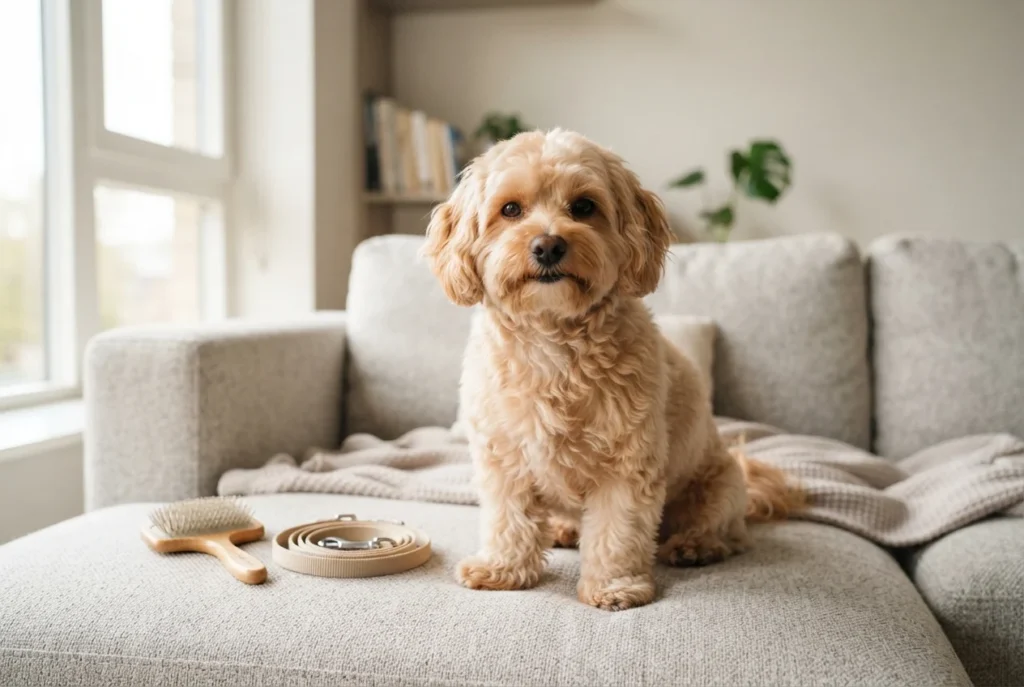
A Maltipoo is a cross between a Maltese and a Toy or Miniature Poodle. Most adults weigh somewhere between 2 and 9 kg, live for 10 to 16 years and want to be wherever their people are. They suit flats and first-time owners well, but they need brushing almost every day, a professional groom every few weeks and company for most of the day.
That’s the short version. This guide covers what decides adult size, what their temperament is really like, how much grooming and health care they need, what one costs in Germany in 2026, and how to buy a puppy without ending up supporting the illegal puppy trade.
What Exactly Is a Maltipoo?
It’s a designer crossbreed, not a pure breed. It first appeared in the United States in the 1990s, and most major kennel clubs don’t recognise it, so there is no official breed standard.
That last point matters more than it sounds. Without a standard, size, coat type and even personality vary a lot from litter to litter. You’re relying on the breeder’s honesty and on the parents in front of you, not on a breed description.
F1, F1b and Multigen: Why the Generation Matters
Breeders often label puppies by generation. Generation affects coat type, curl and how predictable shedding and adult size turn out to be.
| Generation | Parents | What to expect |
|---|---|---|
| F1 | Maltese × Poodle | The most variety, even within one litter. Coats range from silky to wavy. |
| F1b | Maltipoo × Poodle | More Poodle influence. Coats are often curlier and lower-shedding. |
| Multigen | Maltipoo × Maltipoo | Results depend heavily on the breeder’s choice of parents. |
None of these labels guarantees a particular coat. Ask to see the parents and, if possible, adult dogs from earlier litters.
Maltipoo Size: How Big Do They Get?
The Poodle parent mostly decides adult size. Sources differ slightly, but most of these dogs stand about 20 to 35 cm tall and weigh roughly 2 to 9 kg.
| Type | Typical Poodle parent | Approximate adult weight |
|---|---|---|
| Toy Maltipoo | Toy Poodle | about 2.3–4.5 kg |
| Miniature Maltipoo | Miniature Poodle | up to about 9 kg |
| “Teacup” | Bred from the smallest dogs | under toy size (see below) |
When Is a Maltipoo Ausgewachsen (Fully Grown)?
Like most small dogs, it usually reaches its adult height in its first year and may fill out a little after that. The most useful thing you can do before buying is ask for the weights of both parents. Your puppy will most likely land somewhere between them.
If a breeder can’t or won’t tell you how big the parents are, treat that as a warning sign.
A Word on “Teacup” Maltipoos
Some sellers market extra-small “teacup” puppies at premium prices. Vets and insurers have raised ethical concerns about them, because breeding the smallest dogs together tends to bring more health problems. A toy-sized dog of this cross is already very small. There’s no good reason to pay extra for smaller.
Temperament: What Living With One Is Like
These little dogs are affectionate and people-focused. Many owners describe them as a shadow that follows them from room to room. They get the Poodle’s intelligence, so they usually pick up training quickly when it’s kept short and positive.
There are two traits buyers often underestimate:
- Barking. Young Maltipoos in particular can be excitable and vocal. They aren’t guard dogs, but they will tell you about the postman, the neighbour and the wind.
- Being left alone. This is the big one. They want company, and long days alone can lead to separation anxiety. A household where everyone is out for nine hours a day, five days a week, is not a good match unless the dog can come to work or go to a dog-sitter.
Maltipoos With Children and Other Pets
They’re generally friendly with children and other animals, but their size is a real issue. A toy-sized dog can be hurt if a toddler drops it or steps on it, so families with older, calmer children tend to do best. Early socialisation helps: get your puppy used to visitors, household noises like the vacuum cleaner, and bigger dogs, so a small dog doesn’t grow into a nervous one.
Exercise Needs and What German Law Actually Requires
This cross doesn’t need hours of running. A few daily walks, some play and short training games usually keep one happy. Mental work matters as much as physical exercise, so sniffing games and simple tricks are time well spent.
You may have read that German law requires every dog to be walked twice a day for a full hour. That’s not quite right. Since the amendment that took effect on 1 January 2022, the Tierschutz-Hundeverordnung requires “sufficient” outdoor exercise outside a kennel and contact with a carer several times a day, adjusted to the dog’s breed, age and health. The fixed one-hour rule was in the draft but didn’t make it into the final text. Vets still treat one hour a day as a sensible minimum.
Grooming: The Real Time Commitment
Maltipoos are low-shedding, which is why they’re popular with allergy sufferers. Whether they’re truly hypoallergenic is still debated, and no dog is completely allergen-free. If someone in your home has allergies, spend real time around the breed before you commit.
A low-shedding coat needs more care, not less. Here’s a realistic routine:
- Brushing: most days. Curly and wavy coats mat quickly, especially behind the ears and under the legs.
- Professional groom: every 4 to 6 weeks for a trim.
- Bathing: about once a month is usually enough.
- Ears: check weekly. Hair grows inside the ear canal, which can trap moisture and lead to infections.
- Eyes: keep the hair around the eyes trimmed. Light-coloured dogs often get reddish tear stains, so wipe gently around the eyes.
- Teeth: brush regularly. Small mouths with crowded teeth make dental disease common.
- Nails: trim once or twice a month.
Start handling your puppy’s paws, ears and mouth from day one. A dog that accepts brushing calmly makes the whole routine far easier.
Maltipoo Health and Lifespan
Published lifespan figures range from about 10 to 16 years, and many reach their teens with good care. A puppy can inherit problems from either parent breed. These are the ones most often mentioned:
| Condition | What it affects |
|---|---|
| Patellar luxation | Kneecaps that slip out of place |
| Dental disease | Gums and teeth, from crowded small mouths |
| Progressive retinal atrophy (PRA) | Gradual loss of vision |
| White shaker syndrome | Tremors, seen more in small white dogs |
| Epilepsy | Seizures |
| Portosystemic (liver) shunt | Blood bypassing the liver |
| Legg-Calvé-Perthes disease | The hip joint |
| Ear infections | Ear canals, often linked to ear hair |
Before buying, ask which health checks both parents have had, such as knee and eye examinations. Your vet can tell you which tests matter for the two parent breeds. If your dog ever shows tremors, limping or changes in vision, get it checked rather than waiting.
What a Maltipoo Costs in Germany (2026)
Puppy Price
German price guides currently put Maltipoo Welpen from reputable breeders at roughly €1,500 to €3,500. Rarer colours such as apricot, red or phantom often sit at the top of that range.
Don’t treat a high price as proof of quality, though. The pet registry TASSO points out that a low price used to signal a dodgy seller, but illegal traders now often charge breeder-level prices too.
Ongoing Costs
| Cost | What to know |
|---|---|
| Hundesteuer (dog tax) | Set by each municipality. In 2026, Berlin charges €120 a year for a first dog and Munich €100, rising to €144 in 2027. Across 200 cities surveyed by the Bund der Steuerzahler, the average for one dog in 2026 is €110. |
| Dog liability insurance | Required for every dog in Berlin, Bremen, Hamburg, Niedersachsen, Sachsen-Anhalt, Schleswig-Holstein and Thüringen. Elsewhere it’s optional but strongly advisable, because owners are liable for damage their dog causes. |
| Grooming | A professional groom every 4 to 6 weeks. Prices vary by city and coat condition, so ask local salons. |
| Food, vet care, insurance | Small dogs eat little, but vaccinations, dental care and possible surgery add up. Many owners consider surgery insurance (OP-Versicherung). |
One tip people often miss: several German cities give tax breaks for dogs adopted from a shelter. Berlin exempts them for five years, and Munich and Cologne for two. Check your own town’s Hundesteuersatzung.
Buying a Maltipoo in Germany Without Getting Scammed
Fashionable crossbreeds are a favourite of illegal puppy traders. Before you search “Maltipoo kaufen” on a classifieds site, keep this checklist handy:
- Meet the puppy with its mother at the breeder’s home. Watch how she behaves with the litter. If she seems uninterested in the puppies, they may not be hers.
- Check the age. Puppies should be at least eight weeks old at handover, and ten is better.
- For imported puppies, check for the 15-week rule. Puppies can’t be vaccinated against rabies before 12 weeks, and protection takes 21 days to build up. An imported puppy younger than 15 weeks has been brought into Germany illegally.
- Check the paperwork. Imported puppies need an EU pet passport and a microchip. Puppies born in Germany should have a vaccination booklet filled in by a vet working in Germany. Foreign vet entries on a supposedly German puppy are worth questioning.
- Ask for permits. Since August 2014, anyone bringing dogs into Germany to sell them needs official permission. A legitimate importer can show it.
- Get a written contract with the seller’s full name and address.
- Never buy out of pity. Rescuing a sad-looking puppy from a car boot keeps the illegal trade going, and the vet bills often follow.
Adopting Instead
This cross and similar small doodles do turn up in German animal shelters (Tierheime) and breed-specific rescue groups. An adult dog’s size, coat and personality are already known, which takes much of the guesswork out of choosing a crossbreed.
New EU Rules Every Buyer Should Know
The EU’s first common rules on dog and cat welfare, Regulation (EU) 2026/1818, were published in the Official Journal on 10 August 2026. They’re being phased in. Breeders, sellers and shelters have four years from entry into force to microchip and register their animals, and private owners of dogs have ten.
For buyers, the useful part is traceability. Online adverts will have to include verifiable identification details, and close inbreeding is banned. You don’t need to wait for the deadlines, though. Ask any seller for the puppy’s microchip number now, and register your dog with a free pet registry such as TASSO as soon as it’s home.
Is a Maltipoo Right for You?
A good fit if you:
- are home a lot, work from home or can take the dog with you
- live in a flat or a smaller home
- enjoy daily grooming, or don’t mind paying for regular professional grooms
- want a dog that’s easy to train and loves company
Think twice if you:
- are out of the house for long stretches every day
- have very young children who might handle a tiny dog roughly
- want a quiet dog or a guard dog
- need a guaranteed allergy-safe dog
Final Thoughts
A Maltipoo makes a warm, clever companion for people who can give it time, company and consistent coat care. The biggest decisions happen before you bring one home. Pick a size that suits your household, meet the parents, check the paperwork, and walk away from any seller who rushes you. Get those right and you’ll have set up a happy dog for 10 to 16 years.
Frequently Asked Questions
Do Maltipoos shed?
Very little. Their Poodle genes usually give them a low-shedding coat, but shedding varies by generation, and no dog is completely hypoallergenic.
How long do Maltipoos live?
Most sources give a lifespan of roughly 10 to 16 years. Good dental care, a healthy weight and regular vet checks all help.
Is a Maltipoo good for first-time owners?
Often, yes. They’re small, eager to please and quick to learn. New owners should plan for the grooming routine and teach the puppy early on to cope with short periods alone.
How much does a puppy cost in Germany?
Puppies from reputable breeders typically cost around €1,500 to €3,500 in 2026. Add dog tax, liability insurance and grooming to your yearly budget.
Can a Maltipoo be left alone all day?
Not happily. They can learn to manage a few hours, but long daily absences often lead to separation anxiety and barking.