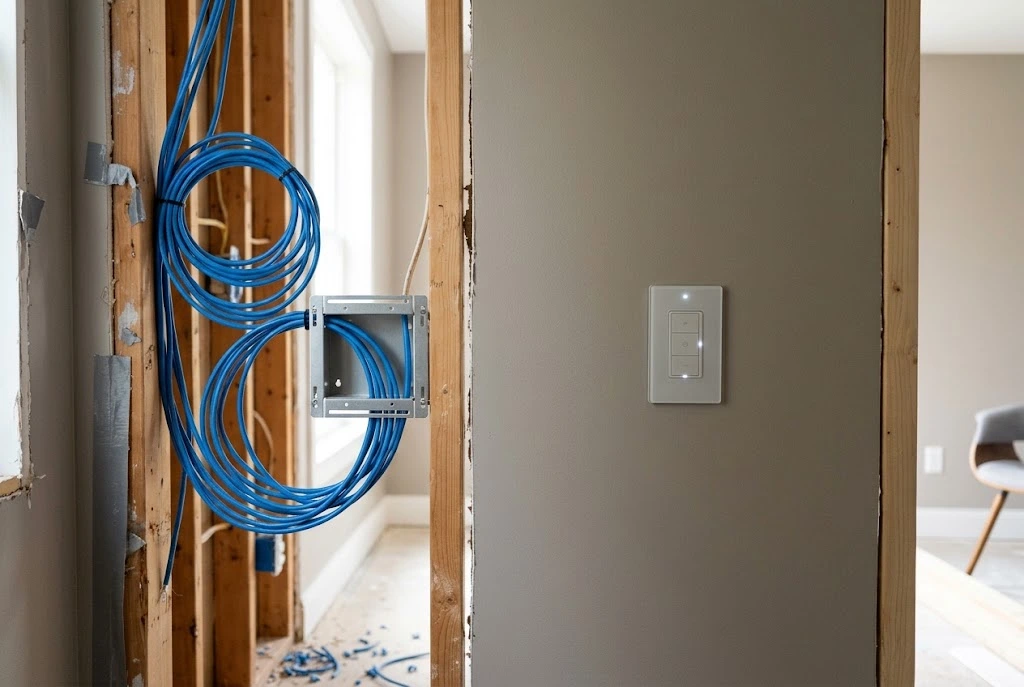
For an existing home, a smart home wiring renovation usually costs about $1 to $6 per square foot for low-voltage work alone. That covers network cabling, Wi-Fi access points, camera runs and a central wiring panel. If the renovation also replaces the home’s electrical wiring, the combined figure can reach $8 to $15 or more per square foot.
For a 2,000 sq ft house, that means roughly $2,000 to $12,000 for smart wiring on its own. The total rises a lot if walls are being opened for a full rewire anyway.
These are planning ranges, not quotes. Your actual smart home wiring renovation cost depends far more on how many cable runs you need and how hard it is to reach your walls than on floor area alone. The sections below explain why, and how to turn a per-square-foot number into a realistic budget.
Why Per-Square-Foot Pricing Only Tells Part of the Story
Contractors often quote electrical work by the square foot because it scales neatly with house size. Smart wiring doesn’t scale the same way.
A 1,800 sq ft ranch with an open attic and unfinished basement can be easier to wire than a 1,200 sq ft two-story home with plaster walls and no crawlspace. The bigger house has more floor area, but the smaller one takes more labor per cable.
What actually drives the bill:
- Number of drops: each cable run to a wall plate, ceiling access point or camera location.
- Wall access: open framing, attic, basement or finished drywall and plaster.
- System scope: networking only, or also audio, video, shades and security.
- Electrical panel capacity: whether the main panel can handle new circuits.
- Local labor rates: metro areas typically cost noticeably more than rural ones.
Treat per-square-foot figures as a sanity check on quotes, not as the quote itself.
Smart Home Wiring Renovation Cost by Project Scope
The table below groups common projects by scope. Figures are approximate US ranges compiled from published contractor pricing and should be confirmed locally.
| Project scope | What’s typically included | Approx. cost per sq ft | 2,000 sq ft home |
|---|---|---|---|
| Light retrofit | Smart switches, hub, 3–5 network drops | $0.50 – $1.50 | $1,000 – $3,000 |
| Network backbone | 10–15 Cat6 drops, ceiling access points, structured wiring panel | $1.50 – $4.00 | $3,000 – $8,000 |
| Full low-voltage retrofit | Backbone plus cameras, in-wall speakers, shade power, doorbell, sensors | $3.00 – $6.00+ | $6,000 – $12,000+ |
| Gut renovation with rewire | New electrical wiring plus full smart wiring while walls are open | $8.00 – $15.00+ | $16,000 – $30,000+ |
Equipment usually isn’t included in these ranges. Smart switches, cameras, speakers and access points are priced separately, and premium lighting control systems can cost more than the wiring itself.
What the “light retrofit” tier really means
Many people don’t need much new cable. Modern smart switches, thermostats and Zigbee or Z-Wave sensors work over existing wiring or wirelessly. Running a few Ethernet drops to the TV, home office and a central spot for the router covers most needs.
One thing to check before buying smart switches: many models need a neutral wire in the switch box. Older homes often don’t have one, which can add electrician time.
Where the network backbone pays off
If you renovate only one tier of wiring, this is usually it. Hardwired ceiling access points solve most Wi-Fi dead zones. A structured wiring panel gives every cable a single, labeled home.
Per-Drop Pricing: The Number Worth Asking For
Low-voltage contractors frequently price by the drop, and that’s the most useful figure for comparing bids. As a rough guide:
- Open walls (new construction or gut renovation): around $75 to $150 per Cat6 drop.
- Finished walls (retrofit): around $150 to $300 per drop, sometimes more for plaster, brick or multi-story runs.
A typical three-bedroom home needs 10 to 15 drops. In a finished home, that works out to roughly $1,500 to $4,500 for the cabling alone.
Quick example
Say you own a 2,200 sq ft two-story home and want:
- Two drops in the living room (TV and console)
- One drop in each of three bedrooms
- Two drops in the home office
- Two ceiling access points (one per floor)
- Four exterior camera runs
- A structured wiring panel in a utility closet
That’s 13 drops plus the panel. At retrofit pricing, expect roughly $2,300 to $4,700 for cabling, plus $300 to $800 for the panel. That’s about $1.20 to $2.50 per sq ft before any equipment, which fits the backbone tier above.
Retrofit vs. Open-Wall Renovation
Timing matters more than almost anything else. Once drywall is up, every cable has to be fished through finished cavities, around fire blocking and past insulation. That’s slow work, and it sometimes leaves small holes to patch and paint.
If you’re already remodeling a kitchen, finishing a basement or gutting a floor, add low-voltage cabling to that phase. The extra labor while the framing is exposed is small compared with coming back later.
A few practical tips during an open-wall renovation:
- Run more drops than you think you need. Cable is cheap, and labor to add it later is not.
- Add empty conduit or flexible tubing from main rooms to the attic or basement for future upgrades.
- Photograph every wall before it’s closed, with a tape measure in frame. This saves hours later.
- Label both ends of every cable before the drywall goes up.
Costs People Often Forget
Quotes that look cheap per square foot sometimes leave out items that show up later:
- Panel upgrades: an older 100-amp service may not support new circuits. Upgrades can add several thousand dollars.
- Drywall patching and painting: some low-voltage installers don’t do finish work.
- Permits and inspections: low-voltage cabling often doesn’t need a separate permit. Any new line-voltage circuits usually do, and rules vary by city.
- Network equipment: a structured panel without a decent router, switch and access points won’t improve much.
- Programming and setup: whole-home automation systems often bill configuration separately.
Wired vs. Wireless: Do You Need New Wiring at All?
Not always. Wireless smart home gear has improved a lot, and for renters or light upgrades it’s usually enough.
Wiring is worth the money when:
- You want reliable Wi-Fi throughout a larger or multi-story home.
- You’re installing several security cameras and don’t want to manage batteries.
- You work from home and need a stable wired connection.
- You plan to stay in the home for years and are renovating anyway.
For a small apartment or a home you may sell soon, a wireless-first setup with one or two Ethernet drops is often the better value.
Safety, Codes and Who Should Do the Work
Low-voltage cabling (Ethernet, coax, speaker wire) is often DIY-friendly in an open-wall renovation. Line-voltage work is different. New circuits, smart switch installs in older boxes and panel changes should be handled by a licensed electrician.
In the United States, residential electrical work generally follows the National Electrical Code (NFPA 70). The NEC has been adopted in all 50 states, though states and cities apply their own editions and amendments. You can review the code on the NFPA’s official NFPA 70 page. For your own project, your local building department is the final word.
Readers in Canada and Australia should check their own electrical codes and licensing rules. Both countries have stricter limits than many US states on what homeowners can legally do themselves.
How to Get an Accurate Quote
- Make a room-by-room list of every drop, camera and access point you want.
- Mark your access points: attic, basement, crawlspace, chases.
- Ask for itemized bids that separate labor, materials, panel work and patching.
- Compare per-drop prices, not just totals.
- Get two or three quotes from both electricians and low-voltage specialists. They price differently.
Final Takeaway
Per square foot, a smart home wiring renovation typically runs $1 to $6 for low-voltage work, and much more when paired with a full electrical rewire. The most useful step is to plan your drops room by room and ask for per-drop pricing. If walls are coming open for any reason, that’s the cheapest moment to wire for the future.
FAQ
How much does it cost to wire a 2,000 sq ft house for smart home use?
Roughly $2,000 to $12,000 for low-voltage smart wiring in an existing home, depending on scope. A gut renovation that includes new electrical wiring can exceed $16,000.
Is smart home wiring cheaper during a renovation?
Yes. Open walls can cut per-drop labor roughly in half compared with fishing cable through finished drywall.
Do I need a permit for smart home wiring?
Often not for low-voltage cabling alone, but usually yes for new electrical circuits or panel work. Check with your local building department.
Can I install smart switches without rewiring?
Usually, as long as the switch box has a neutral wire or you choose a no-neutral model. Older homes may need an electrician to check first.