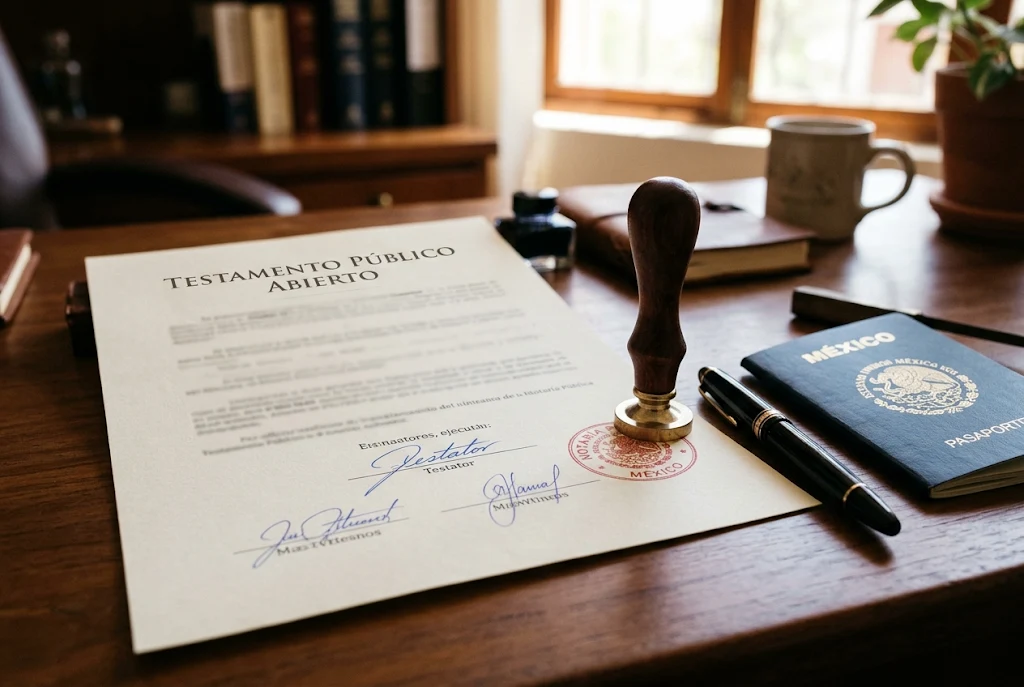
If you own a flat in Cancún, a house in Guadalajara or a bank account in Mexico City, the safest way to decide who gets it is a testamento público abierto (open public will) signed before a Mexican notary. You book an appointment, bring a valid passport and your heirs’ details, tell the notary your wishes, and sign the deed the same day or within a few days. In 2026 the discounted September price ranged from about 1,500 to 4,100 Mexican pesos depending on the state. Outside that month, fees are usually higher and set by each notary.
The process is the same whether you use Notaría Pública 51 in Mexico City, Guadalajara or Puebla, or any other licensed office. What changes from state to state is the price and a few local rules. This guide covers both, with notes for readers living in Russia or elsewhere abroad.
What an Open Public Will Is (and Why Notaries Recommend It)
Mexican civil codes recognise several kinds of will. These include the open public will, the closed public will, the simplified public will, the holographic (handwritten) will and a will made in a foreign country.
The open public will is the one most people choose. You state your wishes out loud, the notary drafts them into a formal deed, reads it back to you, and you sign. The original stays in the notary’s protocol (their official register), so it can’t be lost in a drawer or quietly destroyed by a relative.
Three practical advantages make it the default choice:
- Legal review on the spot. The notary checks that your instructions are actually enforceable before you sign.
- Safe storage. The deed is kept in the notary’s records, and you get a certified copy.
- National registration. The notary reports the will to the national will registry, so it can be found after your death.
Open public will vs. the other options
| Will type | How it’s made | Main drawback |
|---|---|---|
| Open public will | Dictated to a notary and recorded in their protocol | Costs a notary fee |
| Closed public will | You write it, then seal it in front of a notary and witnesses | No legal review of the content, so errors can slip through |
| Simplified public will | Made before a notary, usually alongside a property deed | Only covers one property, and only in some situations |
| Holographic will | Handwritten by you and filed with the state archive | Strict formal rules, and it isn’t available in every state |
| Will made abroad | Made under another country’s law | Heirs face translation, apostille and recognition steps |
For most people, especially foreigners, the small extra cost of an open public will buys certainty. A handwritten will with one missing formality can be challenged. A notarised deed is much harder to dispute.
Who Can Make a Will in Mexico
You don’t need to be a Mexican citizen or resident. Foreigners regularly make Mexican wills for property they own in the country.
The basic conditions are:
- You’re at least 16 years old. Mexican civil law sets 16 as the minimum age to make a will.
- You’re of sound mind when you sign. The notary has to be satisfied of this.
- You act freely, without pressure from anyone.
If you don’t speak Spanish, Mexican civil codes require an interpreter. In some states you can write your will in your own language and have the interpreter translate it into Spanish for the deed. Ask the notary in advance whether they’ll arrange an interpreter or expect you to bring one, and who pays for it.
Documents You’ll Need
Notaries generally ask for a short list. Bring originals and a copy of each:
| Document | Mexican residents | Foreigners (e.g. from Russia) |
|---|---|---|
| Official photo ID | INE voter card or passport | Valid passport |
| CURP (population registry code) | Usually requested | Only if you have one |
| Proof of address | Recent utility bill | Address abroad or in Mexico |
| Heirs’ full names | Required | Required, spelled exactly as in their passports |
| Executor (albacea) details | Full name | Full name |
| Guardian for minor children | If applicable | If applicable |
| Property details | Deed or account numbers help | Deed, fideicomiso (bank trust) or account details help |
Legally, you don’t have to list every asset. You can leave “all my property” to one heir. But naming specific property, such as a Playa del Carmen condo or a particular bank account, makes things far easier for your family later.
Witnesses: an open public will before a notary normally doesn’t need them. Some state codes still require witnesses in special cases, for example if the testator is blind, can’t sign or can’t read. The notary will tell you if your case needs them.
Choosing an Office: Notaría Pública 51 or Another Notary
Notaries in Mexico are numbered within each state, so several offices share the same number. Mexico City, Guadalajara, Puebla and the State of Mexico each have their own Notaría Pública 51, and they’re separate offices with different notaries.
Before you book, confirm three things through the state’s notary college or official directory:
- The current titular notary’s name (holders change when notaries retire)
- The exact address and opening hours
- Whether the office takes appointments in English, or can arrange an interpreter
You don’t have to use a notary in the state where your property is. Any licensed Mexican notary can prepare your will, though a local one is often more convenient when the time comes to settle the estate.
Step-by-Step: Making Your Will at a Notary’s Office
1. Book an appointment
Call or email the office you’ve chosen. During September, slots fill quickly because of the discount campaign, so book a week or two ahead. Some offices also open on Saturdays that month.
2. Have a free first consultation
Most notaries explain the options and the price before you commit. Use this meeting to ask:
- What the total fee is, with taxes included
- Whether an interpreter is needed and who pays for them
- How long until the signed deed and certified copy are ready
3. Decide your instructions in advance
Arrive with clear answers to these questions:
- Who inherits? Name your heirs and say whether they share equally or in set percentages.
- Any specific gifts (legados)? For example, a car to a nephew or a painting to a friend.
- Who is the executor? This person handles the estate. Name a substitute too.
- Who is the guardian of minor children? Only if this applies to you.
4. Review the draft
The notary prepares the deed, sometimes during the same visit. Check every name letter by letter, especially transliterated Russian names. “Aleksandr” and “Alexander” can turn into a paperwork headache years later.
5. Sign
The notary reads the will aloud. You confirm it reflects your wishes and sign, and the notary signs and seals it. If an interpreter or witnesses take part, they sign too.
6. Get your certified copy
You receive a certified copy (testimonio). Keep it somewhere your executor can find it, and tell at least one trusted person which notary holds the original.
How Much a Will Costs in Mexico
There’s no single national price. During the national “Septiembre, Mes del Testamento” campaign, notaries in all 32 states offer reduced fees, free advice and extended hours. Reported September 2026 prices included:
| State | Campaign price (MXN, Sept 2026) |
|---|---|
| Mexico City | 3,800 |
| State of Mexico | 1,500 |
| Puebla | 1,800 |
| Jalisco | 2,300 |
| Nuevo León | 2,500 |
| Nayarit | 4,100 |
A few things to know about these numbers:
- Outside the campaign, fees are higher. In Jalisco, for example, the off-season price was reported at over 18,000 pesos.
- Some states extend the discount. Jalisco ran it until 10 October in 2026, and Campeche until December.
- The campaign price usually covers a standard will. Complex estates, interpreters or extra copies can cost more.
The official Segob campaign site publishes each state’s tariff, and it’s worth checking before you book. Prices are updated every year.
Making a will from abroad
If you live outside Mexico, you can also make an open public will at a Mexican consulate, where the consul acts as a notary. This only works for assets located in Mexico. Consulate fees are set in US dollars. One US consulate, for example, lists 451 USD for foreigners and 225.50 USD for Mexican citizens.
For readers in Russia, contact the Mexican Embassy in Moscow directly. Consular services and appointment availability vary, so confirm before you plan around it.
Common Mistakes That Cause Problems Later
These are the issues that most often turn a simple inheritance into a long process:
- Relying on a will from your home country. Mexican law can recognise foreign wills, but heirs usually face translation, apostille and court steps first. A separate Mexican will for Mexican assets is typically much simpler.
- Forgetting the fideicomiso. Many foreigners hold coastal property through a bank trust. That trust may have its own beneficiary designation, so make sure it matches your will.
- Misspelled names. Heirs must prove they’re the person named in the will, so a mismatch with their passport causes delays.
- Naming no substitute executor. If your only executor dies before you, or declines the role, the process slows down.
- Never updating the will. Only your most recent will counts. After a marriage, divorce, birth or property sale, make a new one.
What Happens After You Sign
The notary sends a notice of your will to the state archive. From there it reaches the national will registry (RENAT), which holds records of wills made in Mexico since 1995.
When you die, your family doesn’t search the registry themselves. Only a judge or a notary can consult RENAT. They request a search, find your latest will, and the inheritance process (sucesión testamentaria) begins. This can often be handled at a notary’s office instead of in court, as long as the heirs agree.
Final Thoughts
Making a will in Mexico takes one or two short visits and a few thousand pesos, especially if you wait for September. Bring your passport and your heirs’ exact names, choose an executor and a substitute, and ask about an interpreter if you need one. Whether you visit Notaría Pública 51 or another licensed office, the steps are the same.
Inheritance law varies by state, and your situation may involve tax or property rules in both Mexico and Russia. A short consultation with the notary, and if needed a lawyer familiar with both countries, is money well spent.
For current state prices, see the official Segob will campaign portal. If you’re abroad, check the Mexican consular will requirements.
FAQ
Can a foreigner make a will in Mexico?
Yes. You don’t need residency or citizenship. A valid passport is usually enough ID, and an interpreter is required if you don’t speak Spanish.
Do I need witnesses for a will before a notary?
Usually not. Witnesses are only required in special cases set by state law, such as when the testator can’t read or sign. The notary will tell you if your case needs them.
Is a will from Russia valid in Mexico?
It can be recognised, but your heirs may need translations, an apostille and extra legal steps first. A Mexican will covering your Mexican assets is usually the faster route.
How long does it take?
The signing itself often takes under an hour. The certified copy may take a few days, depending on the notary’s workload.
Can I change my will later?
Yes. You can make a new will at any time, and only the most recent one is valid.