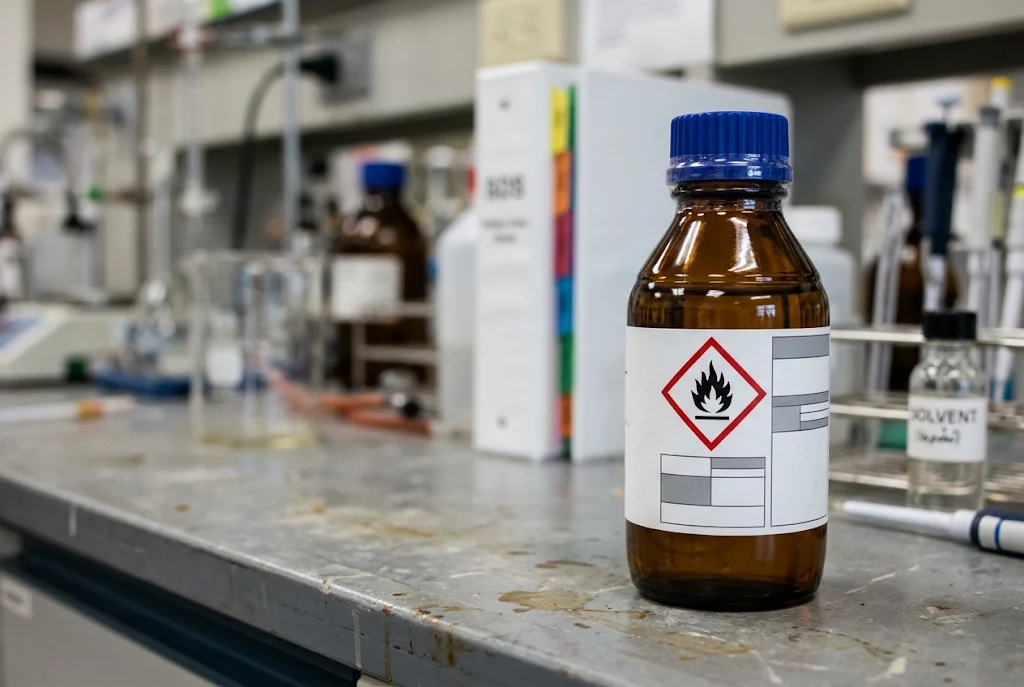
Under OSHA’s Hazard Communication Standard (HazCom), a label on a shipped container of a hazardous chemical has to show six things:
- A product identifier
- A signal word
- Hazard statements
- Pictograms
- Precautionary statements
- The name, address and phone number of the manufacturer, importer or other responsible party
That’s the short answer. The requirement comes from OSHA’s Hazard Communication Standard, 29 CFR 1910.1200, paragraph (f).
People often call these “SDS labels” because the label and the safety data sheet come from the same hazard classification. The label is the quick warning on the drum or bottle, and the SDS is the 16-section document that explains everything in detail. If the two say different things, something has gone wrong.
This guide covers what each element on SDS labels means, what a correct one looks like, the mistakes inspectors and safety teams see most often, and what changed with OSHA’s 2024 update.
The 6 Elements of SDS Labels at a Glance
| # | Element | What it tells the reader | Example |
|---|---|---|---|
| 1 | Product identifier | Which chemical this is, and which SDS matches it | “Acetone” or “Shop Degreaser 40” |
| 2 | Signal word | How severe the hazard is | “Danger” or “Warning” |
| 3 | Hazard statements | What the hazard is and how serious | “Highly flammable liquid and vapor” |
| 4 | Pictograms | The hazard type, at a glance | Flame inside a red diamond |
| 5 | Precautionary statements | How to prevent harm and respond to exposure | “Keep away from heat, sparks, open flames and hot surfaces. No smoking.” |
| 6 | Supplier details | Who is responsible and how to reach them | Company name, street address, phone |
Each element is explained below.
1. Product Identifier
The product identifier is the name or number that links the container to its safety data sheet. It can be a chemical name, a trade name, a code or a batch number. The rule is simple: whatever appears on the label must also appear on the SDS, and ideally on your chemical inventory list as well.
This sounds obvious, but it’s where many problems with SDS labels start. Picture a cleaner sold as “Blue Max” on the bottle while the SDS binder only lists “Glass Cleaner Concentrate.” During a splash incident, nobody wants to be flipping through pages trying to work out which sheet goes with which bottle.
Practical tip: When a new product arrives, check that the label name matches Section 1 of the SDS before the product goes on the shelf.
2. Signal Word
There are only two signal words:
- Danger for the more severe hazards
- Warning for the less severe ones
SDS labels carry just one signal word, even when the chemical has several hazards. If any of its hazards calls for “Danger,” then “Danger” is the word used.
Some low-severity hazard categories don’t require a signal word at all. So a label without one isn’t automatically wrong. Check Section 2 of the SDS to see whether a signal word applies.
3. Hazard Statements
Hazard statements describe what the chemical can do and how serious that is. Their wording isn’t freestyle. Each statement is set by the chemical’s hazard class and category, using the standard phrases in Appendix C of the HazCom standard.
For example, an acetone label usually includes statements such as:
- “Highly flammable liquid and vapor”
- “Causes serious eye irritation”
- “May cause drowsiness or dizziness”
Every hazard statement that applies must appear on the label. Duplicate statements can be removed, but a statement can’t be dropped just because space is tight.
You’ll often see codes such as H225 next to the text. Those are GHS hazard codes. US SDS labels don’t have to include them, but you’re free to add them, and many international suppliers do.
4. Pictograms
A pictogram is a black symbol on a white background inside a red square set on its point (a diamond shape). The GHS defines nine pictograms. OSHA requires eight of them. The ninth, the environment pictogram, is optional under OSHA, although other agencies may require it.
| Pictogram | What it signals |
|---|---|
| Health hazard (person with a starburst on the chest) | Carcinogens, mutagens, reproductive toxicity, respiratory sensitizers, target organ toxicity, aspiration toxicity |
| Flame | Flammables, pyrophorics, self-heating materials, substances that give off flammable gas, self-reactives, organic peroxides |
| Exclamation mark | Skin and eye irritation, skin sensitizers, acute toxicity (harmful), narcotic effects, respiratory tract irritation |
| Gas cylinder | Gases under pressure |
| Corrosion | Skin burns, serious eye damage, chemicals corrosive to metals |
| Exploding bomb | Explosives, self-reactives, organic peroxides |
| Flame over circle | Oxidizers |
| Skull and crossbones | Acute toxicity (fatal or toxic) |
| Environment (not required by OSHA) | Aquatic toxicity |
A few pictogram rules for SDS labels that people tend to miss:
- No blank diamonds. An empty red frame isn’t allowed.
- Precedence rules apply. If the skull and crossbones is on the label, the exclamation mark isn’t used for acute toxicity. If the corrosion symbol is on the label, the exclamation mark isn’t used for skin or eye irritation.
- DOT overlap. On a shipped container, an OSHA pictogram can be left off if a Department of Transportation label already shows a pictogram for the same hazard.
5. Precautionary Statements
Precautionary statements tell people how to avoid harm and what to do if something goes wrong. They come in four groups:
- Prevention: “Wear protective gloves and eye protection.”
- Response: “IF IN EYES: Rinse cautiously with water for several minutes.”
- Storage: “Store in a well-ventilated place. Keep cool.”
- Disposal: “Dispose of contents and container in accordance with local regulations.”
Statements can be combined to save space, for example “Keep away from heat, sparks and open flames.” That’s fine as long as the combined wording still covers every precaution that applies.
For the person handling the chemical, this part of SDS labels is usually the most useful one. The pictogram tells them something is dangerous, and the precautionary statements tell them what to do about it.
6. Name, Address and Phone Number
The last element names the chemical manufacturer, importer or other responsible party and gives a working address and phone number. It’s how a worker, an employer or an emergency responder reaches someone who knows the product.
An emergency phone number isn’t one of the six required label elements, but many suppliers add one. Section 1 of the SDS is where an emergency contact is expected.
What Else Can Go on SDS Labels
The six elements are the minimum. Beyond them:
- Supplementary information is allowed. PPE icons, directions for use or a batch number are fine, as long as they don’t contradict or confuse the required information.
- English is required. Other languages can be added alongside it.
- The label must stay readable. It has to be legible and prominently displayed, and it can’t be removed or defaced.
- Labels must be updated. Once the responsible party learns significant new information about a hazard, the label has to be revised within six months.
- A QR code is a bonus, not a replacement. Linking to the SDS with a QR code is a nice touch, but the six elements still have to be printed on the label.
Shipped Labels vs Workplace (Secondary Container) Labels
The six-element rule applies to containers that leave a manufacturer, importer or distributor. Inside a workplace, the rules for SDS labels are more flexible, and this is where most real-world confusion happens.
| Shipped container label | Workplace / secondary container label | |
|---|---|---|
| Who creates it | Manufacturer, importer or distributor | The employer |
| What’s required | All six elements | The product identifier plus words, pictures or symbols that give at least general hazard information, or a copy of the full shipped label |
| Can NFPA or HMIS systems be used? | No | Yes, if the SDS and employee training give workers the specific hazards |
There’s one narrow exemption. If a worker pours a chemical into a container and uses all of it right away during their own shift, that container doesn’t need a label. As soon as the container is left behind, shared or stored, it does.
A typical example is a janitor diluting bleach into a spray bottle for one job and emptying it before leaving. That bottle can go unlabeled. Leave the same bottle on a cart overnight, and it needs a label.
What OSHA’s 2024 HazCom Update Changed for Labels
In May 2024, OSHA published a final rule that aligns HazCom with GHS Revision 7 and parts of Revision 8. For SDS labels, the changes that matter most are:
- Small containers. Containers of 100 mL or less can carry abbreviated label information. Very small containers of 3 mL or less may show only certain information, such as the product identifier, when a fuller label isn’t feasible. In both cases, the outer packaging must carry the full label and tell users to keep the small container in it.
- Containers released for shipment. The rule clarifies how to handle containers that are already packaged and waiting to ship when new hazard information arrives.
- Revised classification criteria. Some chemicals will be classified differently, which can change their hazard statements, signal words or pictograms.
The compliance deadlines have also moved. On January 15, 2026, OSHA pushed every date back four months (see OSHA’s compliance date extension notice):
| Deadline | Who it applies to |
|---|---|
| May 19, 2026 | Manufacturers, importers and distributors: substances (now passed) |
| November 20, 2026 | Employers: update workplace labels, HazCom program and training for substances |
| November 19, 2027 | Manufacturers, importers and distributors: mixtures |
| May 19, 2028 | Employers: the same updates for mixtures |
Until those dates, companies may follow the 2012 version of the standard, the 2024 version, or both. Dates like these can change again, so check OSHA’s website before relying on them.
Common Mistakes With SDS Labels
These problems come up again and again in workplace audits:
- The product name doesn’t match the SDS. This is the single most common mix-up.
- Secondary containers have no label. Spray bottles, buckets and squeeze bottles are the usual offenders.
- Hazard statements are shortened. Writing “flammable” when the full statement is required isn’t enough on a shipped label.
- Labels are out of date. The supplier has revised the SDS, but old stock still carries the previous classification.
- Labels are damaged. Solvents, moisture and handling wear labels down. If you can’t read it, it doesn’t count.
- The QR code is the only information. A code that points to the SDS doesn’t replace the printed elements.
A Quick Note for Readers in Russia
OSHA HazCom is US law. It matters to you if you export chemical products to the United States, work for a US-based employer or supply US customers. In those cases, your SDS labels need to meet the six-element rule and be written in English.
Within Russia, warning labels on chemical products follow GOST 31340-2022, which replaced GOST 31340-2013 from January 1, 2023, and the SDS is known as the “паспорт безопасности.” Both systems are based on the GHS, so the label elements will look familiar. The wording, language and enforcement rules are different, though. If you sell into both markets, check the current national and Eurasian Economic Union requirements with a qualified regulatory specialist.
Before You Print SDS Labels: A Short Checklist
- Does the product identifier match Section 1 of the SDS exactly?
- Is there only one signal word, and is it the right one?
- Are all applicable hazard statements included, word for word?
- Do the pictograms have red borders, with no blank diamonds and no duplicates that the precedence rules exclude?
- Do the precautionary statements cover prevention, response, storage and disposal?
- Are the supplier’s name, address and phone number current?
- Is the label printed on material that will survive the chemical and the storage conditions?
- Do you have a schedule for checking labels when SDSs are revised?
Final Takeaway
Good SDS labels aren’t complicated. They’re consistent. The six elements simply put the SDS’s hazard classification on the container in a format people can read in a couple of seconds. If your product identifier, signal word and statements match the SDS, and your secondary containers are labeled too, you’ve covered most of what goes wrong in practice.
For anything beyond the basics, such as unusual containers, mixtures or export labeling, read the standard itself on OSHA’s Hazard Communication page or talk to a qualified safety professional.
FAQ
Are SDS labels and GHS labels the same thing?
In everyday use, mostly yes. “SDS label” is an informal name for the hazard communication label that matches a product’s safety data sheet. In the US, that label follows OSHA HazCom, which is based on the GHS.
Does every chemical container at work need all six elements?
No. Shipped containers need all six. Workplace containers can use simpler labels that show the product identifier and general hazard information, as long as workers can get the specific hazards from the SDS and their training.
Can I make my own labels for secondary containers?
Yes. Employers can print their own workplace labels. Many use a full GHS-style label because it’s self-explanatory. Just make sure the product identifier matches the SDS.
How often do chemical labels need to be updated?
Whenever there’s significant new hazard information. Manufacturers, importers and distributors have six months to revise their labels after learning about it.