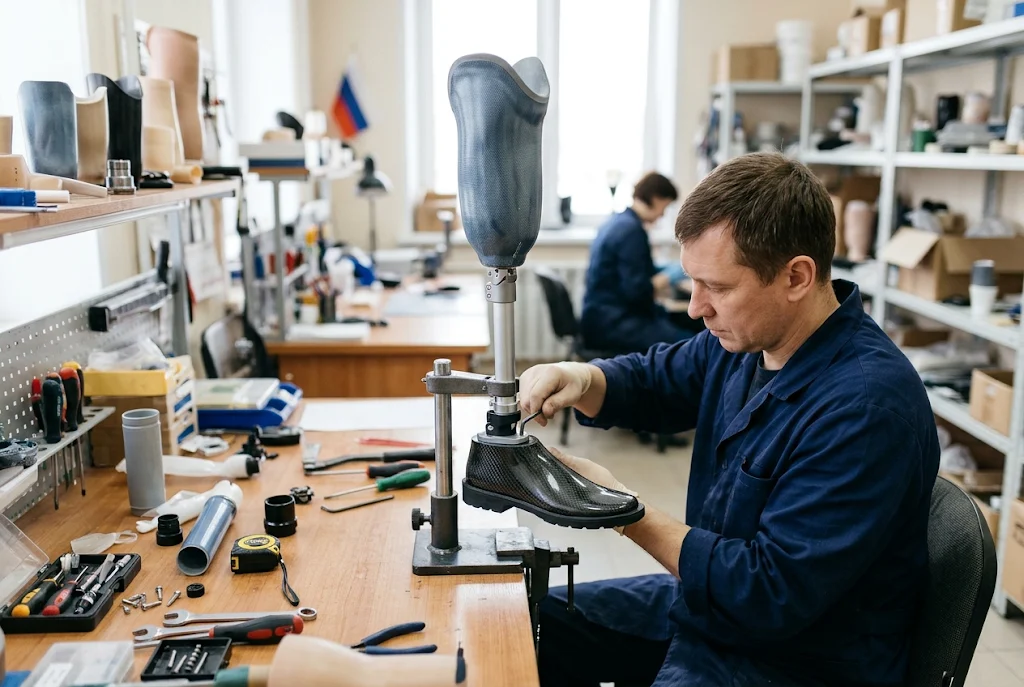
If you’ve been searching “prótesis de pierna precio” for a below-knee leg in Russia, here’s the short answer. A basic modular transtibial prosthesis from a private workshop usually starts somewhere between 50,000 and 170,000 rubles. A typical everyday setup with a vacuum or pin suspension and a carbon foot tends to land in the 300,000–500,000 ruble range. Top-end systems with powered or microprocessor-controlled ankles can go past 2–3 million rubles.
Most people with a confirmed disability don’t pay full price, though. The Social Fund of Russia (SFR) covers below-knee prostheses through three routes, and one of them lets you add your own money to get a better model. This guide covers what drives the price, what the different tiers actually get you, and how to cut the bill.
What a Below-Knee Prosthesis Actually Includes
A transtibial prosthesis isn’t one object. It’s a set of parts, and each one has its own price tag. Knowing the parts makes quotes much easier to compare.
- Socket (гильза). Made from a cast or scan of your residual limb. This is the custom part, and a bad fit here ruins everything else.
- Liner (чехол/лайнер). A silicone or gel sleeve between your skin and the socket. It wears out and gets replaced regularly.
- Suspension. How the leg stays on: a pin lock, a vacuum valve, or a sleeve.
- Pylon and adapters. The tube and connectors linking the socket to the foot.
- Foot. Anything from a simple SACH foot (solid ankle, cushioned heel) to an energy-storing carbon foot or a powered ankle.
- Cosmetic cover. An optional foam shell that gives the leg a natural shape.
Since the design is modular, you can often replace one part, like a worn liner or a foot, without rebuilding the whole leg. That matters a lot for long-term costs.
Prótesis De Pierna Precio in Russia: Typical Price Tiers
The figures below come from public price lists of Russian prosthetic workshops. They’re “from” prices, and the final quote depends on your exam, your activity level and the brands involved.
| Tier | Typical setup | Approximate price (rubles) | Best suited to |
|---|---|---|---|
| Entry / basic | Laminated socket, standard SACH foot, foam cover | ~50,000–310,000 | Low activity, indoor and short outdoor walking |
| Everyday active | Vacuum or pin lock with a polymer liner, energy-storing carbon foot | ~370,000–490,000 | Walking at different speeds, daily outdoor use |
| High activity | Advanced carbon feet, upgraded suspension, multi-axis ankle | ~450,000–850,000 | Long walks, work on your feet, light sport |
| Premium / bionic | Microprocessor or powered ankle-foot systems | ~1,000,000–3,500,000 | Very specific needs, usually after expert assessment |
Here’s what real price lists show:
- One Volgograd workshop lists modular below-knee prostheses from 50,000 rubles and swimming prostheses from 70,000 rubles.
- A Moscow-area centre puts its basic modular configuration at 120,000 rubles and up, and says microprocessor solutions cost much more.
- Another clinic quotes 170,000 to 690,000 rubles for modular below-knee legs.
- At a third workshop, a basic SACH setup is 270,000 rubles, a vacuum-suspension leg with a carbon foot is 370,000, and the top configuration on its list reaches 3.5 million.
The gap between “from 50,000” and “from 310,000” for what looks like the same basic leg is real. It usually comes down to which components are included, whether trial sockets and fittings are in the price, and the clinic’s own labour costs. Always ask for an itemised quote.
Why Two Quotes Can Differ So Much
There are three main reasons. First is the foot: one industry guide from 2024 put carbon feet alone at roughly 55,000–145,000 rubles, and liners at about 11,000–32,000. Second is the socket process. Some clinics include one or more test sockets, and others charge separately. Third is the brand. Imported components often cost more than domestic ones, and supply has shifted since 2022, so availability changes from clinic to clinic.
Domestic vs. Imported Components
Part of the price gap comes from where the components are made. Imported feet and knee modules from large European brands have long been the premium choice, and when you pay yourself, advanced models can cost several million rubles. Russian manufacturers are growing too. In 2026, one domestic group released a microprocessor-controlled knee module and expects it to cost 20–30% less than foreign equivalents. That product is for above-knee users, but it shows where the market is heading: more local options and, over time, more pressure on prices. Ask your clinic which components it uses and whether a domestic alternative would suit you.
A Realistic Example
Picture two people with the same amputation level. The first is retired, walks mostly around the flat and to nearby shops, and is assessed at activity level I–II. A laminated socket, a sleeve or pin suspension and a basic foot will meet their needs, and private quotes would likely fall at the lower end of the table.
The second works on a building site and walks several kilometres a day on uneven ground. They need a vacuum suspension, a durable energy-storing carbon foot and probably a spare liner. Their quote can easily be two or three times higher, even though both legs are “below-knee prostheses”.
How Activity Level Shapes the Price
Russian price lists group prostheses by activity level (уровень активности), usually from I to IV. The idea is simple: the more you move, the more the foot and suspension need to handle.
- Level I. Walks short distances at one steady pace, mostly at home.
- Level II. Walks outdoors and handles kerbs, stairs and uneven ground slowly.
- Level III. Walks at changing speeds, works on their feet, and does some exercise.
- Level IV. High-impact activity such as running or sport.
Your activity level isn’t something you pick yourself. A doctor and a prosthetist assess it, and for state coverage it’s reflected in your individual rehabilitation programme. Buying a level IV foot for level II walking wastes money, and in some cases the stiffer foot is actually harder to walk on.
How to Get a Below-Knee Prosthesis Paid For by the State
For many people this matters more than the sticker price. The SFR treats a prosthesis as a technical means of rehabilitation (TSR), and to qualify you need it listed in your IPRA, the individual rehabilitation and habilitation programme issued after a disability assessment.
According to the Social Fund of Russia, there are three ways to get one.
Option 1: Receive It Directly (In Kind)
You apply to the Social Fund and wait for the item to be issued, usually through a workshop that has a state contract. You pay nothing, but you have less say over the brand or clinic, and waiting times vary by region.
Option 2: Buy It Yourself and Claim Compensation
You buy the prosthesis yourself and the Social Fund reimburses you afterwards. Keep every receipt and document. Compensation is generally tied to what the state paid for a similar item, so if you choose a much more expensive leg, you may only get part of it back. Check the rules with your regional SFR office before you buy.
Option 3: Use the Electronic Certificate
Since June 2023, people with disabilities have been able to buy upper- and lower-limb prostheses with an electronic certificate. The certificate is linked to a Mir bank card. The money isn’t paid to you. It’s reserved in the Federal Treasury and released when you pay a participating clinic.
The main advantage is choice. If you want a more expensive prosthesis than the certificate covers, you can pay the difference out of your own money. You can apply through Gosuslugi, at an MFC (multifunctional public services centre), or at an SFR client office. The Fund also runs an online catalogue of technical means of rehabilitation where you can check which items qualify.
Costs People Forget to Budget For
The prosthesis is only part of the bill. Here’s what tends to catch people out:
- Socket replacements. Your residual limb changes shape a lot in the first year, and a new socket may be needed sooner than you’d expect.
- Liners and socks. These are consumables. Plan to replace them regularly.
- Repairs. Feet, valves and pins wear out. Regional SFR offices regularly fund repairs, so ask before paying out of pocket.
- Rehabilitation. Gait training with a physiotherapist makes a huge difference to how well you’ll walk, and private sessions add up.
- A second leg. Some people get a separate waterproof prosthesis for showering or swimming. One Volgograd workshop lists those from 70,000 rubles.
- Travel. Fittings take several visits, which gets costly if the nearest good workshop is in another city.
Common Mistakes That Push the Price Up
Paying for technology you won’t use. A high-end carbon foot feels great on a test walk, but if you mainly walk short distances, a simpler foot may serve you better and last longer.
Skipping the trial socket. Clinics that rush to the final socket to save time often end up remaking it. A good test fitting saves money over the life of the leg.
Buying before the IPRA is updated. If your rehabilitation programme lists a different type of prosthesis than the one you buy, compensation can be refused or reduced. Get the IPRA right first.
Comparing headline prices only. “From 120,000” and “from 270,000” may describe completely different packages. Ask each clinic exactly what’s included: fittings, test sockets, liners, cover and aftercare.
How to Get an Honest Quote
- Get a consultation first. Many workshops offer a free consultation with a prosthetist.
- Bring your documents. Your IPRA, medical records and any previous prosthesis details help the clinic quote accurately.
- Ask for an itemised breakdown. Socket, liner, suspension, pylon, foot and cover should each be listed.
- Ask about the warranty and adjustments. Find out how many free adjustment visits are included after delivery.
- Check certificate acceptance. If you plan to use the electronic certificate, confirm the clinic accepts it before any work starts.
- Compare at least two clinics. Even within one city, quotes for similar setups can differ by hundreds of thousands of rubles.
The Bottom Line
For a below-knee leg, the real answer to “prótesis de pierna precio” in Russia covers a huge range, from tens of thousands of rubles for a basic leg to millions for bionic systems. For most active everyday users, a realistic private quote sits in the mid-hundreds of thousands. Before you pay anything yourself, though, sort out your IPRA and talk to your regional Social Fund office. Between direct provision, compensation and the electronic certificate, many people get a good prosthesis for little or no money of their own.
Treat the prices in this guide as a starting point, not a quote. Your prosthetist and doctor are the right people to decide what you actually need.
Frequently Asked Questions
How much does a below-knee prosthesis cost in Russia?
Public price lists from Russian workshops show basic modular transtibial prostheses starting at roughly 50,000–310,000 rubles. Active-use setups with carbon feet usually cost 370,000–850,000 rubles, and bionic or microprocessor systems can go above 1 million.
Can I get a prosthetic leg for free in Russia?
Yes, if it’s included in your IPRA. The Social Fund of Russia can provide it directly, reimburse you after you buy it, or issue an electronic certificate to pay for it.
Can I upgrade to a better prosthesis with the electronic certificate?
Yes. You can pay the difference yourself if you choose a more expensive model than the certificate covers.
How often does a below-knee prosthesis need replacing?
It depends on wear, activity and changes in your residual limb. The state sets minimum usage periods for prostheses, and sockets and liners often need replacing sooner. Your prosthetist and regional SFR office can tell you the exact period for your device.
Is a more expensive prosthesis always better?
No. The best prosthesis matches your activity level and fits your residual limb well. A good socket fit matters more than a premium foot.