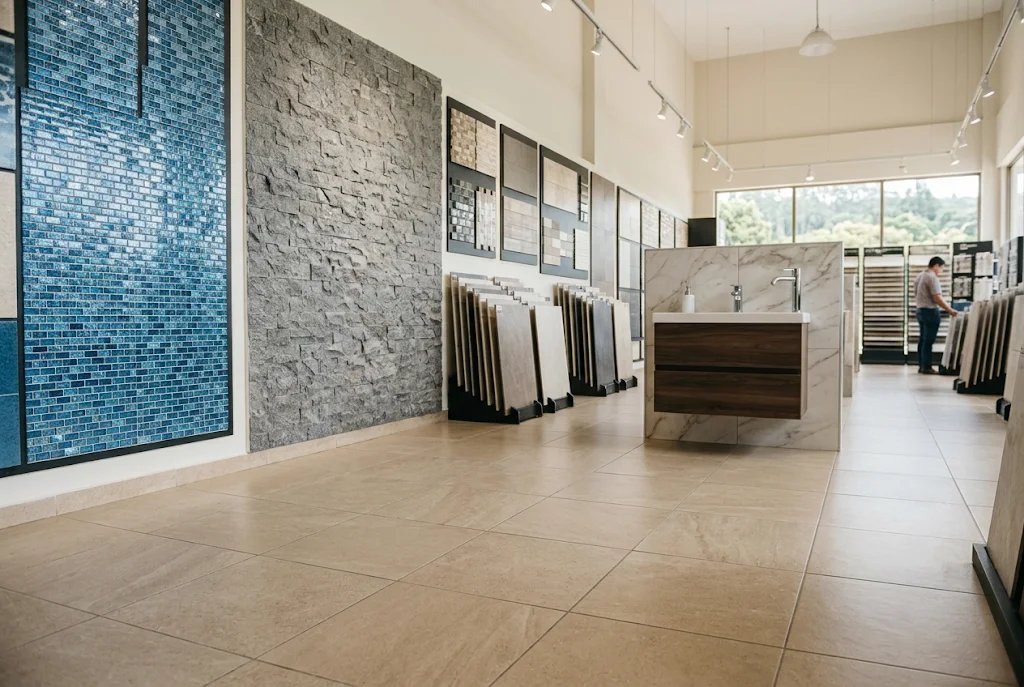
Cenyca is a privately owned company in Quito, Ecuador, that imports and wholesales building finishes. Its range covers ceramic and porcelain floor and wall tiles, glass pool mosaics, decorative stone cladding, border tiles and bathroom fittings such as faucets, sinks and toilets. It started in 1996 as a small family business and sells mainly to hardware stores, contractors and wholesalers, though homeowners fitting out a house can buy from it too.
If the name turned up on a shipping record, a tile box or a builder’s quote, this guide covers who the company is, where its products come from, and what to check before buying from it or from any similar importer.
The Company at a Glance
| Detail | What public records show |
|---|---|
| Legal name | Cenyca S.C.C. |
| Base | Quito, Pichincha province, Ecuador |
| Founded | 29 August 1996 |
| Business type | Importer and wholesale distributor of construction finishes |
| Main products | Tiles, pool mosaics, stone cladding, border tiles, sanitary ware, faucets |
| Typical buyers | Wholesalers, hardware stores, contractors, homeowners |
| Supply origins | Mainly Colombia and Spain, plus Brazil in the past |
Some business databases list a headquarters in Tijuana, Mexico. That looks like a data mix-up with an unrelated school of the same name, covered further down. The tile business operates in Ecuador.
What the Name Stands For
The name is an acronym. A 2006 business thesis about the firm says it stands for “Compañía Ecuatoriana de Negocios y de Construcción de Acabados,” roughly “Ecuadorian Company for Business and Construction Finishes.”
That describes the business well. In Ecuador, “acabados” (finishes) is the trade word for everything fitted on top of the structure: floors, wall coverings, bathroom fittings and kitchen surfaces. When a builder there says a house is “en acabados,” it’s at the stage where a supplier like this one gets the call.
A Short History of Cenyca
A family business from day one
Most of the detailed history comes from an undergraduate thesis written at Universidad Politécnica Salesiana in Quito. The expansion study of the company was published in 2006 and covers 2003 to 2005. It records that the firm was formed on 29 August 1996 as a civil commercial company (the meaning of “S.C.C.”) with fully Ecuadorian capital.
The founders were Miguel Prado, the general manager, and Verónica Prado, the president. At the time, the business ran from a single Quito location with no branches.
Growth through exclusive brands
The importer grew mainly by winning exclusive Ecuadorian distribution rights for foreign tile brands. The 2006 study names Cerámica Italia and Colcerámica, both Colombian, as exclusive lines. It also lists Spanish suppliers such as Natucer and Arce Cerámicas, plus partners in Brazil.
The same study pointed out a gap in the range: at that time the company didn’t carry sinks or faucets. Current company profiles list both, along with toilets, pool mosaics and stone cladding. The firm now describes itself as having more than 30 years of experience, which fits the 1996 founding date.
Keep in mind that the thesis is nearly 20 years old. It’s a good record of the early years, but not a picture of how the business runs today.
What Cenyca Sells Today
The current company description groups its products into a few lines:
- Ceramic and porcelain tiles for floors and walls, indoors and outdoors
- Glass mosaics, aimed mainly at swimming pools
- Decorative stone cladding for feature walls and facades
- Border tiles (listelos) for trimming and decorating tiled walls
- Bathroom fittings, including faucets, sinks and toilets
- Installation services, according to its business listing
Tile importers’ ranges change often because stock depends on container arrivals. Before you plan a room around a specific design, confirm it’s available, either by contacting the company or through its official site, cenyca.com.
Where the Products Come From
Nearly everything on the shelves is imported. Recent customs data gives a fair picture of the main suppliers:
- Spain: U.S.-tracked bills of lading from 2021 and 2023 show shipments from Navarti Cerámica and Azulejos Benadresa, two tile makers in the Castellón region, Spain’s main tile-producing area.
- Colombia: South American export records from 2024 and 2025 show regular shipments from Compañía Colombiana de Cerámica, the group behind the Colcerámica brand.
That split explains the range. Spanish factories tend to supply decorative and larger-format porcelain, while Colombian ceramics cover everyday sizes at lower prices. If a design catches your eye, ask which factory made it. The answer tells you a lot about price, availability and how easy a replacement will be later.
Who Buys From the Company
The 2006 study described four customer groups. They still match the company’s wholesale model:
- Wholesalers who resell to smaller shops
- Hardware stores (ferreterías) in Quito and other cities
- Contractors and builders fitting out housing projects
- Retail customers remodelling their own homes
Back then, deliveries reached well beyond Quito, to Guayaquil, Ambato, Ibarra, Machala and Santo Domingo, among others. Today’s delivery area isn’t published, so ask before you order.
Don’t Confuse It With CENYCA in Tijuana
Searching the name also turns up CENYCA in Tijuana, Mexico, a private school and university (Centro de Enseñanza y Capacitación de Estudios Superiores de Baja California) with its own site at cenyca.edu.mx.
The two aren’t related. Data aggregators sometimes merge them, which is why the Ecuadorian importer sometimes shows a Tijuana address and the school sometimes shows the wrong country. If a profile mixes tiles with Tijuana, it’s mixing up two different organizations.
How It Fits Into Ecuador’s Tile Market
Ecuador’s finishes market has a few large national players and many smaller importers. The 2006 study listed Graiman, Importadora Vega, Hogar 2000 and Cerlux among the competitors, and said Graiman had broader stock and stronger service.
Graiman manufactures in Ecuador and runs its own stores. Cenyca is an importer-distributor. In practice the two models differ like this:
| Importer-distributor | Large national manufacturer | |
|---|---|---|
| Product source | Foreign factories, mostly Colombia and Spain | Mostly its own plants |
| Range | Depends on container arrivals | Steadier core catalogue |
| Main channel | Wholesale, hardware stores, contractors | Own branded stores plus dealers |
| Strength | Specific imported designs and exclusive lines | Availability and after-sales network |
Neither model wins on every count. If you want a particular Spanish porcelain look, an importer may be the only route. If you’re tiling a large house over several months, steady supply might matter more.
How to Buy From Cenyca: A Simple Process
Since there’s no public online shop, buying usually follows the traditional trade route:
- Measure first. Work out the square metres for each room, then add your waste allowance (see below).
- Shortlist designs. Visit the showroom or ask for current catalogue photos. Write down the product name, size and factory for each option.
- Ask for a written quote. It should show the price per square metre or per box, how many square metres are in each box, and whether VAT is included.
- Confirm stock and lot. Make sure the full quantity comes from one production lot and is in stock now, not “arriving soon.”
- Agree delivery and installation. If you want the company’s installation service, get the scope and timing in writing.
- Inspect on arrival. Open a few boxes before installation starts. Check the shade code, look for chips, and dry-lay a few tiles in daylight.
Contractors often get trade pricing, so if your builder already has an account there, ordering through them may cost less.
Practical Tips Before Buying Tiles From an Importer
These checks apply here and at any other tile importer.
Know whether you need porcelain or ceramic
Porcelain is denser and absorbs much less water. Its standard definition is a water absorption below 0.5 percent. That makes it the safer choice for patios, wet rooms and busy floors. Regular ceramic is usually cheaper and easier to cut, and it’s fine on indoor walls.
Buy from one production lot
Tiles from different firing batches can vary slightly in colour and size. Ask for the lot or shade code printed on each box, and buy enough of one lot at once. Mixing lots is one of the most common reasons a finished floor looks patchy.
Order extra for cuts and repairs
Add about 10 percent to the measured area for straight layouts, and more for diagonal or herringbone patterns. With imported tiles this matters even more, because a discontinued design may never come back. Keep a box or two after the job for future repairs.
Match the adhesive to the tile
Dense porcelain needs a polymer-modified adhesive made for low-absorption tiles. Sika Ecuador, for example, labels its porcelain mortar as a C2-type adhesive certified under NTE INEN-ISO 13007-1. Ask your installer which product they plan to use.
Check pool mosaics for pool use
Not every glass mosaic is rated for permanent underwater use. Confirm that the mosaic, adhesive and grout are all suitable for pools, and keep the product sheets in case you need to make a warranty claim.
Is It an Option for Buyers Outside Ecuador?
For readers in Russia, Europe or elsewhere, the company is best seen as a local Ecuadorian distributor. Its trade records show goods coming into Ecuador, and there’s no public evidence that it ships retail orders abroad. Customer service and the website are in Spanish.
Foreign tile manufacturers might see it as a possible distribution contact, since the records show it buying regularly from overseas factories. Foreigners building or renovating property in Ecuador can treat it as one of several Quito suppliers worth comparing. Public records list more than one Quito address, so confirm the current showroom location before you go.
The Bottom Line
Cenyca is a family-founded Quito importer that has supplied tiles, mosaics, stone cladding and bathroom fittings to Ecuador’s building trade since 1996. Its strength is imported Colombian and Spanish product sold through wholesale and trade channels. If you’re thinking of buying, get a written quote, insist on a single production lot, and check that every product suits the space it’s going into.
Frequently Asked Questions
What does Cenyca stand for?
It’s an acronym for “Compañía Ecuatoriana de Negocios y de Construcción de Acabados,” roughly Ecuadorian company for business and construction finishes.
Where is the company located?
It’s based in Quito, Ecuador. Records list more than one Quito address, so check the current location before visiting.
Is it the same as CENYCA University?
No. CENYCA University is an unrelated school in Tijuana, Mexico. The tile company operates only in Ecuador.
Does the company make its own tiles?
No. Records show it imports tiles, mainly from Colombia and Spain, and distributes them in Ecuador.
Can homeowners buy directly?
Yes. Retail customers have long been one of its customer groups, though most volume goes through wholesalers, hardware stores and contractors.