Your gas meter keeps a running total of every bit of natural gas that has flowed into your home since it was installed. Learning to read it takes about five minutes. Once you can, you’ll be able to check your bill, submit your own reading when the utility can’t reach the meter, and spot unusual usage before it turns into a surprise invoice.
Quick answer: Find your meter and check whether it shows a row of numbers (a digital index) or a set of small clock-style dials. Then note the unit, which will be cubic metres (m³) or hundreds of cubic feet. On a digital index, write the numbers down from left to right. On a dial meter, read each dial in turn and take the lower number whenever a hand sits between two digits. To find out how much gas you’ve used, subtract your last reading from today’s.
The sections below cover each meter type in detail, show how to turn a reading into the figure on your bill, and list the mistakes that trip most people up.
Where to Find Your Gas Meter and What It Measures
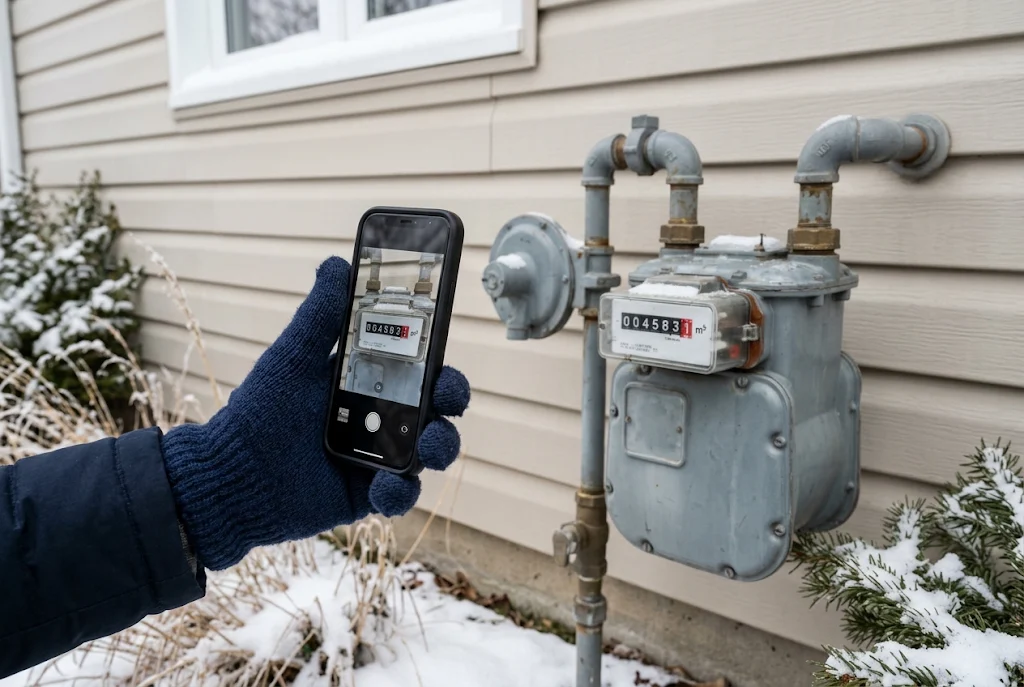
Most Canadian homes have the meter outside, close to ground level. According to Manitoba Hydro’s guide to reading your natural gas meter, an outdoor meter usually sits at about knee height and may have metal posts in front of it to protect it from damage. If the meter is indoors, it’s normally in the basement close to the ceiling.
In a townhouse or apartment building, you may find a bank of meters side by side. Each one should be tagged with a unit number or an account-linked meter number. Match that number against your bill before you write anything down. Reading a neighbour’s meter is a more common mistake than you’d think.
Metric or Imperial? Check the Label First
Canadian utilities use both metric and imperial meters, so it’s worth checking before you do any maths. FortisBC explains that its imperial meters measure gas in hundreds of cubic feet, while its metric meters measure in single cubic metres.
Look on the meter face, near the numbers, for the unit label:
| Label on the meter | What it means | What one unit on the index equals |
|---|---|---|
| m³ or “cubic metres” | Metric meter | 1 cubic metre |
| CU FT, ft³ or “cubic feet” | Imperial meter | Usually 100 cubic feet (check for a “×100” note) |
| kWh | Not a gas meter | This is your electricity meter |
If you see kWh, you’re looking at the wrong meter. Gas meters measure volume, not electrical energy.
How to Read a Digital Gas Meter
A digital index looks like a car’s odometer: a row of numbered wheels behind a small window. This is the easiest type to read, and it’s what most newer meters in Canada use.
- Stand directly in front of the meter so the numbers aren’t distorted by the angle.
- Write down every number from left to right, including any leading zeros.
- Leave out any small separate test dials (more on those below).
- Note the date and, ideally, take a photo of the display.
For example, if the wheels show 0 1 2 4 8 on a metric meter, your reading is 1,248 cubic metres. That’s the total volume the meter has recorded since it was installed, not what you used this month.
If a wheel is partway between two numbers, record the lower one. The number is still rolling over and hasn’t reached the higher value yet.
How to Read a Dial Gas Meter
Older meters, and some imperial ones still in service, use a row of small clock-style dials instead of rolling numbers. They look intimidating, but they follow a few simple rules.
Each dial runs from 0 to 9. Neighbouring dials usually turn in opposite directions, so one moves clockwise and the next moves counter-clockwise. FortisBC’s instructions say to read each dial in the direction marked on it.
Rules for Reading the Dials
- Go left to right, recording one digit per dial.
- If a hand sits between two numbers, use the lower one. The one exception: if it’s between 9 and 0, read it as 9.
- If a hand looks like it’s exactly on a number, check the dial immediately to its right. If that hand hasn’t yet passed 0, the dial you’re reading hasn’t fully reached that number, so record the next lower digit.
Here’s a worked example on a four-dial imperial meter:
| Dial | Hand position | Digit to record |
|---|---|---|
| 1st | Between 3 and 4 | 3 |
| 2nd | Between 9 and 0 | 9 |
| 3rd | Right on 6, and the dial to its right reads 8 | 5 |
| 4th | Between 8 and 9 | 8 |
The reading is 3958. On a meter that counts in hundreds of cubic feet, that means 395,800 cubic feet recorded to date.
The third dial is where most people slip. The hand looks like it’s on 6, but the next dial hasn’t passed 0 to complete that revolution, so the correct digit is 5.
Ignore the Small Test Dials
Many meters have one or two smaller dials set apart from the main row, often labelled with something like “½ cu ft” or “2 cu ft.” These are test dials that technicians use to check flow. They’re not part of your reading, so leave them out on both dial and digital meters.
How to Read a Smart or Remote-Read Gas Meter
“Smart gas meter” means different things depending on your utility. In Canada, many utilities fit a small radio module to an ordinary meter so readings can be collected automatically, without anyone needing to visit your yard. In that setup, the meter underneath still has a normal dial or digital index, and you read it exactly as described above.
If your meter has an electronic screen instead:
- Press the display button if the screen is blank. Many units sleep to save battery.
- Cycle through the screens until you see a total followed by the volume unit (m³ or ft³).
- Write that number down from left to right and ignore anything after a decimal point unless your utility tells you otherwise.
- Skip screens showing dates, flow rates or error codes, since those aren’t your cumulative reading.
Rollout of remote-read and fully electronic gas meters varies by province and utility, and the screen layout depends on the manufacturer. If your display doesn’t match these steps, your utility’s website or customer service line can confirm what each screen shows.
Turning Your Reading Into Gas Usage
A single reading tells you very little on its own. The useful number is the difference between two readings.
Usage = current reading − previous reading
If your bill shows a previous reading of 1,010 and your meter now shows 1,248, you’ve used 238 cubic metres since that bill’s reading date.
If Your Meter Is Imperial
Most imperial meters count in hundreds of cubic feet, so multiply the difference by 100 to get cubic feet. If you want to compare with a metric figure, 100 cubic feet is roughly 2.83 cubic metres.
Why Your Bill Might Show Gigajoules
Some Canadian utilities bill by energy rather than volume. FortisBC, for example, applies a conversion factor to turn the volume your meter records into gigajoules (GJ), and the factor appears on the bill under the gas usage calculation. To check a bill like this, take your usage figure and multiply it by the conversion factor printed on that bill.
Other utilities bill directly in cubic metres. Either way, the volume on the meter is the starting point, and your bill should show how it was converted.
Actual vs Estimated Readings
Utilities can’t always read every meter. Snowbanks, locked gates and dogs all get in the way. When that happens, they usually estimate your usage based on past bills, and the next actual reading corrects any over- or underestimate. Check whether your bill says “actual” or “estimated” before deciding something is wrong.
Common Mistakes When Reading a Gas Meter
Even careful people get readings wrong. These are the slips that cause most mismatches:
- Reading the electricity meter. It’s often mounted nearby. If the display shows kWh, it’s the wrong one.
- Including the test dials. They make your number look far larger than it should be.
- Rounding up on dial meters. Always take the lower number when a hand is between two digits.
- Forgetting the multiplier. An imperial reading of 395 might mean 39,500 cubic feet, not 395.
- Comparing against an estimated bill. An estimate can be well off. Your own reading is usually more reliable.
- Reading a shared-building meter that isn’t yours. Match the meter number to your bill.
- Reading at irregular times. If you’re tracking usage, read on the same day each month, at roughly the same time of day.
What to Do If Your Reading Doesn’t Match Your Bill
A gap between your meter and your bill is usually an estimate or a misread rather than a faulty meter. Work through it in this order:
- Check whether the bill used an estimate. If it did, your next actual reading should even it out.
- Take a clear, dated photo of the meter. This gives you evidence if you need to discuss the bill.
- Submit your own reading. Many utilities, including FortisBC and Manitoba Hydro, accept customer readings online or by phone.
- Ask your utility to review the account if the numbers still don’t add up after an actual read.
- Request a meter accuracy check if you suspect the meter itself. Gas meter accuracy in Canada is regulated federally under the Electricity and Gas Inspection Act. If you aren’t satisfied with your utility’s response, you can file a measurement-related complaint with Measurement Canada, which handles disputes about natural gas meters.
Keep records of your readings, photos, and any reference numbers from calls. A short, organized timeline makes any dispute much easier to resolve.
Gas Meter Climbs After Nozzle Removed? That’s the Pump, Not Your Home Meter
Some people searching for gas meter help are actually dealing with a fuel pump at a gas station. They’ve hung up the nozzle, and the price or litre count on the display keeps going up. That’s a different device from the natural gas meter on your house, but the same federal regulator covers both. Fuel dispensers are measuring devices, and Measurement Canada oversees their accuracy.
If it happens to you:
- Don’t drive off or argue at the pump. Tell the attendant right away, while the display still shows the problem.
- Record the details. Note the pump number, the date and time, and the final amount. A quick photo or short video of the display is the best evidence.
- Keep your receipt, even if the station adjusts the charge on the spot.
- Check the inspection sticker. Pumps carry a sticker showing when they were last inspected, and it’s worth noting the date.
- File a complaint if it isn’t resolved. Measurement Canada accepts complaints about gas pumps through the same online complaint form linked above. Choose the gas pump option instead of the meter option.
Don’t assume fraud straight away. A display can misbehave for several reasons, and only an inspection can say whether the pump measured correctly. Reporting it is still the right move, because an inaccurate pump affects every driver who uses it.
Safety Tips Around Your Gas Meter
Reading the meter is safe, but the meter itself is part of a pressurized gas system, so treat it with some care.
- If you smell rotten eggs, don’t stop to read anything. Natural gas has an odorant added so leaks are noticeable. Leave the area right away, don’t operate switches or create sparks, and call your utility’s emergency line or 911 once you’re a safe distance away.
- Keep snow and ice off the meter gently. In winter, brush snow away by hand or with a broom. Don’t kick, chip or hammer ice off the meter or its piping. If heavy ice builds up, call your utility.
- Leave the meter alone otherwise. Don’t paint it, cover it, attach things to it, or try to adjust it. Tampering is dangerous and can be illegal.
- Keep a clear path to it. Meter readers and emergency crews need access, especially in winter.
Can a Gas Meter Help You Spot a Leak?
Sometimes. With every gas appliance off, watch the smallest test dial or the last digit of a digital index for several minutes. Some movement is normal if you have pilot lights on a water heater or fireplace. If the meter keeps moving steadily and you can’t explain why, contact your utility or a licensed gas fitter rather than trying to trace the problem yourself.
The Bottom Line
Reading a gas meter comes down to three steps: identify the type and unit, record the numbers correctly, and subtract your previous reading. Dial meters take a little more care, because of the lower-number rule and the opposite-turning hands, but they follow the same logic as digital ones.
Next time your bill arrives, take a reading the same day and compare it with what’s printed. If they line up, you’ll know your bills are on track. If they don’t, you now have the reading, a photo, and a clear path to get it sorted.
Frequently Asked Questions
How often should I read my gas meter?
Monthly is a good habit if you want to track usage or check bills. Reading on the same date each month gives you comparable figures, especially through the heating season, when usage climbs sharply.
Do I read a gas meter left to right or right to left?
Record the digits from left to right. On dial meters, each individual dial may turn clockwise or counter-clockwise, so follow the direction marked on that dial when deciding which number the hand has passed.
Why does my gas meter show cubic feet when Canada uses metric?
Many imperial meters are still in service across Canada. Your utility knows which type you have and converts the reading accordingly, so you don’t need a new meter. Just account for the units when you do your own maths.
Can I submit my own gas meter reading?
Many Canadian utilities accept customer readings online or by phone, which is useful when snow or a locked gate stops a meter reader. Check your utility’s website for its submission options and deadlines.