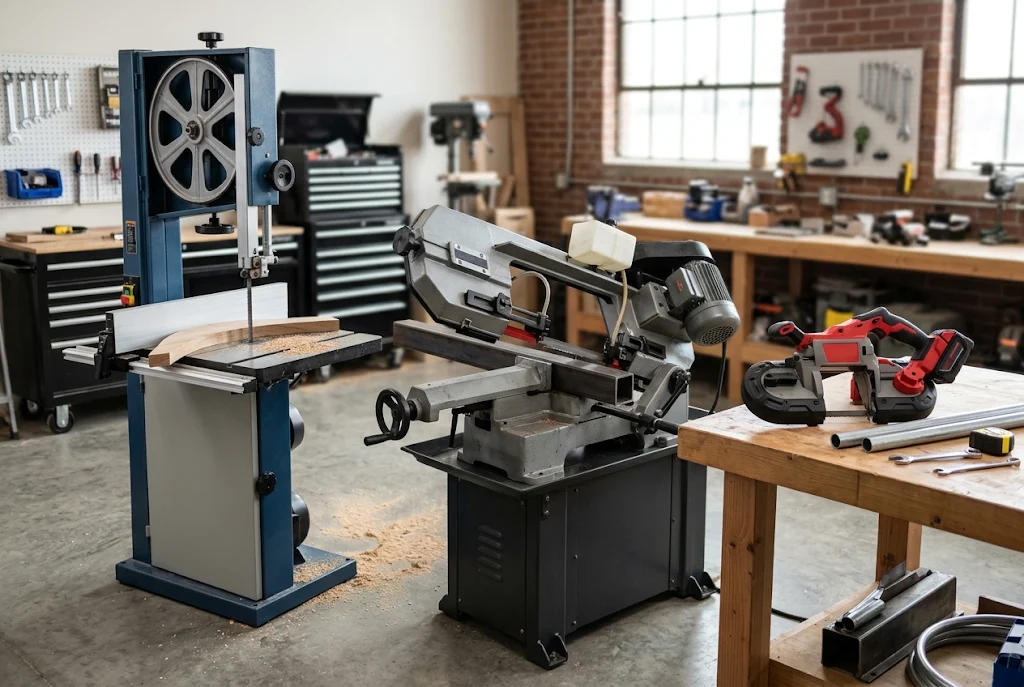
A sierra cinta (the Spanish name for a band saw) comes in three main types: vertical, horizontal and portable. Vertical models cut curves and shapes in wood, plastic or metal on a flat table. Horizontal models cut bar, pipe and profiles to length while the stock sits clamped in a vise. Portable models are handheld saws for cutting pipe, rod and strut on site, where you can’t bring the work to a machine.
All three share the same basic idea. A continuous toothed steel band runs around two or more wheels and cuts in one direction, with no back-and-forth stroke. What changes is how the blade is oriented, how the material is held and how big a piece you can handle. The sections below explain each type, what it’s good at and where it falls short, so you can pick the one that matches your work.
How a Sierra Cinta Works
Before comparing types, it helps to know the parts they all have in common:
- Wheels (pulleys): usually two, sometimes three on compact machines. One is driven by the motor; the other is used to tension and track the blade.
- Blade (band): a closed loop of thin steel with teeth on one edge. Width, tooth pitch and material decide what it can cut.
- Blade guides: bearings or blocks above and below the cut that keep the blade from twisting.
- Tension and tracking adjustments: they keep the band tight and centred on the wheels.
Because the blade moves continuously in one direction, the cut is steady and the blade spreads its heat and wear along its whole length. That’s why a band saw can run long cuts in thick stock without overheating as quickly as a short reciprocating blade.
The kerf (the width of material removed) is also narrow. When you’re cutting expensive hardwood or alloy bar, less waste per cut adds up.
Vertical Sierra Cinta
The vertical sierra cinta is the one most people picture. The blade runs straight down through a horizontal table, and you push the workpiece into it by hand or with a feed accessory.
What it’s used for
- Curved and irregular cuts: with a narrow blade, you can follow a drawn line around tight bends. Furniture parts, chair legs, bowl blanks and templates are typical jobs.
- Resawing: standing a board on its edge and slicing it into thinner boards. This is one of the main reasons woodworkers buy one.
- Straight rip cuts: with a fence fitted, it can rip boards, though a table saw is usually faster for long, straight work.
- Contour cutting in metal: metal-cutting vertical saws run much slower and are used in workshops and toolrooms to cut plate and shapes.
Wood vs metal vertical saws
This is where beginners often go wrong. A woodworking sierra cinta runs its blade fast. A metal-cutting vertical saw runs far slower, often with a gearbox or variable speed control, because steel needs a low blade speed to avoid burning the teeth.
You can’t simply put a metal blade on a fast wood saw and expect it to last. Some machines offer two speeds or a variable drive so they can handle both, but check the manufacturer’s speed range before buying if you plan to cut metal.
Sizes to know
Vertical models are usually described by:
- Wheel diameter, which roughly sets the throat depth (how wide a piece fits between the blade and the frame).
- Cutting height (resaw capacity), which is the maximum height under the upper guide.
A small benchtop sierra cinta suits hobby work and thin stock. Floor-standing machines with larger wheels and stronger motors handle resawing wide boards and heavier daily use.
Pros and cons
| Pros | Cons |
|---|---|
| Cuts curves no other stationary saw can match | Hands work close to the blade, so technique matters |
| Excellent for resawing thick boards | Setup (tension, tracking, guides) takes practice |
| Narrow kerf and little waste | Straight cuts are slower than on a table saw |
| Quieter and generally less prone to kickback than circular saws | Wood models are too fast for most metal work |
Horizontal Sierra Cinta
A horizontal sierra cinta is a metalworking machine first. The material is clamped in a vise, and the saw frame, which holds the blade, lowers through it under gravity or a hydraulic feed. You don’t push the workpiece; the machine does the cutting while you set it up.
What it’s used for
- Cutting round bar, square tube, pipe, angle and beams to length
- Repeat cuts in fabrication shops, where the same length is needed again and again
- Mitre cuts, on models where the head or vise swivels to an angle
Common designs
- Pivot (scissor) type: the frame hinges at the back and swings down. Simple, affordable and common in small workshops.
- Double-column type: the head travels straight down on two columns. It’s more rigid and better suited to large sections and production work.
- Combination 4×6-style saws: small machines that cut horizontally but can be tilted upright and used as a basic vertical saw. They’re handy in a home garage, though neither mode matches a dedicated machine.
Features worth checking
- Coolant system: larger saws pump coolant over the blade to reduce heat, extend blade life and improve the finish. Overheating can soften the teeth and dull them quickly.
- Feed control: a hydraulic cylinder or adjustable feed rate stops the blade from being forced through hard material.
- Automatic shut-off: most switch off at the end of the cut, so you can measure or prep the next piece.
- Capacity: check the maximum round and rectangular sizes at 90° and at 45°. Capacity drops at an angle.
A fully automatic sierra cinta goes further, with automatic bar feeding, clamping and length control. Those belong in production plants rather than small workshops.
Pros and cons
| Pros | Cons |
|---|---|
| Accurate, square cuts with little effort | Not designed for curves or freehand shapes |
| Can run while the operator does other tasks | Heavier and needs a dedicated spot in the shop |
| Handles thick and hard metals well | Larger models need three-phase power |
| Less waste than abrasive cut-off saws | Higher upfront cost than a cut-off saw |
Portable Sierra Cinta
A portable sierra cinta is a handheld band saw. The blade loops around wheels inside a compact body, with an open section at the front where the cut happens. You place it over the work and let the tool’s weight do most of the cutting.
What it’s used for
Electricians, plumbers and steel installers use portable band saws to cut:
- Conduit and pipe
- Threaded rod
- Unistrut-type support channel
- Rebar and small metal profiles
They’re especially useful on scaffolding or in a finished building, where an angle grinder’s sparks would be a fire risk or a nuisance. A band saw makes a cleaner, cooler cut with far fewer sparks.
Corded vs cordless
- Corded models give continuous power for a full day of cutting.
- A cordless sierra cinta is now common and very practical on sites without easy power. Run time depends on battery size and how thick the material is.
Full-size vs compact
Full-size portable saws accept larger pipe and profiles and usually need two hands. Compact versions are lighter, can often be used one-handed, and suit overhead work, but their cutting depth is smaller. Before buying, compare the stated maximum cutting capacity with the largest pipe or profile you cut regularly. Blade lengths also differ between models, so make sure replacement blades are easy to buy where you work.
Pros and cons
| Pros | Cons |
|---|---|
| Brings the cut to the material | Limited cutting depth |
| Cleaner, cooler and quieter than a grinder | Straightness depends on your hand and stance |
| Few sparks, good for occupied buildings | Not suited to wood or curved shapes |
| Cordless models need no power outlet | Batteries add to the running cost |
Quick Comparison of Band Saw Types
| Feature | Vertical | Horizontal | Portable |
|---|---|---|---|
| Main job | Curves, shapes, resawing | Cutting stock to length | On-site cutting of pipe and rod |
| Typical materials | Wood, plastic; metal on slow models | Steel, aluminium, alloys | Pipe, conduit, rod, strut |
| How the work is held | By hand on a table | Clamped in a vise | Held still, saw is moved |
| Curved cuts | Yes | No | No |
| Best user | Woodworkers, toolrooms, makers | Fabricators, metal shops | Electricians, plumbers, installers |
| Space needed | Bench or floor space | Floor space | A tool case |
How to Choose the Right Type
When choosing a sierra cinta, start with the material and the shape of the cut, not with the price.
- Mostly wood, curved parts or resawing? Choose a vertical sierra cinta. Pick wheel size and resaw height to match your widest boards.
- Mostly metal bar and pipe cut to length in a workshop? Choose a horizontal machine. Check its capacity at 45° if you cut mitres.
- Cutting on site, at height or in finished buildings? Choose a portable model and match its cutting depth to your usual pipe sizes.
- A small garage doing a bit of everything? A combination horizontal/vertical saw can cover both jobs, as long as you accept its limits.
Power supply in Russia
In Russia, household sockets supply single-phase 230 V, while workshops and industrial sites often have three-phase 400 V (still commonly called 380 V). Most benchtop vertical saws and small horizontal saws run on single-phase power, but larger floor machines are often three-phase only. Confirm the motor’s voltage and phase before you buy, especially when importing a machine. A qualified electrician should connect anything three-phase.
Blades Matter as Much as the Machine
Even the right type of sierra cinta performs badly with the wrong blade. Three points cover most problems:
- Width: narrow blades turn tight curves; wide blades cut straighter and are better for resawing.
- Tooth pitch (TPI): fine teeth for thin metal and smooth finishes, coarse teeth for thick wood and fast cuts. A common rule of thumb is to keep at least three teeth in the material at all times.
- Material: carbon steel blades are fine for wood and light use. Bimetal blades, with hardened tooth tips welded to a flexible backing, last much longer in metal.
Always use the blade length specified for your machine. Band lengths aren’t interchangeable between models.
Safety Basics for Every Type
A sierra cinta is generally considered calmer to use than a circular saw, but it can still cause serious hand injuries. The OSHA guidance on band saw machine guarding notes that blade contact is the most common cause of injury and that a band saw can’t be fully guarded. These habits help:
- Set the upper guide just above the workpiece so only the cutting section of the blade is exposed.
- Use a push stick for small pieces on a vertical saw; keep fingers out of the line of the blade.
- Clamp metal firmly in the vise on a horizontal saw, and support long bars at the far end.
- With a portable saw, let the tool’s weight feed the cut and keep the workpiece secured.
- Disconnect power before changing or adjusting the blade.
- Wear eye protection and avoid gloves, loose sleeves and jewellery near the moving blade.
Workplace rules in Russia set their own labour safety requirements for machinery, so follow your employer’s instructions and the manufacturer’s manual over any general guide.
Which Type Should You Pick?
For most readers, the decision is simple once you know your main job. Choose a vertical sierra cinta for woodworking and shaped parts, a horizontal model for cutting metal stock to length, and a portable saw when the cutting has to happen on site. If you’re buying your first machine, list the five jobs you do most often, then check that the saw’s capacity and speed match them before comparing brands or prices.
For a short Spanish-language overview of how the machine works, see this explanation of what a sierra de cinta is from Maquineros.
FAQ
Can one sierra cinta cut both wood and metal?
Some can, if they have variable or multiple blade speeds and you change to a suitable blade. A standard woodworking band saw runs too fast for most metals, so check the speed range in the specifications first.
Is a band saw safer than a circular saw?
It’s generally less prone to kickback because the blade pushes the work down onto the table. It still poses a serious cutting risk, so proper guarding and careful technique are essential.
What’s the difference between a vertical and a horizontal band saw?
A vertical saw has a fixed blade and you move the workpiece, which allows curves. A horizontal saw holds the workpiece in a vise and lowers the blade through it, which gives straight, accurate cuts to length.
Are cordless portable band saws powerful enough?
For conduit, threaded rod, strut and small pipe, a modern cordless sierra cinta handles most everyday site work. For heavy, continuous cutting of thick sections, a corded portable saw or a stationary machine is the better choice.