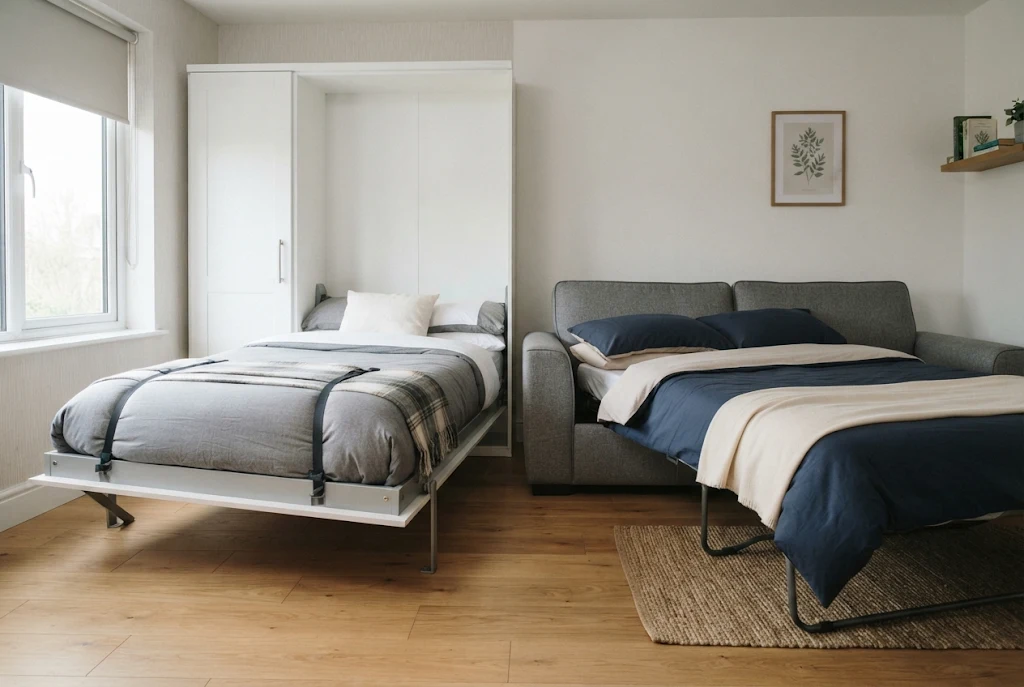
If sleep quality is what matters most, a Murphy bed usually wins. It folds a proper, full-depth mattress into the wall, so you sleep on the same kind of mattress you’d put on a normal bed. A sofa bed is a sofa first and a bed second. Even good pull-out models use a thinner mattress that has to fold or squash into the seat base.
That doesn’t make the sofa bed the wrong choice. It’s cheaper, needs no wall fixing, and gives you seating every day. The right answer depends on how often someone actually sleeps on it, how much you can spend, and what your walls and floor space allow. This guide goes through each of those so you can decide without a showroom salesperson steering you.
The Quick Answer by Situation
Start here if you want a shortcut:
- Someone sleeps on it most nights (a studio flat, a lodger, a grown-up child back home): a Murphy bed.
- Guests stay a few nights a year: a decent pull-out sofa bed is usually enough.
- You rent and can’t drill into walls: a sofa bed, or a freestanding cabinet-style fold-away bed.
- Your budget is under about £800: a sofa bed. Installed wall beds rarely come in below that.
- The room is a home office during the day: a Murphy bed with a built-in desk or shelving is hard to beat.
How Each One Works
Murphy beds (also called wall beds)
A Murphy bed is a bed frame on a hinged mechanism that folds up into a cabinet fixed to the wall. Most use counterbalance springs or gas pistons, so lifting a double-sized bed takes far less effort than you’d expect. The name comes from William Lawrence Murphy, who patented an early version, and “Murphy bed” is now used for most fold-away wall beds whatever the brand.
There are two orientations:
- Vertical: the bed folds up head-first. It needs more ceiling height but less wall width.
- Horizontal (side-tilt): the bed folds up along its long side. It suits rooms with low or sloping ceilings, such as loft conversions.
Most units sold in the UK take a standard mattress, but each mechanism has a maximum mattress depth and weight. Check that limit before you order a mattress.
Sofa beds
In the UK, “sofa bed” covers a few designs that sleep very differently:
- Click-clack: the backrest folds flat to meet the seat, and you sleep on the seat foam. These are cheap and quick to convert, but the surface is firm and often has a ridge where the two halves meet.
- Pull-out: you take the seat cushions off and unfold a metal frame with a separate mattress stored inside. These are more comfortable, but the mattress is thin and some frames have a bar you can feel through it.
- Fold-out or flip: the seat flips forward to form the bed. They sit between the two on price and comfort.
Which?’s sofa bed buying advice singles out mattress quality on pull-out models, because a thin mattress makes for an uncomfortable night.
Which One Actually Sleeps Better?
This is the main question, so it’s worth looking closely at what makes a bed comfortable.
Mattress depth and support
A Murphy bed mattress lies on a flat, slatted or solid platform, just like an ordinary bed frame. You can pick it yourself: pocket sprung, memory foam or hybrid, at whatever firmness suits you.
A sofa bed mattress has to fit inside the sofa, so its depth is limited. Many pull-out mattresses are only around 10 to 15cm deep, and click-clacks use seat foam instead of a mattress at all. Some UK retailers suggest looking for a mattress at least 14cm deep, with no support bar, if anyone will use the bed regularly. That’s a useful minimum when you’re comparing models.
Size
A Murphy bed can be a full UK double (135 x 190cm), a king (150 x 200cm) or even larger, depending on the unit. Sofa beds are often shorter and narrower than they look. A three-seater sofa doesn’t always open into a full double, and some sleeping areas fall short of 190cm long, which taller guests notice straight away. Always check the sleeping dimensions, not the sofa dimensions.
Everyday wear
A sofa bed takes two kinds of wear. People sit on it all day, which compresses the seat foam, then it gets slept on at night. A Murphy bed mattress is only ever used for sleeping, so it tends to keep its shape for longer.
Bottom line on comfort: if someone sleeps on it more than a couple of nights a week, the Murphy bed is the more comfortable option. For the odd weekend guest, a good pull-out sofa bed is fine, especially with a mattress topper.
Space: What Each One Really Takes Up
Both save space, but in different ways.
A Murphy bed takes up very little floor space when it’s closed. The cabinet usually sits only a short way out from the wall. When it’s open, though, you need clear floor space for the whole bed plus room to walk around it. Before buying, measure the depth of the room from the wall where the cabinet will go, and check that no radiator, socket or door swing is in the bed’s path.
A sofa bed always takes up the space of a sofa. Opened up, it reaches roughly as far into the room as a bed, and the coffee table usually has to move every time.
One thing many comparisons skip is that a Murphy bed frees up the room around the wall as well. With a desk or shelving unit built in, a box room can work as a full office during the day without any furniture shuffling at night.
Cost in the UK
Prices vary a lot, so treat these as rough ranges and get quotes for your own room.
| Murphy bed | Sofa bed | |
|---|---|---|
| Typical price range | Around £800 to £3,000 installed | A few hundred pounds to £2,000+ |
| Mattress | Usually bought separately | Included |
| Installation | Often needs a fitter | None, just delivery |
| Extras that add cost | Desks, shelving, sofa combos, lighting | Storage, premium mattress, upholstery |
According to UK trades site MyBuilder’s Murphy bed price guide, installation typically costs between £800 and £3,000, depending on materials, labour and extra features. Fitted, made-to-measure units with wardrobes or sofas built in can cost well beyond that.
Sofa beds start lower. UK reviewers list click-clack models from a few hundred pounds, while well-made pull-out sofa beds with sprung or memory foam mattresses often cost four figures.
Remember to add the cost of a mattress when you budget for a Murphy bed. It’s the most commonly forgotten extra.
Installation and Your Walls
This is where the two options differ the most.
A sofa bed arrives, gets unwrapped, and that’s it.
A Murphy bed has to be fixed securely to the wall, because a loaded bed puts a lot of force on the cabinet as it opens and closes. That raises some UK-specific questions:
- What is the wall made of? Solid brick or block walls hold fixings well. Stud walls and plasterboard need the right fixings into the timber or metal studs, and some older or thin partition walls aren’t suitable at all.
- Do you own the property? Renters need the landlord’s written permission before drilling large fixings into a wall. If that’s unlikely, look at freestanding cabinet beds that don’t need wall mounting, or stick with a sofa bed.
- Will you fit it yourself? Flat-pack wall beds are available, but they’re heavy and have to be level and well anchored. Unless you’re confident with large DIY jobs, a professional fitter is worth the money. A badly fixed wall bed is a genuine safety risk.
If you have any doubt about your wall, get a qualified joiner or fitter to look at it before you order. Don’t ask after the bed has arrived.
Safety and Fire Rules for Sofa Beds
Sofa beds count as upholstered furniture, so in the UK they come under the furniture fire safety regulations. Trading standards guidance from Bromley Council explains that these rules cover beds, sofa beds, cushions and mattresses, and apply to new and used furniture alike.
The regulations were updated recently. The 2025 amendment regulations came into force on 30 October 2025, mainly changing labelling and which baby products are covered. For you as a buyer, the practical point stays the same: check for a permanent fire safety label, especially if you’re buying a second-hand sofa bed. If the label is missing, walk away.
For Murphy beds, the main safety issues are mechanical. Make sure the unit is properly anchored, keep children from swinging on the open bed or the frame, and follow the manufacturer’s instructions on mattress weight and on any straps that hold the bedding in place.
Daily Life: Making the Bed and Putting It Away
How each one fits into a normal day is easy to overlook.
Murphy bed routine: Most designs hold bedding in place with straps, so the duvet and pillows fold up with the bed. Put it down at night and up in the morning, and it takes seconds. That’s why people with a Murphy bed in a studio actually use it every day, instead of leaving it down permanently.
Sofa bed routine: You take off the cushions, open the frame, put on the bedding, then strip everything off in the morning and find somewhere to store it. That’s fine for guests, but it gets tiring quickly if you do it nightly. Many people who sleep on a sofa bed every night end up leaving it open, which defeats the point.
Common Mistakes to Avoid
- Buying on the sofa test alone. Lie down on the opened bed for a few minutes, in your normal sleeping position, before buying.
- Forgetting to measure the open footprint. Both need much more floor space open than closed.
- Ignoring ceiling height. Vertical Murphy beds need enough clearance to fold up. Sloped or low ceilings may need a horizontal model.
- Skipping the mattress budget. Allow extra for a Murphy bed mattress that fits the mechanism’s depth and weight limits.
- Choosing a click-clack for regular use. They’re great value for occasional guests, but they aren’t built for nightly sleeping.
So, Which Should You Choose?
Choose a Murphy bed if comfort comes first, someone sleeps on it regularly, you own the property (or have permission), and your budget can cover a fitted unit plus a mattress. It’s the closest you’ll get to a real bed that disappears in the daytime.
Choose a sofa bed if the bed is mainly for guests, you need seating every day, you rent, or you want to keep costs down. Spend a little more on a pull-out with a decent mattress and you’ll avoid most of the complaints people have about sofa beds.
The simplest way to decide is to count the nights. Regular use points towards a Murphy bed, and occasional use towards a sofa bed.
FAQs
Can you sleep on a Murphy bed every night?
Yes. Murphy beds are designed for nightly use and take a standard mattress, so they can be as comfortable as an ordinary bed. Check the unit’s maximum mattress depth and weight.
Are sofa beds bad for your back?
Not necessarily, but thin mattresses and support bars can be uncomfortable over many nights. If you have back problems, try the bed before buying and talk to a GP or physiotherapist about what kind of support suits you.
Do Murphy beds come with a mattress?
Usually not. Most are sold as a frame and cabinet, so budget for the mattress separately.
Can I put a Murphy bed in a rented flat?
Only with your landlord’s permission, because most models must be fixed to the wall. Freestanding cabinet beds or a sofa bed are easier alternatives for renters.