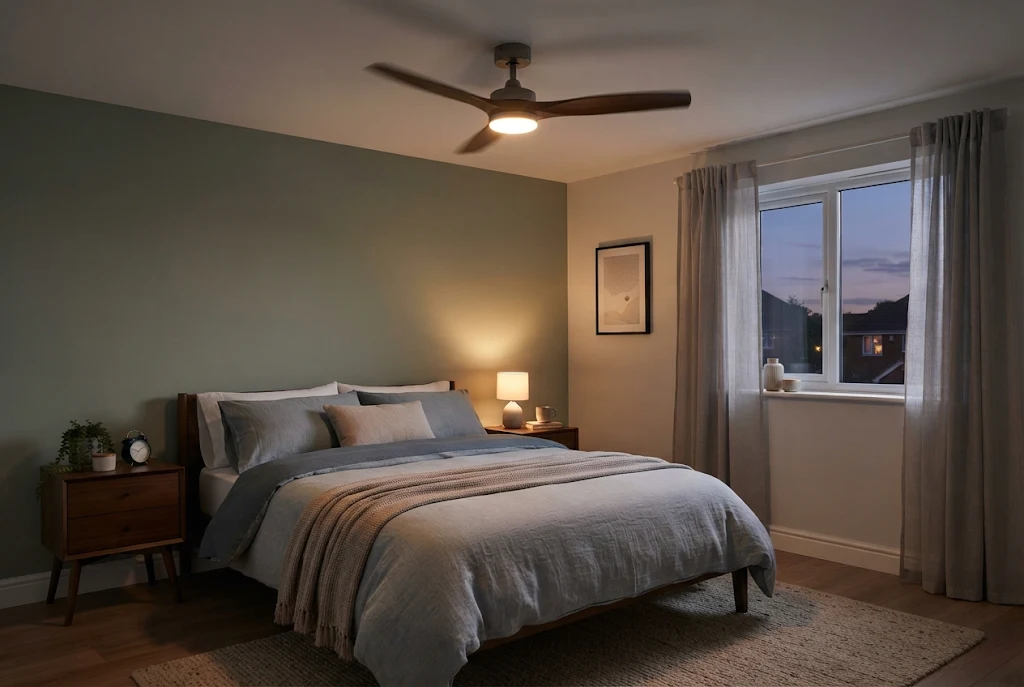
A good bedroom fan does two things well: it moves enough air to keep you comfortable, and it does it without a hum, rattle or click that keeps you awake. If you only remember one thing, remember this — for a bedroom, prioritise a low noise rating (ideally under about 35 dB on its lower speeds) and a DC motor, then match the blade size to your room. Those two choices matter far more than the finish or the number of blades. The rest of this guide walks through how to judge quietness, how to size a fan to your room, what the light and control options really add, and what it costs to run through a British summer.
What makes a ceiling fan right for a bedroom?
Bedrooms have different priorities from a kitchen or a living room. You’re often lying still, the room is quieter at night, and any mechanical noise stands out. So the “best” bedroom fan isn’t the most powerful one — it’s the one that gives you steady airflow at a whisper.
Three features do most of the work:
- Quiet operation at the speeds you’ll actually use overnight.
- An efficient motor so it sips electricity if you leave it on for hours.
- The right size for the room, so you get even airflow without a wind-tunnel effect over the bed.
Everything else — styling, a dimmable light, a smart-home app — is a bonus once those three boxes are ticked.
How a quiet fan actually keeps you cool
A ceiling fan doesn’t lower the temperature of a room. It moves air across your skin, which speeds up the evaporation of sweat and carries your body heat away, so you feel cooler even though the thermometer hasn’t moved. This is the same wind-chill principle that makes a breezy day feel colder than a still one, and it’s why the way these fans circulate air cools people rather than the space itself.
The practical takeaway: there’s no point leaving a fan running in an empty bedroom. Switch it on when you’re in the room and off when you leave. It also means you don’t need gale-force speeds — a gentle, consistent draught over the bed is usually all it takes to drop how warm you feel by a few degrees.
What to look for when choosing
Noise level
Noise is the number one complaint about bedroom fans, and it’s the easiest thing to get wrong. Look for a quoted sound level in decibels (dB). As a rough guide, anything around 30–35 dB is library-quiet and fine for sleeping; above 45 dB you’ll notice it.
Two things drive noise. The first is the motor (more on that below). The second is build quality — loose blade screws, a wobbly downrod or a cheap mounting bracket create vibration you’ll hear as a rhythmic tick or hum. A heavier, well-balanced fan that’s properly fitted is almost always quieter than a bargain model, whatever the spec sheet claims.
Motor type: DC vs AC
This is the single biggest decision for a bedroom.
- DC motors are smaller, lighter and markedly quieter. They use roughly 50–70% less electricity than an equivalent older AC fan, start and stop more smoothly, and usually offer more speed settings plus a remote as standard.
- AC motors are the traditional type. They’re cheaper to buy, often sturdier, and perfectly fine for a living room, but they tend to be a little louder and less frugal.
For a room you sleep in and may run the fan in for hours, a DC motor is worth the extra upfront cost. You’ll claw some of it back on your electricity bill and get a quieter night.
Size and your room
An oversized fan in a small bedroom feels like standing in a draught; an undersized one in a big room barely stirs the air. Blade span (the diameter of the fan) should match the floor area. Use this as a starting point:
| Room size | Approx. floor area | Suggested blade span |
|---|---|---|
| Small (box room, single) | Up to 10 m² | 90–105 cm (36–42 in) |
| Medium (standard double) | 10–20 m² | 105–130 cm (42–52 in) |
| Large (master suite) | Over 20 m² | 130 cm+ (52 in+) |
Ceiling height matters too. You want the blades roughly 2.3–2.7 m above the floor for good airflow and safe clearance. If your ceiling is low, look for a low-profile “flush” or “hugger” fan that sits close to the ceiling; if it’s high or sloped, you’ll need an extension downrod to bring the blades into the room.
Light and controls
Many bedroom fans double as the main light fitting, which is handy if you don’t want a separate pendant. A ceiling fan with light keeps the ceiling uncluttered, and modern units almost always use integrated LED panels rather than old halogen bulbs — cooler, longer-lasting and cheaper to run.
A few points worth checking before you buy a ceiling fan lamp combo:
- Dimmable light, ideally with warm-white output for a bedroom. Bright, cool-white light isn’t restful at night.
- Separate control for the fan and the light, so you can run one without the other.
- A remote or wall control. A remote is genuinely useful when you’re already in bed. Some models add app or voice control, which is a nice-to-have rather than essential.
- A reverse function. The ability to switch the blade direction lets you use the same fan in winter (more on that below).
If a quiet room is the goal, a model that combines the fan and light into one well-made unit usually beats bolting a cheap light kit onto a basic fan.
Energy efficiency and running costs
Fans are already one of the cheapest ways to stay cool, and an efficient one costs very little to run. The simple formula is:
Cost = power (kW) × hours × price per kWh
Take an efficient DC fan drawing about 30 watts (0.03 kW). Run it for eight hours at an illustrative 27p per unit and that’s 0.03 × 8 × 0.27 ≈ 6p a night. An older AC fan pulling 60–70 watts would cost roughly double — still small, but it adds up over a long summer. (Unit rates change, so check your own tariff; the UK price cap is reviewed every quarter.)
When comparing models, look at the airflow-per-watt figure if it’s quoted — the US ENERGY STAR programme, for example, measures efficiency in cubic feet per minute per watt, and a higher number means more air moved for the same electricity. In the UK, you can also check a product’s energy rating; the rules behind the UK energy label are set out by the government, and a better-rated model will generally cost less to run over its life.
Quick comparison: what each feature does for a bedroom
| Feature | Why it matters at night | What to aim for |
|---|---|---|
| Noise level | Keeps the fan from disturbing sleep | ~30–35 dB on low |
| Motor | Drives both noise and running cost | DC for quiet, efficient use |
| Blade span | Even airflow without a draught | Matched to room size (see table) |
| Light | Frees up the ceiling, sets the mood | Dimmable, warm-white LED |
| Remote/control | Adjust without getting up | Remote as a minimum |
| Reverse mode | Year-round use | Summer and winter settings |
Common mistakes people make
A few avoidable errors turn a good fan into an annoying one:
- Buying on looks alone. A striking design that’s noisy or wrongly sized will frustrate you every night.
- Going too big “to be safe.” An oversized fan on low still pushes a lot of air; many people end up running it so slowly it’s pointless, or so fast it’s a wind tunnel.
- Ignoring the fitting. Even a brilliant fan will rattle if it’s mounted to a flimsy ceiling box. Bedroom fans are heavy and spin for hours — the fixing needs to be solid, and in most UK homes that’s a job for a qualified electrician.
- Leaving it on in an empty room. Since a fan cools people and not the air, running it while you’re out just wastes electricity.
- Forgetting winter. A fan with a reverse setting isn’t only a summer gadget.
Getting the most from your fan
Use the reverse setting in winter. Switch the blades to spin the other way on a low speed and the fan gently pushes warm air — which naturally collects near the ceiling — back down into the room. It won’t heat the space, but it evens out the temperature and can let you nudge the thermostat down slightly.
Set the summer direction correctly. In warm weather the blades should push air downward so you feel the breeze. If you’re sitting under the fan and don’t feel a draught, it’s probably spinning the wrong way — most fans have a small switch on the body or a remote button to flip it.
Keep it clean. Dust builds up on the leading edge of the blades and throws them out of balance, which is a common cause of wobble and noise. A wipe every few weeks keeps it quiet and running smoothly.
Fit it properly. Correct height, a secure mount and balanced blades are what separate a silent fan from an irritating one. If you’re installing rather than replacing, factor in the cost of an electrician — it protects both the fan and your ceiling.
The bottom line
For a bedroom, the best ceiling fan is a quiet, efficient one that’s the right size for the room — a DC motor, a sensible blade span, a low noise rating, and a reverse mode so it earns its keep all year. A dimmable warm-white light and a remote make it more pleasant to live with, but they’re extras on top of those fundamentals. Nail the basics and you’ll barely notice the fan is there, which, at 3am in July, is exactly the point.
FAQ
Are DC ceiling fans really quieter than AC ones? Generally, yes. DC motors run more smoothly and with less electrical hum, and they’re usually lighter and better balanced, which reduces vibration noise. Build quality and correct fitting still matter, but a decent DC fan is the safer bet for a quiet bedroom.
What size ceiling fan do I need for a standard double bedroom? For a typical double of around 10–20 m², a blade span of roughly 105–130 cm (42–52 inches) suits most rooms. Smaller rooms want something nearer 90–105 cm so the airflow isn’t overwhelming.
Can I use a ceiling fan in winter? Yes, if it has a reverse function. Running the blades in reverse on a low speed pushes warm air down from the ceiling and helps distribute heat more evenly, so the room feels more comfortable without you turning the heating up as much.
Is it expensive to run a ceiling fan all night? No. An efficient fan drawing around 30 watts costs only a few pence for a full night’s use. Exact cost depends on your electricity tariff, so check your current unit rate, but fans are among the cheapest cooling options available.
Do I need an electrician to fit one? In most UK homes, yes. Ceiling fans are heavy, spin for long periods and need a secure electrical fixing, so professional installation is the safe choice unless you’re replacing a like-for-like fitting and are confident with the wiring regulations.