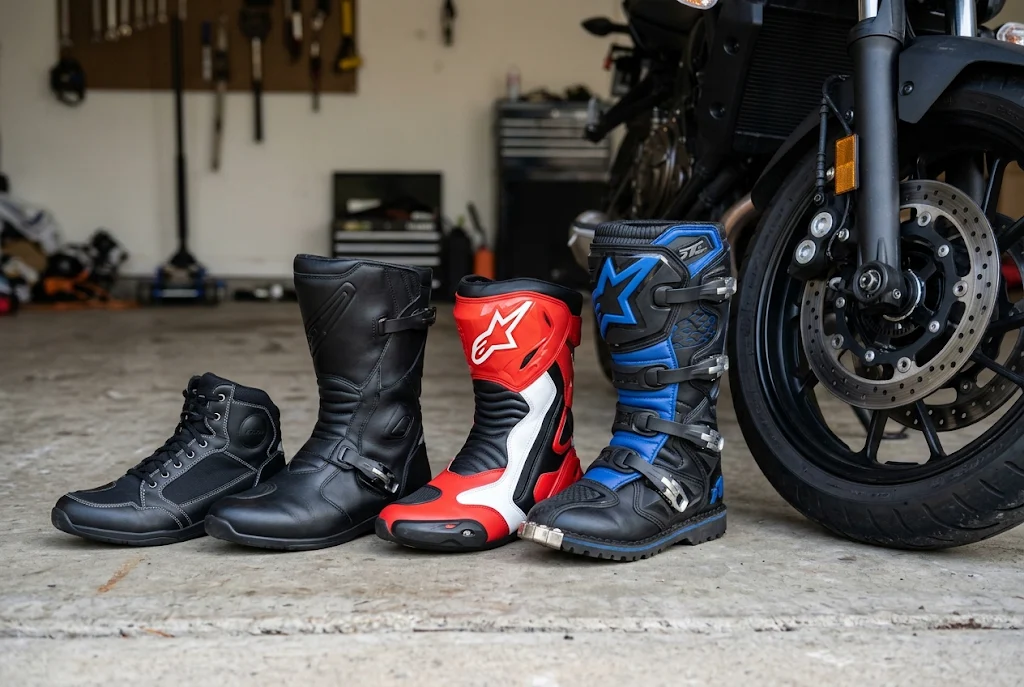
The right botas para motociclista depend on how and where you ride. Here’s the short version: commuters do best with short, comfortable urban boots or riding shoes, touring riders need waterproof mid- or high-cut boots, sport riders need stiff, high boots with ankle bracing, and anyone riding off-road needs tall motocross or enduro boots. Whatever the style, check the label for EN 13634 certification, make sure the sole is oil-resistant and grippy, and choose a fit that holds your heel without crushing your toes.
The rest of this guide covers each riding style, what the certification label actually tells you, how to get the size right, and the mistakes riders make most often when they buy their first pair.
Why Regular Boots and Sneakers Aren’t Enough
A lot of riders start out in trainers, hiking boots or work boots. It feels fine until the day the bike goes down.
The problem isn’t just how thick the material is. Everyday shoes tend to come off in a slide, the soles fold easily, and nothing protects the ankle bones that stick out on each side. Those bones take a lot of the impact when a foot gets caught under a bike or dragged along the asphalt.
The research on this is fairly consistent:
- A survey of 763 riders injured in crashes in Victoria, Australia, found that 47% of riders wearing motorcycle boots got a lower-limb injury, compared with 55% in other boots and 63% in ordinary shoes.
- The same transport authority found that open-wound injuries (abrasions, burns, cuts) affected about 25% of riders in boots, against 47% of riders in unsuitable footwear like sneakers or sandals.
- An Australian study of motorcycle protective clothing found that wearing any kind of boot cut the risk of foot and ankle injury by about half compared with shoes.
Work boots are better than sneakers. Purpose-built motorcycle boots are better than both, because they’re made to stay on your foot and to resist being crushed or twisted.
Matching Botas Para Motociclista to the Way You Ride
This is the biggest decision, and it matters more than the brand. A race boot is miserable to walk around a city in, and a casual riding shoe won’t protect you much at track speeds.
| Riding style | Typical boot | Height | Key features | Main trade-off |
|---|---|---|---|---|
| City commuting | Urban boot or riding shoe | Ankle / short | Hidden ankle cups, reinforced toe and heel, walkable sole | Less shin protection |
| Touring and long distance | Touring boot | Mid to high (mid-calf) | Waterproof membrane, comfortable footbed, zip plus Velcro closure | Heavier, warmer in summer |
| Sport and track | Racing boot | High | Ankle bracing system, shin plate, replaceable toe slider, stiff sole | Hard to walk in |
| Adventure (road plus gravel) | Adventure boot | High | Mix of touring comfort and off-road stiffness, buckles | Bulky for city use |
| Motocross and enduro | MX / enduro boot | Knee-high | Hard shell, multiple buckles, steel shank, strong sole | Very stiff, not for walking |
| Cruiser and custom | Leather riding boot | Mid | Classic look, thick leather, low heel | Often no certified armour, so check the label |
City commuting
If your riding is mostly short trips around town, you’ll spend nearly as much time walking as riding. Urban boots and certified riding shoes look close to normal footwear but hide protectors at the ankles and stiffeners in the toe and heel.
Look for a sole that bends a little at the ball of the foot for walking but resists twisting from side to side. Bend the boot with both hands like you’re wringing out a towel. If it twists easily, it won’t do much for your foot in a crash.
Touring and long-distance riding
Touring boots are built for long days in mixed weather. Comfort becomes a safety issue after six hours in the saddle, because sore, cold or wet feet distract you.
The important features here are a waterproof membrane, a cushioned footbed, and a closure that seals well against rain. A side zip backed by a Velcro flap is a common and practical setup.
Sport riding and track days
Sport boots are the stiffest road boots you can buy. Good ones limit how far your ankle can bend or twist, have a hard shin plate, and use replaceable toe sliders because your toes touch the ground when you lean the bike over hard.
They aren’t made for walking. If you commute on a sports bike, plenty of riders keep a pair of normal shoes in a tail bag or at work.
Off-road, enduro and electric dirt bikes
Off-road riding means more low-speed falls, rocks hitting your shins, and feet getting trapped under the bike. Motocross and enduro boots are tall, rigid and buckled for exactly that reason.
This is worth saying because of how popular lightweight electric dirt bikes have become. If you’ve been reading a Talaria X3 review or watching trail videos of similar bikes, keep in mind that a light, quiet bike still crashes like a dirt bike. Talaria sells the X3 as an off-road machine, and dealers recommend full protective gear. Proper MX or enduro boots belong on the list next to the helmet, not as an afterthought.
Cruiser and custom riding
Classic leather biker boots look the part, but looks and protection aren’t the same thing. Many fashion “motorcycle boots” have no armour, a heel that’s too high and a sole that peels off easily.
If you like the style, look for cruiser boots that carry EN 13634 certification. A growing number of brands make them.
What the EN 13634 Label Means
EN 13634 is the European standard for motorcycle footwear. It’s the most useful single thing you can check when you shop, and it’s also widely referenced in Russia and other markets outside the EU.
A certified boot has a label or a stamp inside the tongue or shaft with a small motorcycle symbol, the standard code (usually EN 13634:2017), and four numbers. Those numbers stand for four tests:
- Height of the boot (the first number refers to how much of the leg it covers)
- Abrasion resistance, meaning how long the material lasts sliding on a rough surface
- Impact cut resistance, which tests how hard it is for a blade-like impact to cut through
- Transverse rigidity, or how well the boot resists being crushed from the sides
Each test is rated Level 1 (basic protection) or Level 2 (higher protection). A label reading “2 2 2 2” means Level 2 across the board. That’s typical of sport and touring boots. Urban boots and riding shoes often show a mix, like “1 2 2 1”.
A few practical points:
- “CE” on its own means very little. The label should name EN 13634 specifically. A boot marketed as “motorcycle style” without that code hasn’t necessarily been tested for riding.
- Short boots will always score lower on height. That’s expected for riding shoes and doesn’t mean the rest of the boot is weak.
- Waterproofing isn’t part of the standard. Some labels include extra codes for water resistance, but a fully waterproof claim should be backed by a membrane the maker names, such as Gore-Tex or its own equivalent.
Materials: Leather, Microfibre and Textile
| Material | Pros | Cons | Best for |
|---|---|---|---|
| Full-grain leather | Excellent abrasion resistance, moulds to your foot, lasts years with care | Heavier, needs conditioning, breaks in slowly | Touring, sport, cruiser |
| Microfibre / synthetic leather | Lighter, consistent quality, easier to clean | Can feel less breathable, doesn’t mould as much | Sport, urban |
| Textile with reinforcements | Light, breathable, usually cheaper | Lower abrasion resistance in exposed areas | Summer and city riding |
| Plastic shell parts (TPU) | Strong against impacts and crushing | Stiff, adds weight | Shin plates, MX boots, ankle cups |
Most good boots combine materials. You’ll see leather or microfibre for the main body, TPU for shin and ankle protection, and a membrane inside for water.
Climate Matters More Than You’d Think
For riders in Russia, weather is a real factor. The season is short, spring and autumn bring cold rain and road grit, and summer days in many regions can still get hot.
- For early spring and autumn riding, a waterproof boot with a thermal lining keeps your feet working properly. Cold feet react more slowly on the rear brake and the gear lever.
- For summer, vented boots or perforated urban shoes are far more comfortable. A waterproof touring boot in 30°C heat is hard work.
- If you ride all season, many riders end up with two pairs: a warm waterproof pair for the cold months and a lighter vented pair for summer.
Remember that water can still get in over the top of even a waterproof boot in heavy rain. Wearing rain trousers over the shaft, not tucked inside, helps a lot.
How to Get the Fit Right
A boot that’s too loose can twist or come off. A boot that’s too tight cuts off circulation and makes it harder to work the controls.
- Try them on late in the day. Feet swell a little by evening.
- Wear your riding socks. Thicker, longer socks change the fit noticeably.
- Start with your normal shoe size, then check the maker’s size chart. Sizes vary between brands, and Italian and Asian brands often run differently from each other.
- Check your heel. Walk a few steps. Your heel shouldn’t lift more than slightly.
- Check your toes. You should be able to wiggle them, with a little room at the front.
- Sit on a bike if you can. Make sure you can feel the gear lever and that the boot doesn’t push into your shin when your foot is on the peg.
- Check the calf. Tall boots need to close over your calf and over your riding trousers if you wear them inside.
Stiff boots, especially sport and MX boots, feel strange at first. Some stiffness at the ankle is the whole point. Pain or pressure points, though, usually don’t go away with break-in.
Common Mistakes When Buying Botas Para Motociclista
- Buying on looks alone. Plenty of boots sold as “biker boots” are fashion items with no protection.
- Choosing a boot that’s too thick for your controls. Very bulky boots can make it hard to get your toe under a small gear lever, especially on lighter bikes.
- Ignoring the sole. A slippery sole on a wet or oily surface is dangerous when you put your foot down at a stop. Look for oil-resistant rubber with a decent tread.
- Skipping the closure check. Laces can catch on pegs or come undone. If you like laced boots, choose ones with a cover flap or lace pocket.
- Keeping worn-out boots too long. Cracked soles, broken buckles, or a boot that’s been through a crash should be replaced. Damaged protectors may not work the second time.
How Much Should You Spend?
Prices vary a lot by region, brand and import costs, so it’s better to think in tiers than in exact numbers.
- Entry level: Certified urban boots and riding shoes from budget gear brands. Fine for commuting if they carry EN 13634.
- Mid-range: Waterproof touring boots and decent sport boots. This is where most riders find the best value.
- Premium: Race boots with advanced ankle bracing systems, top MX boots, and high-end touring boots with premium membranes.
A sensible rule is to spend on the features your riding actually needs. A commuter doesn’t need a race boot, but a track-day rider shouldn’t save money on ankle bracing.
Conclusion
Choosing botas para motociclista comes down to three questions. How do you ride, what weather do you ride in, and does the boot carry real certification? Answer those, then spend time on fit, and you’ll end up with boots you’ll actually wear every ride. That matters more than anything else, because the best boots in the world don’t help if they’re sitting by the door.
If you’re unsure, try a few styles on in a shop, sit on a bike in them, and pick the pair that protects you properly while still letting you feel the controls.
Frequently Asked Questions
Do I need botas para motociclista for short city rides?
Most crashes happen at urban speeds, so yes, some protection is worth it. Certified riding shoes or short urban boots are a good middle ground if you don’t want full boots for short trips.
Can I use hiking or work boots instead?
They’re better than sneakers, but they aren’t designed to stay on in a slide or to protect the ankle bones. Real motorcycle boots offer more protection.
What size should I buy?
Start with your normal shoe size, then check the brand’s size chart. Try them on with your riding socks, and make sure your heel stays put when you walk.
Are waterproof boots too hot for summer?
They can be. If you ride a lot in hot weather, a vented boot or a second, lighter pair is more comfortable.
What boots should I wear on an electric dirt bike?
Treat it like any other dirt bike. Tall motocross or enduro boots with buckles and a rigid shell give the protection you need for off-road falls.