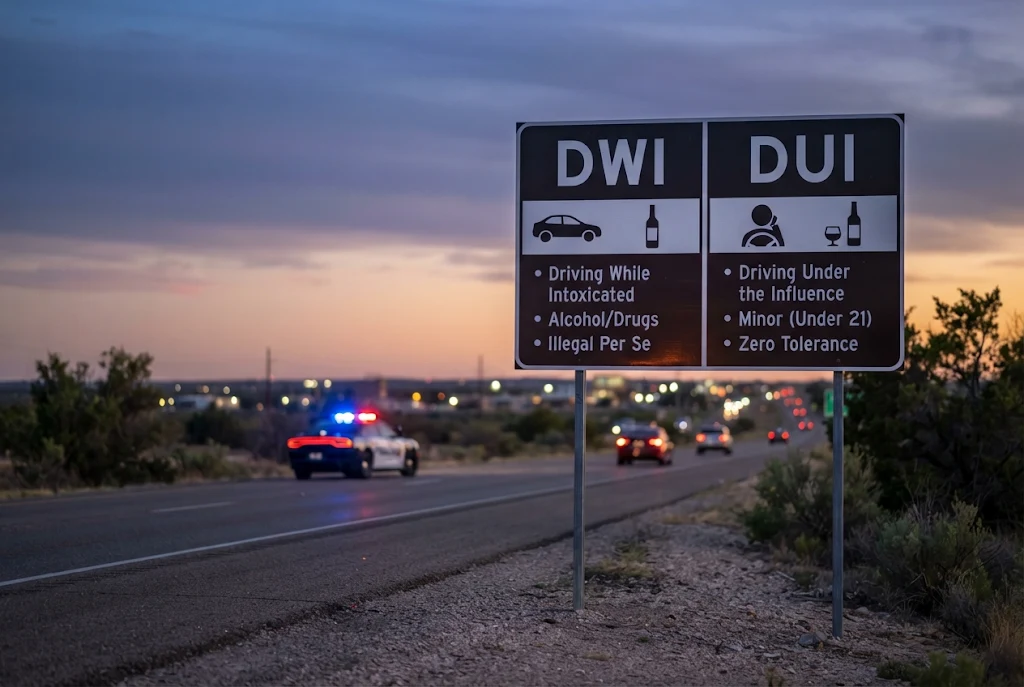
Most states treat DUI and DWI as two names for the same crime. Texas doesn’t. Here, the DUI vs DWI question has a clear answer: they’re two separate offenses, written into two different codes, aimed at two different groups of drivers.
A DWI (Driving While Intoxicated) is the main drunk or drugged driving charge. It can apply to a driver of any age and starts as a jailable misdemeanor. A DUI in Texas means Driving Under the Influence of Alcohol by a Minor. It applies only to drivers under 21 who have any detectable amount of alcohol in their system, and a first offense is a fine-only Class C misdemeanor. In short, DWI is the far more serious charge, and an under-21 driver can face either one depending on how impaired they were.
Below, you’ll see how each charge works, what the penalties look like, what changed in 2025, and the mistakes that cost people the most.
DWI vs DUI in Texas at a Glance
| DWI | DUI (minor) | |
|---|---|---|
| Full name | Driving While Intoxicated | Driving Under the Influence of Alcohol by a Minor |
| Where it’s written | Texas Penal Code §49.04 | Texas Alcoholic Beverage Code §106.041 |
| Who it applies to | Anyone, any age | Drivers under 21 only |
| Substances covered | Alcohol, drugs, or any other substance | Alcohol only |
| Alcohol threshold | 0.08 BAC, or loss of normal faculties at any level | Any detectable amount |
| First-offense level | Class B misdemeanor, 72-hour jail minimum | Class C misdemeanor, fine only |
The table explains why the two terms get mixed up so often. Lots of people say “DUI” out of habit, and even official crash reports in Texas use “DUI-alcohol” as a broad label. In a Texas courtroom, though, the charge name matters a lot.
What Counts as a DWI in Texas
Texas law gives prosecutors two separate ways to prove someone was “intoxicated.” Under the Texas Penal Code’s intoxication chapter, a person is intoxicated if they don’t have the normal use of their mental or physical faculties because of alcohol, drugs, or another substance, or if their alcohol concentration is 0.08 or higher.
That first route surprises people. You can blow a 0.06 and still be charged if the officer documents slurred speech, poor balance on field sobriety tests, or swerving. The 0.08 number is one way to prove the case, not a safe zone underneath it.
A few other details are worth knowing:
- Drugs count. That includes prescription medication and over-the-counter sleep aids if they impair your driving. Having a valid prescription is not a defense.
- “Operating” is broader than driving. Courts have looked at things like sitting in the driver’s seat with the engine running.
- “Public place” is broad too. Parking lots, gas stations, and other areas open to the public qualify, not just highways.
What Counts as a DUI in Texas
The minor DUI law is a zero-tolerance rule. A driver under 21 commits the offense by operating a motor vehicle in a public place (or a watercraft) with any detectable amount of alcohol in their system. Impairment doesn’t need to be proven. One beer at a party, then a drive home, is enough.
Here’s what Alcoholic Beverage Code §106.041 sets out for penalties:
- First and second offense: Class C misdemeanor, which in Texas carries a fine of up to $500.
- Community service: 20 to 40 hours for a first offense, 40 to 60 hours if there’s a prior conviction under this section. The service has to relate to alcohol education or prevention.
- Alcohol awareness program: Required for first-time offenders. If the driver is under 18, the judge can order a parent or guardian to attend too.
- Third offense or later: For someone who is no longer a “child” and has two prior convictions, the penalty jumps to a fine of $500 to $2,000, up to 180 days in jail, or both. Deferred disposition is also off the table at that point.
License consequences come on top of this. Failing to complete the required alcohol program on time can trigger a license suspension. A failed or refused test at the roadside starts its own suspension process, which is covered below.
Can a Driver Under 21 Get a DWI Instead?
Yes, and this is the part many parents and college students miss. The minor DUI law doesn’t shield an under-21 driver from the adult charge. If a 19-year-old is stopped with a 0.10 BAC, or is visibly impaired, they meet the definition of “intoxicated.” Prosecutors can file a DWI.
The statute also says the minor DUI offense is not a lesser included offense of DWI. In practice, that means the minor charge isn’t an automatic fallback. The driver’s age decides which charges are available. The evidence decides which one actually gets filed.
A realistic example: two 20-year-olds leave the same party. One had a single drink and shows no signs of impairment, but a breath test picks up alcohol. That’s likely a minor DUI. The other had five drinks and fails field sobriety tests. That’s likely a DWI, with jail exposure and much heavier fines.
DUI vs DWI Penalties: How DWI Punishment Climbs
Adult-level DWI penalties build on each other. Prior convictions, BAC level, passengers and location all push the charge higher.
| Situation | Offense level | Possible punishment |
|---|---|---|
| First DWI | Class B misdemeanor | 72 hours to 180 days in jail, fine up to $2,000 |
| First DWI with an open container | Class B misdemeanor | Jail minimum rises to 6 days |
| BAC of 0.15 or higher | Class A misdemeanor | Up to 1 year in jail, fine up to $4,000 |
| Second DWI | Class A misdemeanor | 30 days to 1 year in jail, fine up to $4,000 |
| Third DWI or later | Third-degree felony | 2 to 10 years in prison, fine up to $10,000 |
| Child passenger under 15 | State jail felony | 180 days to 2 years in state jail, fine up to $10,000 |
| In an active school crossing zone (from Sept. 1, 2025) | State jail felony | 180 days to 2 years in state jail, fine up to $10,000 |
The fine most people don’t see coming
On top of the court fine, Texas adds a separate state traffic fine after a DWI conviction under Transportation Code §709.001. It’s $3,000 for a first conviction within 36 months, $4,500 for a second or later one in that window, and $6,000 if testing showed an alcohol concentration of 0.16 or more. This fine replaced the old Driver Responsibility Program surcharges, which the Legislature repealed in 2019. Courts can waive or reduce it for people who prove they’re indigent.
Add in bail, attorney fees, an ignition interlock device if one is ordered, and higher insurance premiums, and a “simple” first DWI can easily become a five-figure cost.
The 2025 Change Most Drivers Missed: School Zones
Senate Bill 826 took effect on September 1, 2025. It amended the DWI statute so that a DWI committed in a school crossing zone, while the reduced school-zone speed limit is in effect, is now a state jail felony.
Two details stand out from the bill text. First, the law doesn’t require children to be present. The trigger is the location and the active reduced speed limit. Second, it applies only to offenses committed on or after September 1, 2025.
This matters because school zones sit on everyday commuting routes. A driver heading home from a long lunch on a weekday afternoon could cross one without thinking about it, and what would have been a first-offense misdemeanor becomes a felony.
Your License: A Separate Fight That Starts at Arrest
Many people assume their license is safe until a judge rules on the criminal case. It isn’t. Texas runs a civil process called Administrative License Revocation (ALR), managed by the Department of Public Safety and completely separate from the criminal case.
According to the Texas DPS ALR program page, you can contest the suspension, but you have to request a hearing within 15 days of being served notice. Miss that window and the suspension takes effect automatically on the 40th day.
The standard suspension periods for adult drivers are:
- Refusing a breath or blood test: 180 days for a first offense, 2 years with a qualifying prior.
- Failing a test (0.08 or higher): 90 days for a first offense, 1 year with a qualifying prior.
Notice that refusing is punished more harshly than failing. You can also end up with two suspensions from the same arrest: one from ALR and one from a later DWI conviction. Drivers under 21 face ALR suspensions too, even at low alcohol levels.
Common Mistakes After a Texas Traffic Stop
These come up again and again, and most of them are avoidable:
- Thinking “under 0.08” means you’re fine. Impairment alone can support a DWI.
- Letting the 15-day ALR deadline slip. It’s the single most time-sensitive step after an arrest.
- Assuming a teen’s charge is “just a ticket.” A Class C conviction is still a criminal conviction, and repeat offenses carry jail time.
- Believing prescriptions are exempt. If the medication impairs your driving, DWI applies.
- Not checking the location. Since September 2025, a school crossing zone can turn a misdemeanor into a felony.
- Talking through the case on social media. Posts about the night out can end up as evidence.
What to Do If You or Your Teen Is Charged
Every case is different, and this article isn’t legal advice. These steps are a sensible starting point:
- Read every document you were given. Look for the notice of suspension and note the date it was served.
- Mark the 15-day ALR deadline on your calendar right away.
- Write down what happened while you still remember it clearly: times, locations, what you drank or took, and what the officer said.
- Speak with a Texas criminal defense attorney who handles DWI and minor alcohol cases. Many offer a free first consultation.
- Ask about occupational licenses. If your license is suspended, you may be able to drive to work or school with a restricted license.
- For minors, ask about expunction. Texas law offers a path to clear certain alcohol offenses committed under 21 once the person turns 21. Eligibility depends on the record, so confirm it with a lawyer.
The Bottom Line
The DUI vs DWI difference in Texas comes down to age and severity. DUI is a zero-tolerance, fine-level offense for drivers under 21. DWI covers everyone, applies to alcohol and drugs alike, and carries jail time from the first offense. After September 1, 2025, it can also mean a felony if the stop happens in an active school zone. If you’re facing either charge, protect your license by acting within 15 days, and get advice from a qualified Texas attorney before you make any decisions about your case.
Frequently Asked Questions
Is a DUI or DWI worse in Texas?
A DWI is worse. A first DWI is a Class B misdemeanor with a minimum of 72 hours in jail. A first minor DUI is a Class C misdemeanor punished by a fine of up to $500, community service, and an alcohol awareness class.
Can an adult over 21 get a DUI in Texas?
No. In Texas, the DUI charge exists only for drivers under 21. Adults stopped for impaired driving face a DWI.
What is the legal alcohol limit for drivers under 21 in Texas?
There is effectively no limit. Any detectable amount of alcohol while driving is enough for a minor DUI charge.
Can you get a DWI for driving on prescription drugs?
Yes. Texas defines intoxication to include drugs and other substances. If a prescription medication takes away the normal use of your mental or physical faculties, you can be charged with DWI.