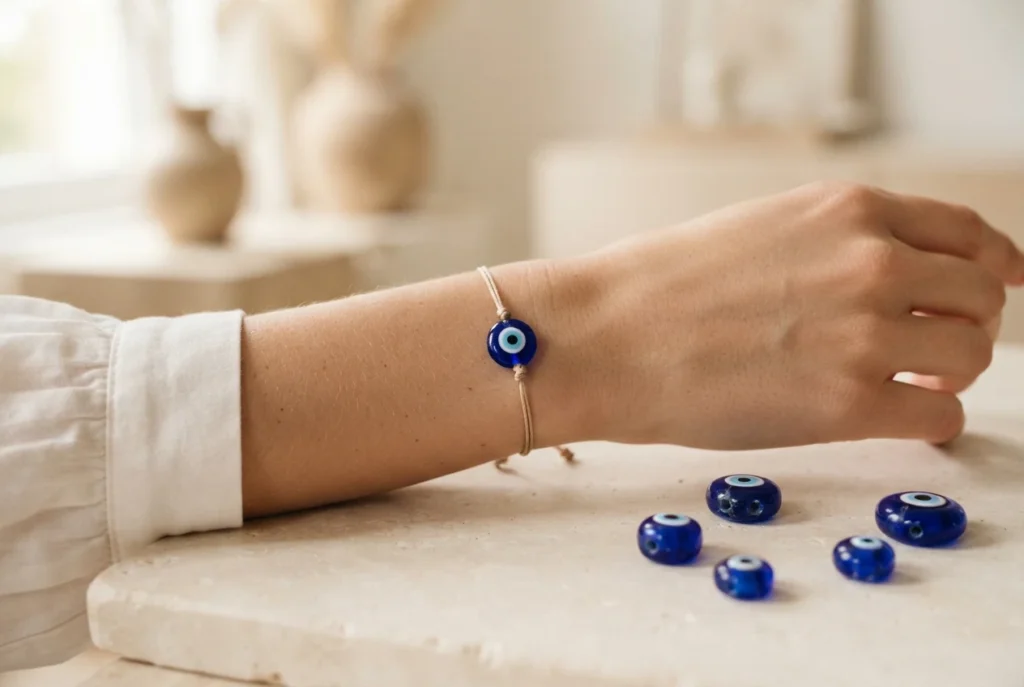
An evil eye bracelet is a protective charm you wear on your wrist. The eye on it isn’t the curse. It’s meant to stare the curse back down. For thousands of years, people around the Mediterranean, the Middle East and South Asia have believed that an envious look can bring bad luck, illness or loss. The blue-and-white eye bead was made to catch that look and turn it away.
So when someone wears one today, it usually stands for one of three things: protection from jealousy and bad energy, a link to their family’s heritage, or simply a symbol they like. Sometimes it’s all three. Below you’ll find where the belief came from, why the eye is almost always blue, how it ended up on a bracelet, and how to wear one with a bit of understanding behind it.
What an Evil Eye Bracelet Actually Represents
Every evil eye bracelet is built around a simple idea. If envy travels through the eyes, then an eye that looks back can block it. Encyclopaedia Britannica describes the evil eye as a glance believed to cause injury or even death, and it notes that pregnant women, children and animals were thought to be most at risk.
That’s why the charm often shows up around new babies, new homes, new businesses and new cars. Anything that’s going well, and that other people might envy, was seen as a target.
The curse vs. the charm
This is the most common mix-up. Strictly speaking, “the evil eye” is the harmful look itself. The bead on your bracelet is the defense against it, and its proper name in many languages is a nazar or nazar boncuğu (Turkish for “evil eye bead”).
In everyday English, people use “evil eye” for both. That’s fine in conversation, but it helps to know the difference when you’re reading about the history or talking with someone from a culture where the belief is taken seriously.
Where the Evil Eye Belief Began
Nobody can point to a single birthplace, and anyone who claims to is guessing. What historians can do is trace the earliest written and physical evidence.
Bronze Age roots
Some of the oldest written references come from Ugarit, a port city in what is now Syria. It existed until about 1180 BC, and its texts mention the evil eye. Protective eye amulets have been dated to about 5,000 years ago. Many scholars think the belief spread through early Mediterranean and West Asian cultures, possibly starting in ancient Sumer.
Greece and Rome
Greek writers took the idea seriously enough to try to explain it. Plutarch devoted a chapter of his Symposium to it. He suggested that the eyes give off harmful rays, but he also admitted the whole thing seemed hard to explain.
Romans had their own fixes. They carried charms called fascinus. That word comes from the Latin verb for casting a spell, which is where English gets “fascinate.” When Romans praised something, they often added a short phrase to ward off bad luck. People in many cultures still do a version of this today.
Glass beads and the nazar
The bead on a modern evil eye bracelet is tied to the history of glassmaking. Glass beads became widespread after Mediterranean glass production took off around 1500 BC. They were traded through Egypt, Phoenicia, Greece, Persia and Rome. The classic nazar amulet is handmade glass in rings of dark blue, white, light blue and black, sometimes with a yellow or gold edge. You’ll see it most often in Turkey, where it hangs in doorways, cars, offices and baby cribs.
How Different Cultures Name and Use It
One thing most articles skip is how many cultures share this belief, and how differently they handle it. Here’s a quick reference:
| Region or language | Name for the evil eye | Common protection |
|---|---|---|
| Greece | Mati or kako mati | Blue eye charms, prayers |
| Turkey | Nazar (bead: nazar boncuğu) | Blue glass bead |
| Arabic-speaking countries | Al-ʽayn | Saying “Masha’Allah” with a compliment |
| Jewish tradition (Hebrew) | Ayin hara | Saying “b’li ayin hara,” red string |
| Pakistan and India | Nazar | Black thread, charms, a small black dot on babies |
| Spanish-speaking regions | Mal de ojo | Red bracelets, charms |
| Brazil | Mau-olhado | Certain plants, such as rue |
Survey data shows how widespread the belief still is. A 2012 Pew Research Center survey found that most people in 20 of the 39 countries it studied believed in the evil eye. A 2015 Pew survey of Central and Eastern Europe found a median of 48% of adults held the belief, with Greece highest at 66%. Those surveys are several years old, so treat them as a snapshot, not current figures.
Why the Eye Is Usually Blue
The cobalt-blue eye is so standard that many people don’t realize other colors exist. In the nazar tradition, blue is believed to shield against evil and soak up negativity. Some folklorists also link it to an old belief that people with rare light-colored eyes were more likely to cast the evil eye, so a blue eye “fights fire with fire.” That idea is common in folklore writing, but it’s an interpretation, not a proven origin story.
What about other colors?
Today you’ll find evil eye beads in red, green, pink, purple, yellow and more. Jewelry brands give each color a meaning. Red is often tied to courage, green to new beginnings, and pink to love and friendship.
Here’s what most guides don’t tell you: those color meanings are mostly modern and come from the jewelry trade. They aren’t part of ancient tradition, and different brands list different meanings for the same color. If you’re buying an evil eye bracelet for its meaning, the classic dark blue is the one with real historical weight. Other colors are a fine choice for style or personal reasons.
How the Symbol Ended Up on a Bracelet
The evil eye bracelet is a fairly recent form of a very old charm. For most of its history, the eye hung in homes, sat on doors or was pinned to clothing. Over time it moved onto the body as jewelry, and the wrist made sense. It’s visible, it’s close to the hands people use to work and greet others, and a bracelet is easy to wear every day.
A few things made the evil eye bracelet a global fashion item:
- Travel souvenirs. Visitors to Greece and Turkey bring home cheap glass-bead bracelets from market stalls, and the look spread through vacation photos.
- Fine jewelry versions. Designers began setting the eye in gold with enamel, sapphires or diamonds, which turned it from a souvenir into an everyday luxury piece.
- Anxious times. Porter magazine (from fashion retailer Net-a-Porter) reported that sales of evil eye jewelry jumped during the 2020 pandemic, when people were looking for small comforts.
- The emoji. The nazar amulet 🧿 was added to Unicode in 2018, which made the symbol part of everyday texting.
How to Wear One With Respect
You don’t need to belong to a particular culture to wear an evil eye bracelet. Still, a little awareness makes it more meaningful and helps you avoid awkward moments.
Which wrist?
Some traditions favor the left wrist, based on the idea that the left side “receives” energy. Others don’t care. There’s no single rule, so pick the wrist that feels natural. If you wear it for family reasons, ask an older relative what your family’s custom is. That’s often the most personal answer you’ll get.
If it breaks or cracks
When an evil eye bracelet snaps or the bead cracks, many wearers worry. In nazar folklore, a cracked or broken bead is a good sign. It means the charm absorbed a strong envious look and did its job. Traditionally, people replace it rather than repair it. Some keep the broken piece and others throw it away. Customs vary, and no source treats one as the official rule.
A few practical tips
- Check the bead material. Handmade glass beads are traditional but can chip. Enamel or resin versions hold up better for daily wear, especially if you type a lot or wash your hands often.
- Watch small beads around kids. Many families put eye charms on babies. Loose beads and thin cords can be a choking or strangling hazard, so pin charms to clothing or crib bedding out of reach instead of putting a bracelet on an infant. Follow your pediatrician’s advice on anything a baby can reach.
- Don’t treat it as a joke. For many people it’s a real part of their faith or family life, so it helps to know a little of the history before you wear one.
- Mind the clasp. A cheap evil eye bracelet on stretch cord can snap within weeks. A sliding knot or a lobster clasp lasts longer and is easier to adjust.
- Gift it with context. If you give one as a present, a short note about what it means turns a cute accessory into a thoughtful gift.
A Quick Reality Check
There’s no scientific evidence that an envious look can cause harm, or that a glass bead can block it. The evil eye bracelet works the way a lucky charm does: as a reminder, a comfort and a symbol of good wishes.
It’s also worth knowing that not every religious authority approves. Early Greek church fathers treated envy as a spiritual problem rather than a power of the eye itself. Today, the Greek Orthodox Archdiocese of America treats prayers against the evil eye as something only a priest should perform. Some Muslim scholars view amulets as superstition and prefer prayer and saying “Masha’Allah.” If you’re buying one for a religious family member, it’s worth knowing where they stand.
The Takeaway
An evil eye bracelet carries an idea that’s thousands of years old: envy is real, it can hurt, and a watchful eye can push it back. It began in Bronze Age amulets, took shape in Mediterranean glass, and now shows up on wrists everywhere from Istanbul to Los Angeles.
If you’re choosing one, start with what it means to you. That might be protection, heritage, a memory from a trip, or simply a design you like. The classic blue eye is the most traditional choice, and wearing it with some knowledge of its story is what gives it meaning.
FAQ
What does an evil eye bracelet mean?
It’s a protective charm meant to guard against the “evil eye,” an envious or harmful look believed to bring bad luck. Many people also wear it as a symbol of heritage or as everyday jewelry.
Where did the evil eye originate?
There’s no single proven origin. Some of the earliest evidence comes from Bronze Age texts in Ugarit (modern Syria) and from amulets about 5,000 years old. The belief later spread through Greece, Rome, the Middle East and South Asia.
Is it OK to wear an evil eye bracelet if it’s not part of my culture?
Generally, yes. It’s widely sold and worn across cultures. Learning what it means, and not treating it as a costume piece, goes a long way.
Can men wear an evil eye bracelet?
Yes. In Greece, Turkey and South Asia, men have long carried or worn eye charms. Leather cords, plain beads and metal cuffs are popular men’s styles.
Is an evil eye the same as a hamsa?
No. The hamsa is a hand-shaped amulet, and the nazar is an eye-shaped bead. They’re often combined in one design, since both are used for protection.