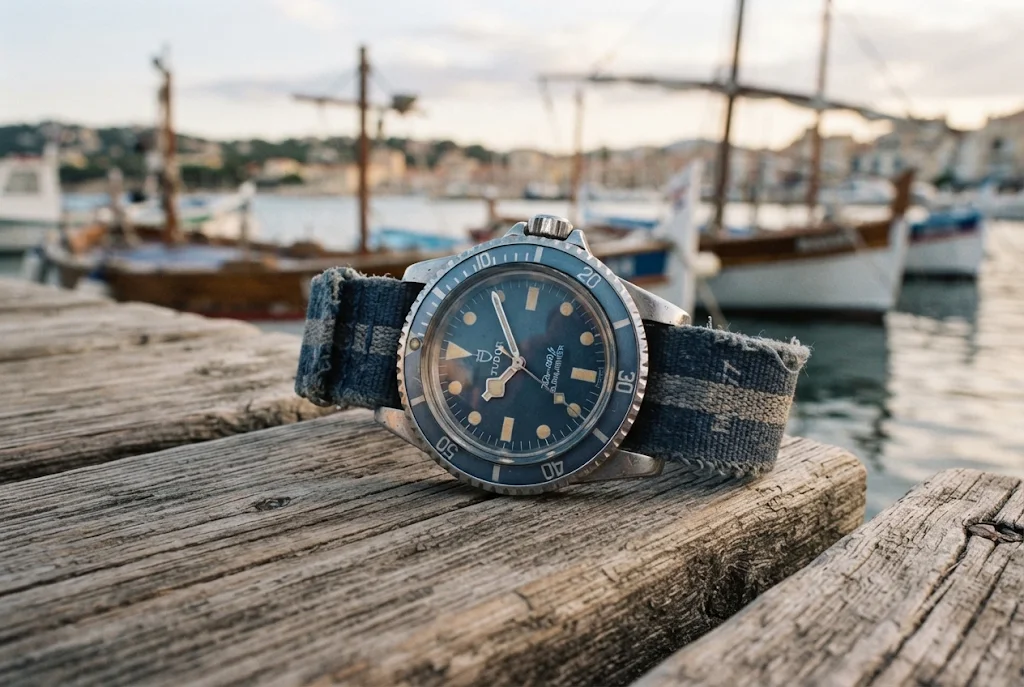
“Marine Nationale” is the name collectors use for Tudor Submariners that the French Navy issued to its divers between the mid-1950s and the 1980s. The navy began testing Tudor dive watches in 1956, adopted the crown-guard reference 7928 in 1959 and, from 1974, had “M.N.” and the year of delivery engraved on the caseback. The most famous of them is the blue reference 9401 from 1975.
These watches weren’t sold in shops, so they aren’t really a model in their own right. Each one is a standard Tudor Submariner with a documented military career, and that history is what collectors pay a premium for. Below you’ll find which references served, how to read the engravings, what they sell for in 2026 and how to check one before you buy.
What “Marine Nationale” Means on a Tudor Submariner
The Marine Nationale is the French Navy. When collectors call a watch an “MN Sub”, they mean a Tudor Submariner that the navy bought, issued and serviced for its own divers.
These were working tools. The navy ordered them without metal bracelets and fitted its own straps. A team of approved watchmakers serviced them and recorded each watch in ledger books.
Three things set an MN watch apart from a civilian one:
- Issue engraving: “M.N.” plus a two-digit year on the caseback, used from 1974 onwards
- Paper trail: an entry in the navy watchmakers’ service ledgers
- Serial number: one that falls in a batch known to have gone to the navy
Earlier MN watches from before 1974 carry no engraving at all. For those, provenance depends almost entirely on the paperwork.
How the Partnership Started: Toulon, 1956
The story starts with a group of navy researchers. According to Tudor’s own French Navy history, in early 1956 the Groupement d’Étude et de Recherches Sous-Marines (G.E.R.S.), based in Toulon, received Oyster Prince Submariners to evaluate. These were references 7922 (automatic) and 7923 (manual wind), both water resistant to 100 metres.
The results were good. Tudor says a letter from the G.E.R.S. commander described the water resistance as “perfect” and the functioning as completely correct.
Then the specification moved on. At the end of the 1950s a new order asked for 200 metres of water resistance, which led to the reference 7924. Collectors call it the “Big Crown” because of its oversized winding crown.
The References the French Navy Used
The MN story spans several generations of Tudor Submariner. Here’s a quick overview based on Tudor’s archive and auction-house records:
| Reference | Linked to the navy from | Key feature | Collector note |
|---|---|---|---|
| 7922 / 7923 | 1956 | First Tudor divers, 100 m | Evaluation watches, rarely documented |
| 7924 “Big Crown” | Late 1950s | 200 m, oversized crown | Born from a 200 m order |
| 7928 | 1959 | First crown guards | “Square Crown Guards” version adopted early |
| 7016 | 1969 (MN engraving from 1974) | Snowflake hands, square indexes | First Tudor diver engraved “M.N.” |
| 9401 / 94010 | 1975 into the 1980s | Blue dial and bezel (“Tudor blue”) | The best-known MN reference |
Reference 7928: crown guards arrive
In 1959 the 7928 added two steel shoulders to protect the crown from knocks, the weakest point on any dive watch. Tudor says the French Navy adopted it as soon as the first examples appeared, and several later versions were all used by navy divers.
Reference 7016: the snowflake look
In 1969 the 7016 brought in the design most people now link with Tudor: square hour markers and angular hour hands, nicknamed “Snowflake” by collectors. A date-equipped sister reference, the 7021, came out at the same time.
Reference 9401: the one everyone wants
The 9401 replaced the 7016 in 1975. Phillips describes it as a 39.5 mm steel watch running the automatic calibre 2776 with hacking seconds, which lets you stop the second hand to set the time precisely. It came in two styles: first with snowflake hands, and later with triangular hour markers.
Reading the Caseback: What “M.N. 76” Tells You
The engraving follows a simple pattern. “M.N.” stands for Marine Nationale, and the number after it is the year the navy received the watch. “M.N. 76” means it was delivered in 1976.
That makes it a strong clue but not proof. Engravings are easy to add to a civilian watch, and fakes of MN casebacks are a well-known problem. On its own, an engraving tells you only that someone engraved the caseback.
What counts is whether the engraving, the serial number and the paperwork agree with one another.
Why the Snowflake Mattered to Divers
The snowflake design wasn’t just a styling choice. Tudor explains that the larger, squarer markers and hands could hold more luminous material, so they glowed for longer. For navy divers working in dark or murky water, that made a real difference.
This is a good example of how the navy partnership worked in practice. Feedback from the field shaped the watch, and the result later became part of Tudor’s identity. You’ll find the same hands on Tudor dive watches today.
Straps, Not Bracelets
If you picture an MN Sub on a steel bracelet, think again. Navy watches were usually delivered without bracelets and worn on fabric straps.
Tudor names two common types:
- Black braided nylon straps
- Rarer handmade straps cut from recycled French parachute elastic, green with a yellow or red centre thread
A genuine period parachute strap is a collectable in itself. If a seller offers one, ask where it came from, just as you would with the watch.
How Long the Watches Served
According to Tudor, the 9401 kept being delivered to the navy into the 1980s, and the watches stayed in use into the 2000s, especially at the French Navy diving school and among its combat swimmers.
One unit stands out: Commando Hubert, the navy’s combat diver commandos. Ledger entries show Tudors issued to this unit, and watches with documented Commando Hubert service sell at a premium.
Long service has a practical downside. Most MN watches were worn hard and serviced many times, so replacement parts and polished cases are common.
What a Marine Nationale Tudor Submariner Costs in 2026
Prices depend far more on documentation than on the reference alone. One recent sale shows the gap clearly.
At Phillips’ Hong Kong Sessions online auction in March 2026, a circa-1975 reference 9401/0 engraved “M.N. 1975” carried an estimate of HK$60,000–120,000 (about €6,500–12,900 at the time). It came with a copy of the navy ledger entry and its presentation box, and it sold for HK$355,600, roughly three times the top estimate.
For comparison, standard civilian Tudor Submariners average around $5,000 on the pre-owned market, according to WatchCharts’ price guide as of late 2026. That figure covers many references and conditions.
Keep these points in mind when you look at prices:
- A well-documented watch can sell for several times the price of an otherwise similar civilian example
- Auction results are single data points, not fixed values
- Exchange rates and market demand change, so check recent results before you bid
This is a collector’s market rather than a guaranteed store of value. Before spending a large sum, it’s worth getting advice from an independent specialist.
MN Watch or Civilian 9401: Which Makes More Sense?
Not every buyer needs the military version. A civilian blue snowflake Tudor Submariner has the same design and movement, and it usually costs much less. The question is what you’re actually paying for.
| Factor | Documented MN watch | Civilian 9401 |
|---|---|---|
| Design | Same snowflake look | Same snowflake look |
| Provenance | Navy service, often ledger-backed | Standard retail history |
| Risk of fakes | Higher, because the engraving adds value | Lower, though still present |
| Typical condition | Heavier wear, replacement parts | Varies widely |
| Price | Significant premium | Lower entry point |
Choose the MN version if the service history is what draws you in and you’re ready to do serious checks. If you mainly love the look and want a vintage diver to wear every day, a clean civilian example is the more relaxed choice, and you avoid paying for a story that can’t be proven.
How to Check an MN Watch Before You Buy
A careful check will protect you more than any amount of enthusiasm. Work through these steps:
- Match the numbers. Check the reference between the lugs at 12 o’clock and the serial at 6 o’clock. Ask the seller or a specialist whether the serial falls within known Marine Nationale batches.
- Ask for the ledger. The navy watchmakers recorded the serial number, brand and issuing unit. A ledger extract or copy is the strongest evidence available. Not every watch was catalogued, though, so a missing entry isn’t automatically a red flag.
- Study the engraving. It should be sharp and old, consistent with decades of wear. Scratches that run under the engraving rather than through it suggest it was added later.
- Check the original parts. Dial, hands and bezel insert all affect value. Service replacements are normal for issued watches, but they should be disclosed and priced in.
- Don’t panic over a polish. Navy watchmakers often polished cases during servicing, so a polished MN case can still be genuine.
- Choose the right seller. Established auction houses and specialist dealers with a written authenticity guarantee and a return policy are the safer route.
- Plan for import costs. If you’re in Germany and buying from outside the EU, import VAT and possibly customs duty will apply. Check with German customs (Zoll) before you commit.
Common mistakes to avoid
- Paying an MN premium for a civilian 9401 with a fresh engraving
- Assuming every blue snowflake is military, when Tudor also sold blue versions to the public
- Ignoring dial condition, since aged blue dials can fade or degrade unevenly
- Buying on photos alone without an independent watchmaker’s opinion
The Modern Link: Pelagos FXD
The partnership didn’t end with the vintage watches. In 2021 Tudor signed a new agreement with the French Navy and launched the Pelagos FXD, developed with the combat swimmers of Commando Hubert.
The official Pelagos FXD page lists a 42 mm titanium case machined from a single block with fixed strap bars, which is where the “FXD” name comes from. The caseback carries the navy logo and “M.N.21”, a direct nod to the old engravings. Snowflake hands and square markers return, and the bidirectional 120-click bezel is set up for underwater compass work.
If you love the MN history but don’t want to spend vintage money, this is the most direct modern link to it. Check current retail prices with an authorised dealer in Germany, as launch prices have changed since 2021.
The Takeaway
The Tudor Submariner Marine Nationale story is about a watch improved by the people who relied on it. French Navy testing helped bring crown guards, the snowflake hands and the blue 9401, and those features still define Tudor dive watches today.
If you’re thinking about buying one, put documentation first. A ledger entry, a matching serial and an honest description of replaced parts matter more than the engraving. Study a few recent auction results, get an independent opinion, and then decide what you’re comfortable paying.
FAQ
What does M.N. mean on a Tudor Submariner?
It stands for Marine Nationale, the French Navy. The number after it is the last two digits of the year the navy received the watch, for example “M.N. 77” for 1977.
Which Tudor Submariner did the French Navy use most famously?
The reference 9401, introduced in 1975 with a blue dial and bezel. Collectors often call it “Tudor blue”.
Are Marine Nationale Tudors still issued today?
No vintage Submariners are issued now. Tudor renewed its partnership with the French Navy in 2021 with the Pelagos FXD, which carries an “M.N.21” caseback engraving.
Is an engraved caseback enough to prove authenticity?
No. Engravings can be added later. Look for a matching serial batch, ledger documentation and an expert inspection.