If you want flowers and bees to work together in a German garden or on a balcony, plant something for every month from February to October, and choose mostly native, single-flowered species. Willow and crocus feed the first queens of the year. Viper’s bugloss, bellflowers, meadow sage and field scabious carry the summer. Ivy and heather finish the season. The 25 plants below are grouped by when they flower, so you can fill the gaps in your own planting instead of starting from scratch.
The list is written for central European conditions: cold winters, mostly temperate summers and soils from northern sand to southern limestone. German names are in brackets, since that’s what you’ll see on nursery labels.
The 25 Plants at a Glance
| Sr# | Plant (German name) | Main flowering | Best spot |
|---|---|---|---|
| 1 | Goat willow (Sal-Weide) | Mar–Apr | Sun, larger gardens |
| 2 | Crocus (Krokus) | Feb–Mar | Lawn, beds, pots |
| 3 | Lungwort (Lungenkraut) | Mar–May | Partial shade |
| 4 | Cornelian cherry (Kornelkirsche) | Feb–Apr | Hedge, sun to part shade |
| 5 | Blackthorn (Schlehe) | Mar–Apr | Hedge, sun |
| 6 | Apple tree (Apfelbaum) | Apr–May | Sun |
| 7 | White dead-nettle (Weiße Taubnessel) | Apr–Oct | Wild corner, part shade |
| 8 | Meadow cranesbill (Wiesen-Storchschnabel) | Jun–Aug | Sun to part shade |
| 9 | Dog rose (Hunds-Rose) | Jun | Hedge, sun |
| 10 | Bird’s-foot trefoil (Gewöhnlicher Hornklee) | May–Sep | Lawn edge, dry sun |
| 11 | Viper’s bugloss (Gewöhnlicher Natternkopf) | May–Sep | Dry, full sun |
| 12 | Meadow sage (Wiesen-Salbei) | May–Jul | Sun, well-drained |
| 13 | Bellflowers (Glockenblumen) | Jun–Sep | Sun to part shade, pots |
| 14 | Field scabious (Acker-Witwenblume) | Jun–Sep | Sun, meadow |
| 15 | Greater knapweed (Skabiosen-Flockenblume) | Jun–Sep | Sun, poor soil |
| 16 | Yarrow (Wiesen-Schafgarbe) | Jun–Oct | Sun, any soil |
| 17 | Musk mallow (Moschus-Malve) | Jun–Sep | Sun |
| 18 | Wild marjoram (Wilder Dost) | Jul–Sep | Sun, dry, pots |
| 19 | Thyme (Thymian) | Jun–Aug | Sun, pots |
| 20 | Lavender (Lavendel) | Jun–Aug | Sun, pots |
| 21 | Borage (Borretsch) | Jun–Sep | Sun, veg patch |
| 22 | Phacelia (Büschelschön) | Jun–Sep | Sun, empty beds |
| 23 | Stonecrop (Große Fetthenne) | Aug–Oct | Sun, dry, pots |
| 24 | Heather (Besenheide) | Aug–Oct | Sun, acidic soil |
| 25 | Ivy (Efeu) | Sep–Oct | Walls, fences, trees |
Flowering times shift by a few weeks between the Rhine valley and the Alps or the north coast, so treat the months as a guide.
Why the Match Between Flowers and Bees Matters in Germany
Most people picture honeybees when they plant for pollinators. But Germany’s real diversity sits with wild bees. A 2025 paper from Bavaria’s nature conservation academy counts 604 wild bee species recorded in Germany. Of those, 270 are on the national Red List and another 42 are on the early-warning list.
Many of them are picky eaters. A 2022 overview from the University of Freiburg found that 138 German bee species collect pollen from just one plant family, and a few from a single species. The viper’s bugloss mason bee (Natternkopf-Mauerbiene), for example, collects pollen only from viper’s bugloss. Several scissor bees (Scherenbienen) depend on bellflowers.
That’s why this list leans on native wildflowers. A bed full of lavender helps bumblebees and honeybees, but it does nothing for a bellflower specialist. A good pollinator garden mixes both kinds.
Early Spring: The First Food of the Year
From February to April, queen bumblebees and early solitary bees come out of hibernation hungry. Food is scarce, so even a few early plants make a real difference.
- Goat willow (Sal-Weide, Salix caprea). One of the most valuable early plants in Germany. Male plants carry pollen-rich catkins in March. If you have the space, ask the nursery for a male plant.
- Crocus (Krokus). Wild-type species such as Crocus tommasinianus open on the first sunny days. They’re cheap, spread on their own and fit under lawns.
- Lungwort (Lungenkraut, Pulmonaria officinalis). A shade plant whose pink-to-blue flowers draw early hairy-footed flower bees (Frühlings-Pelzbienen). It’s useful under trees, where little else flowers in March.
- Cornelian cherry (Kornelkirsche, Cornus mas). A shrub with small yellow flowers before the leaves appear. It’s a good swap for forsythia, which looks just as cheerful but offers bees very little.
- Blackthorn (Schlehe, Prunus spinosa). White blossom along hedges in March and April. Choose it for a mixed native hedge rather than a single ornamental shrub.
Spring into Summer
- Apple tree (Apfelbaum). If you have room for one tree, a fruit tree pays back twice: bees get blossom in April and May, and you get the crop. Pears and cherries work just as well.
- White dead-nettle (Weiße Taubnessel, Lamium album). It flowers from spring into autumn and is popular with bumblebees. It’s not a stinging nettle and doesn’t sting, so leave it in a wild corner.
- Meadow cranesbill (Wiesen-Storchschnabel, Geranium pratense). Open violet-blue flowers on a tough, long-lived perennial. Don’t confuse it with the “geraniums” in balcony boxes, which are pelargoniums and give bees little.
- Dog rose (Hunds-Rose, Rosa canina). A single-flowered wild rose that bees reach easily, with rose hips for birds in autumn. Heavily double garden roses look lush but hide their pollen.
- Bird’s-foot trefoil (Gewöhnlicher Hornklee, Lotus corniculatus). A low yellow legume for lawn edges and dry patches. Legumes are one of the plant families that specialist bees rely on, so it’s worth letting it grow.
High Summer: Native Wildflowers That Specialists Need
This is the group most top-ten lists skip, and it’s the one that helps rare bees most. Here, the link between flowers and bees is at its tightest.
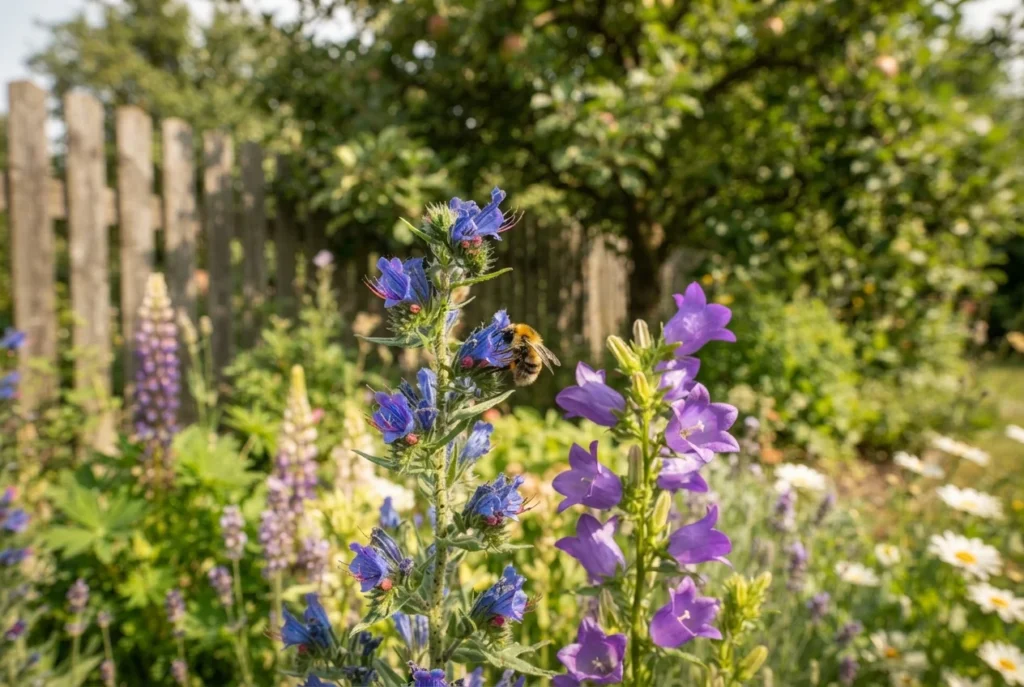
- Viper’s bugloss (Gewöhnlicher Natternkopf, Echium vulgare). Tall blue spikes that flower for months on dry, sunny ground. It’s the only pollen source for the viper’s bugloss mason bee in central Europe.
- Meadow sage (Wiesen-Salbei, Salvia pratensis). A native sage with violet flowers in early summer. Cut it back after the first flush and it often flowers again.
- Bellflowers (Glockenblumen, Campanula). Harebell, peach-leaved and nettle-leaved bellflowers all work. They suit pots too, and they feed several specialist bees. On warm mornings you’ll sometimes find small bees asleep inside the bells.
- Field scabious (Acker-Witwenblume, Knautia arvensis). Lilac pincushion flowers for a sunny meadow patch. Teasel-family plants like this one are a pollen source for specialist bees, including a large, rare mining bee (Knautien-Sandbiene).
- Greater knapweed (Skabiosen-Flockenblume, Centaurea scabiosa). Purple, thistle-like heads that do best on poor, chalky soil. Rich compost actually makes them weaker.
- Yarrow (Wiesen-Schafgarbe, Achillea millefolium). Flat white flower heads that many small bees visit. It grows almost anywhere and handles drought well.
- Musk mallow (Moschus-Malve, Malva moschata). Large pink single flowers from June into September. It’s short-lived but self-seeds.
Herbs and Easy Annuals
These help mostly generalists like bumblebees and honeybees, and they’re ideal if you garden on a balcony.
- Wild marjoram (Wilder Dost, Origanum vulgare). One of the most visited plants in a summer garden, and it’s also the oregano for your kitchen. Let some stems flower rather than harvesting every leaf.
- Thyme (Thymian). Breckland thyme (Sand-Thymian) and broad-leaved thyme are native options. Both cope with hot, dry window boxes.
- Lavender (Lavendel, Lavandula angustifolia). It isn’t native, but bumblebees love it. Pick plain Lavandula angustifolia over showy hybrids where you can.
- Borage (Borretsch, Borago officinalis). Star-shaped blue flowers and an annual that reseeds. Good next to vegetables, where the bees it draws in also help your beans and squash.
- Phacelia (Büschelschön, Phacelia tanacetifolia). A fast annual for an empty bed. Sow it in spring and it flowers within weeks, but it does little for the specialists above.
Late Summer and Autumn: Closing the Gap
Late-flying bees are among the hardest hit in rural Germany, so September food matters.
- Stonecrop (Große Fetthenne, Hylotelephium telephium). Flat flower heads from August to October, very drought-tolerant and easy in pots. Cultivars with open flowers work better than very dense ones.
- Heather (Besenheide, Calluna vulgaris). It needs acidic, sandy soil, so it’s a natural fit in northern Germany. On chalk, use stonecrop instead.
- Ivy (Efeu, Hedera helix). Ivy is the last big nectar source of the year, and it feeds the ivy bee (Efeu-Seidenbiene), which flies from September to late October. Only mature, shrubby ivy flowers. If you trim it, wait until flowering is over at the end of October.
Popular Plants That Give Bees Very Little
Lots of garden-centre favourites are colourful but nearly useless as food. The main problem is double flowers. Breeders have turned the stamens into extra petals, so there’s no pollen left and often no nectar either.
Common low-value choices include:
- Double-flowered roses, peonies, dahlias and chrysanthemums
- Balcony “geraniums” (pelargoniums)
- Forsythia
- Cherry laurel (Kirschlorbeer)
You don’t have to remove them all. Just make sure they aren’t the only things in flower. Also avoid planting Canadian goldenrod (Kanadische Goldrute). Bees do visit it, but it spreads aggressively into the countryside and crowds out native plants.
One more thing to check before you buy: consumer tests in Germany have repeatedly found bee-harmful pesticide residues on ornamental plants. Organic (Bio) nurseries and labelled organic plants lower that risk.
Sowing Outside Your Garden? Check the Regional Seed Rule
Inside your own garden, you can plant what you like. Things change if you sow a flower strip in the open countryside, such as a field margin, a verge outside your plot or a patch of common land.
Under section 40 of the Federal Nature Conservation Act, only regionally native seed may be used in open countryside since 1 March 2020, and anything else needs a permit. Look for seed labelled “gebietseigen” or “Regiosaatgut” for your seed-origin region. Many cheap “bee meadow” packets aren’t, and some contain non-native species. If you’re unsure, your local nature conservation authority (untere Naturschutzbehörde) can tell you what applies.
A Balcony Version: Eight Picks for Pots
Flowers and bees don’t need a garden to find each other. This shortlist from the 25 above handles containers well:
- Crocus (plant bulbs in autumn)
- Bellflowers
- Wild marjoram
- Thyme
- Lavender
- Stonecrop
- Meadow sage (in a deep pot)
- Borage
Use a peat-free mix with some sand or grit for the herbs, and group pots together. A single box is easy to miss, but a cluster of flowers is worth a bee’s trip.
What You Can Still Do in Late November
Most planting waits for spring, but a few jobs make sense right now:
- Plant crocus bulbs as long as the ground isn’t frozen.
- Leave dead stems standing. Some wild bees nest and overwinter in hollow or pithy stems, so cutting everything back in autumn can remove next year’s bees.
- Don’t dig over sunny, bare patches. Many wild bees nest in the ground, and those sandy spots may already hold brood cells.
- Plan your gaps. Write down which months your garden had nothing in flower this year, then pick plants from the matching section above.
The Takeaway
The best pollinator garden isn’t the one with the most plants. It’s the one that never goes hungry between February and October. Start with one plant from each season group, choose native, single-flowered species where you can, and leave room for a little untidiness. Flowers and bees will do the rest, and you’ll likely see species you’ve never noticed before by the second summer.
FAQ
What are the best flowers for bees in Germany?
Native, single-flowered species beat showy hybrids. Strong all-rounders include goat willow, viper’s bugloss, bellflowers, meadow sage, wild marjoram, field scabious and ivy. Together they cover spring, summer and autumn.
Do bee-friendly plants have to be native?
No, but natives do more. Lavender, borage and phacelia feed bumblebees and honeybees well. Many rare wild bees, though, can only use pollen from specific native plant families.
Can I help bees on a small balcony?
Yes. A few pots of thyme, marjoram, bellflowers and stonecrop provide food from early summer into autumn. Grouping pots makes them easier for bees to find.
Why do bees ignore some of my flowers?
Double flowers often have no pollen or nectar, and some popular ornamentals produce very little. Bees quickly learn which plants are worth visiting.