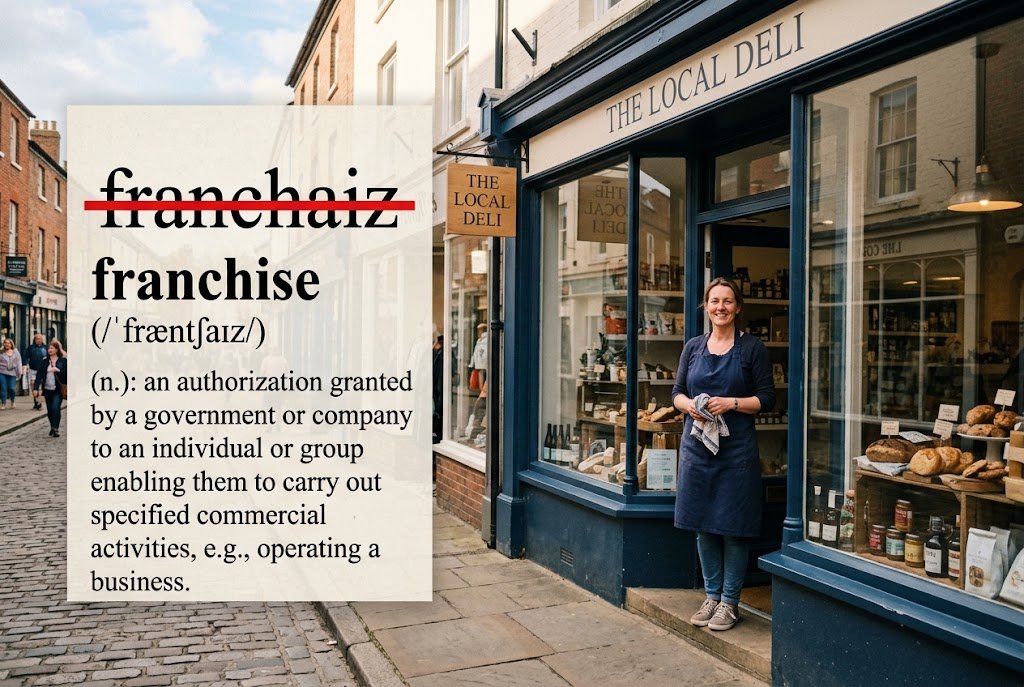
Franchaiz isn’t a standard English word. It’s a phonetic spelling of “franchise”, and in nearly every case the writer means a business arrangement where one company lets another trade under its name, using its systems, in return for fees. A coffee shop run by a local owner under a national brand is the classic example.
So if you’ve spotted franchaiz in an advert, a job post or a message from a contact, read it as “franchise” and you’ll almost certainly be right. Below, you’ll find why the spelling turns up, what the proper word covers, how franchising works in the UK, and what to check if the word appears in a business offer.
What does franchaiz mean?
You won’t find franchaiz as an entry in the mainstream dictionaries, because it isn’t a recognised spelling. It’s simply the sound of the word written down. The correct word, “franchise”, is pronounced FRAN-chize, and “-aiz” is a very natural way to spell that second syllable if you’ve only ever heard it spoken.
Context tells you which meaning is intended. Someone writing “I want to open a franchaiz” means a business. Someone writing “my favourite movie franchaiz” means a film series. The first use is by far the most common, particularly in searches, which is why the rest of this guide spends most of its time there.
Why do people write franchaiz instead of franchise?
There isn’t a single cause, but a few explanations fit what you see online.
English spelling doesn’t match the sound
The ending “-ise” gives readers no clue about its pronunciation. Compare “franchise” (rhymes with “eyes”) with “promise” (rhymes with “miss”). People who learn a word by ear tend to spell what they hear, and that’s how you end up with franchaiz, franchize and similar versions.
The word travels through other languages
Many languages have borrowed this word. Japanese writes it as フランチャイズ, which is romanised as “furanchaizu”, and that ending is close to the spelling we’re discussing. Speakers of other languages may type English business terms by sound too, especially on a phone, when searching in a mix of languages.
Some languages have their own form of the word altogether, so a learner may never have seen the English spelling. Spanish uses “franquicia” and Romanian uses “franciză”.
Is Franchaiz a brand or company?
Not in any widely known sense. Searches turn up no major UK company, product or public figure called Franchaiz. The closest match is franchaiz.biz, a Japanese franchise-listing site whose address appears to be built from the Japanese pronunciation.
Of course, a small business could adopt the name at any time, since unusual spellings are popular for brands. If you’ve seen it with a logo rather than in a sentence, check the company itself before assuming anything.
What the word franchise can mean
Most people only think of fast food, but “franchise” is older and broader than that. It came into Middle English from Anglo-French, from a verb meaning “to free”, and was in use by the 14th century. Its first sense was a freedom or immunity, and the idea of a special right runs through all its modern uses.
| Context | What it means | Example |
|---|---|---|
| Business | A licence to sell a company’s goods or services, or the outlet that holds it | A local owner running a branded gym |
| Film, TV and games | A series of related works sharing characters or a world | A superhero film series |
| Sport | A team and its membership of a league, mostly in North America | An NFL team |
| Politics | The right to vote | “Extending the franchise” to more citizens |
| Public services | A right to run a service under a government contract | UK passenger rail, for many years |
The political meaning survives in two everyday words: “enfranchise” and “disenfranchise”. You’ll see those in history lessons and news reports about voting rights.
How a business franchise works in the UK
Two parties make the arrangement. The franchisor owns the brand and the business model. The franchisee buys the right to run an outlet or territory using them.
Both sides get something from it. The franchisor grows without opening every site itself, and the franchisee starts with a tested concept, training and a name customers may already know.
Key terms explained
| Term | Plain meaning |
|---|---|
| Franchisor | The company that owns the brand |
| Franchisee | The person or company paying to operate under it |
| Initial fee | The one-off payment to join |
| Management service fee | The ongoing payment, often a percentage of sales |
| Territory | The area the franchisee is allowed to trade in |
| Operations manual | The franchisor’s rules for how the business must be run |
What it costs
Business Wales lists the usual start-up costs as the up-front fee, premises, equipment, opening stock and the cost of setting up a legal entity. After that come the ongoing fees and everyday running costs, and possibly charges for training or national advertising.
One point catches out plenty of first-time buyers. Ongoing fees are often charged on sales, not profit. Here’s a made-up example: a shop with £300,000 in annual sales paying a 6% fee hands over £18,000, whether that year was profitable or not. Rent, wages and stock all still have to be paid from what’s left.
The trade-offs
Franchising is often described as a safer way into business, and there’s some truth in that, but you pay for the safety in fees and freedom.
| What you gain | What you give up |
|---|---|
| A tested concept instead of starting from scratch | Part of your sales, every month or year |
| A brand, marketing, training and manuals | Freedom to change products, prices or suppliers |
| Support from the franchisor and other franchisees | Control over the brand: another franchisee’s bad press can hurt you too |
| Possibly easier funding, if the brand has a good reputation | Free choice of buyer: the franchisor usually approves any sale |
Think about temperament as well as money. If you enjoy following a system and managing staff, this structure may suit you. If you started out wanting to run things your own way, the operations manual could start to feel like having a boss again.
How it differs from similar arrangements
Three terms get mixed up with franchising, and sellers don’t always use them carefully.
| Arrangement | How it differs from a franchise |
|---|---|
| Licence | Usually permission to use a name or product, with much less control or support |
| Distributorship | You resell a supplier’s goods, but you don’t copy a full business system |
| Agency | You sell on behalf of another business, usually for commission |
The label on the brochure matters less than the contract. Read what you’re actually being given, and what you’re being asked to pay for it.
What UK law says
This is where UK readers need to be careful, because plenty of online guidance is written for the United States. The UK has no law written specifically for franchising. Agreements fall under general contract, competition and consumer law.
Industry self-regulation comes through the British Franchise Association (bfa). Membership is voluntary, and members agree to follow its code of ethics. According to a UK franchising research review, there’s no mandatory pre-contract disclosure here, and bfa survey data put the sector at about 770,000 jobs and £19.1 billion in turnover in 2024.
That has a practical consequence. If an American article tells you to study the Franchise Disclosure Document, you won’t automatically receive one in the UK. You’ll have to ask for the information, and it’s reasonable to treat a refusal as a warning sign.
What to check if “franchaiz” appears in an offer
A spelling mistake doesn’t make an opportunity dishonest. Plenty of genuine small operators write quickly, and many aren’t writing in their first language. Still, if a formal offer, brochure or website misspells its own core product, it deserves a closer look before any money moves.
Work through these checks in order:
- Find the legal entity. Get the full company name and look it up on the Companies House register. Check how long it has traded and whether its accounts are up to date.
- Ask whether it’s a real franchise. The word gets used loosely. Distributorships, agency deals and some multi-level marketing schemes may be sold under the same label, and they work very differently.
- Check for bfa membership. It isn’t compulsory, so absence alone proves nothing, but membership does give you a standard to hold the franchisor to.
- Speak to existing franchisees. Ask for a full list, then pick the names yourself. Include former franchisees and those who aren’t doing well, since a seller’s chosen success stories won’t tell you much.
- Test the numbers. Build your own forecast for your own area. A franchisor’s projections are a sales document, and a model that works in Manchester may not suit a small market town.
- Get legal advice before paying. The Business Wales franchise guidance says not to sign an agreement or pay any fee or deposit until you’ve taken legal advice. Use a solicitor with franchise experience, and ask about the term, renewal, territory and exit terms.
Pressure is often a more useful warning than poor spelling. Be wary of anyone who says a territory will go by Friday, or who asks for a non-refundable deposit before you’ve seen the agreement.
Searching for franchise information? Use the standard spelling
Typing franchaiz into a search box may still bring up useful results, because search engines often correct common errors. Official registers and directories are less forgiving, though. If you’re looking through bfa member lists, lender pages or legal guides, search for “franchise” and add “UK”, so you don’t end up reading rules meant for another country.
The same goes for a site that lists opportunities. If a page is built around franchaiz rather than the correct word, look for a real company name, address and contact details before trusting what it says.
How to spell it correctly
The correct spelling is franchise, with “-ise”. This holds in both British and American English, so unlike “organise” and “organize” there’s no regional choice to make.
Related forms follow the same pattern:
- Franchising: the business method
- Franchisor: the company granting the rights
- Franchisee: the operator buying them
- Franchised: describing a business run this way, as in “a franchised outlet”
So keep franchaiz out of anything formal, such as a business plan, a loan application or a contract. Banks and solicitors may read an error in the key term of your own proposal as carelessness, even when the idea behind it is sound. In an informal text to a friend, nobody will mind.
The short version
Franchaiz is a phonetic spelling of “franchise”, not a separate word or a recognised brand. Treat it as the business term unless the context points to films, sport or voting.
If you’re only checking the spelling, you’re done. If you came across it while looking at a business opportunity, your next step is to confirm the legal company behind the offer and speak to current franchisees. Take independent legal and financial advice before you commit any money.
Frequently asked questions
Is franchaiz a real word?
No. It’s a non-standard, phonetic spelling of “franchise”. People will generally understand it, but you shouldn’t use it in formal writing.
How do you pronounce franchise?
Say FRAN-chize, with the stress on the first syllable and the second rhyming with “size”.
Is a franchise the same as a chain?
Not quite. A chain is a group of outlets under one brand, and a company may own them all itself. In a franchise, independent operators run outlets under licence. Many brands use a mix of both.
Do I need a licence to buy a franchise in the UK?
There’s no general franchise licence, as the UK has no franchise-specific law. Your particular trade may still need its own permits, such as food business registration or an alcohol licence, so check what applies to your sector.