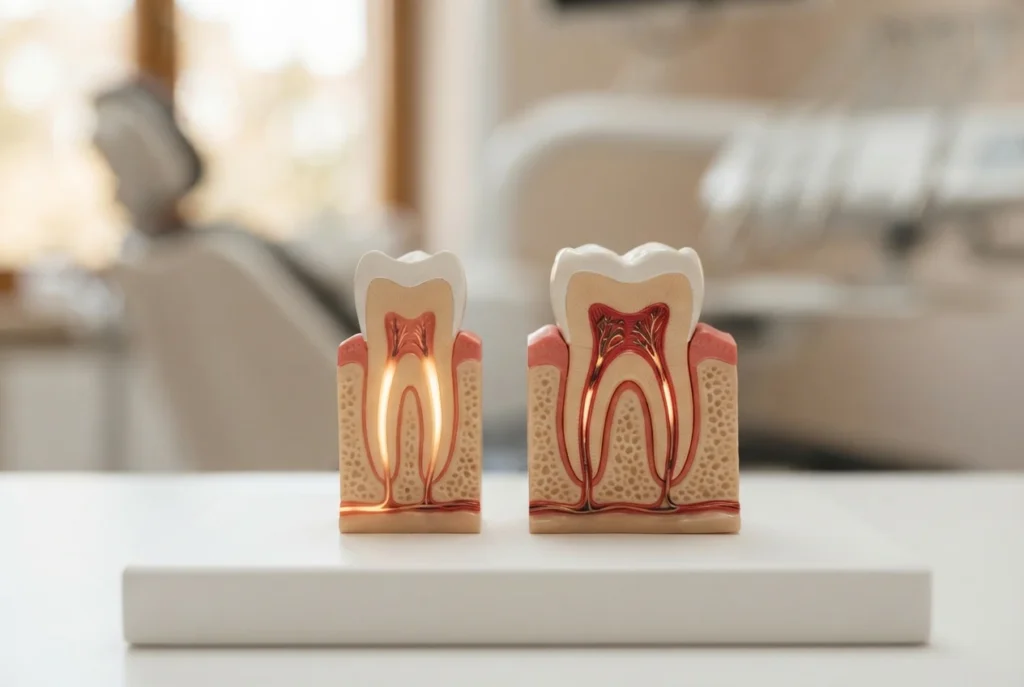
If your dentist just told you a tooth needs a root canal, the next question is usually about money. So how much is a root canal? In the US, it depends mostly on which tooth needs it. A front tooth is the cheapest. A molar costs the most, and it usually needs a crown afterward, which can roughly double the bill.
Here’s the short answer. Delta Dental’s claims data, put typical out-of-network fees at about $1,200 for a front tooth, $1,300 for a premolar and $1,500 for a molar. That covers the root canal only. Insurance often pays 50% to 80% of it after your deductible.
The rest of this guide explains why the gap exists, what goes on top of the base fee, and how to read a quote so you’re not surprised at checkout.
How Much Is a Root Canal by Tooth Type? A Quick Comparison
Prices vary by city, by provider and by how complicated your case is. Use these as ballpark figures, not a quote.
| Tooth | Typical canals | Approx. root canal fee (out-of-network, 2026) | Crown usually needed? |
|---|---|---|---|
| Front tooth (incisor or canine) | Usually 1 | About $1,200 | Sometimes; a filling may be enough |
| Premolar (bicuspid) | 1 to 2 | About $1,300 | Often |
| Molar | 3 or more | About $1,500 | Usually |
In-network prices are often lower. Delta Dental’s figures above are out-of-network charges, so a dentist in your plan’s network may bill less. Other national chains publish their own numbers. Aspen Dental, for example, lists a 2026 range of about $625 to $1,607 for the root canal procedure, depending on the tooth and the case.
Why a Molar Costs More Than a Front Tooth
The price gap isn’t arbitrary. It comes down to anatomy and time in the chair.
More canals to find and clean
A front tooth usually has one straight root with one canal. A molar has two or three roots and often three or four canals, sometimes more. In one study of upper first molars, researchers found a fourth canal in about 67% of extracted teeth, and one tooth had seven.
Every canal has to be located, cleaned, shaped and sealed. A canal that gets missed can stay infected, so dentists treating molars often use magnification and extra imaging to find every one.
Harder to reach
Molars sit at the back of your mouth. That means less room to work, a harder angle, and more effort to keep the area dry. Curved or very narrow canals, which are more common in back teeth, add even more time.
More likely to be sent to a specialist
Because molars are trickier, general dentists refer more of them to endodontists. Endodontists are dentists with at least two extra years of training focused on root canal care, according to the American Association of Endodontists (AAE). Their fees are often higher, but complex cases may be done in fewer visits and with better odds of finding every canal.
What this means in practice
A straightforward front tooth might take one visit of about an hour. A molar with four canals, or one that’s badly infected, can take longer or need two appointments. That extra time is a big part of what you’re paying for.
Where premolars fit in
Premolars, the teeth between your canines and molars, sit in the middle on price. Many have one canal, but upper premolars often have two. If someone asks you how much is a root canal on a premolar, about $1,300 out-of-network is a fair 2026 reference point. Like molars, they handle chewing pressure, so a crown is often recommended.
The Crown Factor: Where the Real Price Difference Shows Up
This is the part many people miss when they compare quotes. When an office tells you how much is a root canal, that number rarely includes the final restoration.
After treatment, the tooth needs something to seal and protect it. Delta Dental notes that at a minimum, the tooth will need a new filling, and a crown is often the preferred option.
- Front teeth take lighter biting forces. If plenty of healthy tooth structure is left, a dentist may seal the access hole with a tooth-colored filling instead of a crown.
- Molars handle most of your chewing. After a root canal, the tooth can become more brittle, so dentists commonly recommend a crown to keep it from cracking.
Crowns aren’t cheap. Aflac, citing GoodRx data it accessed in 2026, puts typical crown costs between $800 and $2,500 without insurance, depending on the material. Porcelain, zirconia and gold all land at different points in that range.
A realistic all-in example
Here’s how the totals can stack up before insurance, using the estimates above:
| Scenario | Root canal | Restoration | Rough total |
|---|---|---|---|
| Front tooth, filling only | ~$1,200 | Filling (a few hundred dollars) | ~$1,400 to $1,600 |
| Front tooth with crown | ~$1,200 | Crown ($800 to $2,500) | ~$2,000 to $3,700 |
| Molar with crown | ~$1,500 | Crown ($800 to $2,500) | ~$2,300 to $4,000 |
Your actual numbers will differ. The point is that a molar usually costs more twice: once for the root canal, and again because it almost always needs a crown.
Other Fees That Can Show Up on Your Bill
Your quote may list several line items besides the procedure itself. Ask about these upfront:
- Exam and X-rays. Usually billed separately, especially at a specialist’s office.
- 3D imaging (CBCT scan). Sometimes used for molars with unusual or hidden canals.
- Core buildup. If a lot of the tooth is gone, the dentist rebuilds it before placing a crown. This is a separate charge.
- Temporary filling or crown. Placed between visits.
- Emergency or after-hours fees. If the tooth flares up on a weekend.
- Retreatment. If an old root canal fails, treating the same tooth again usually costs more than the first time.
Check the procedure code on your estimate
Dental offices bill root canals with standard codes. D3310 is a front (anterior) tooth, D3320 is a premolar and D3330 is a molar. Seeing the code on your written estimate helps you confirm which tooth you’re being billed for. It also lets you compare quotes from two offices fairly and check what your insurer will pay before you book.
How Much Is a Root Canal With Insurance?
Most dental plans treat root canals as a “basic” or “major” service. Delta Dental says plans commonly cover 50% to 80% of the root canal cost once you’ve met your deductible.
Here’s a simple example. Say your molar root canal is $1,500 and your plan pays 50% after a $50 deductible:
- You pay the first $50.
- The plan pays 50% of the remaining $1,450, which is $725.
- Your share is about $775 for the root canal.
Then the crown is billed separately, often with its own coverage percentage.
Watch your annual maximum
Most plans cap what they’ll pay in a calendar year. A molar root canal plus a crown can use up much of that limit on its own. If you’re close to the cap, ask your dentist whether part of the work, such as the crown, can safely be scheduled in the next plan year. Don’t delay treatment just to save money, though, unless your dentist confirms it’s safe.
Some plans also require pre-authorization, so call your insurer or ask the office to send a pre-treatment estimate first.
Ways to Lower Your Cost Without Cutting Corners
How much is a root canal going to cost you personally? That depends on the choices you make before treatment. If the number on your quote is hard to swallow, you have options:
- Stay in network. If you have insurance, an in-network dentist usually charges a discounted fee.
- Ask for a written estimate with codes. It makes comparing two offices much easier.
- Look into dental schools. Supervised students and residents often treat patients at lower fees. Expect longer appointments.
- Consider a dental savings plan. These membership plans offer discounted fees at participating dentists. They aren’t insurance, so check what’s included.
- Ask about payment plans. Many offices offer monthly payments or work with healthcare financing companies. Read the interest terms carefully.
- Use HSA or FSA funds. Root canals and crowns are generally eligible medical expenses for these accounts.
One thing not to do is put off a recommended root canal to save money. An untreated infection can spread or cause an abscess, and the tooth may end up needing extraction, which brings its own costs.
Root Canal vs Pulling the Tooth: The Long-Term Math
An extraction usually costs less on the day. For a front tooth, though, a gap is hard to live with. For a molar, losing the tooth can affect chewing and let neighboring teeth drift.
The AAE points out that replacing a missing tooth with an implant or bridge generally costs more and takes more appointments than saving it. So the cheaper option today often turns out to be the more expensive one over a few years.
That said, not every tooth can be saved. If a tooth is cracked below the gumline or there isn’t enough healthy structure left, your dentist may advise extraction. Ask them to explain the long-term options and costs for your specific tooth.
Questions to Ask Before You Agree to Treatment
Bring these to your appointment:
- Which tooth is it, and how many canals do you expect?
- Will you do it, or should I see an endodontist?
- Does the quote include X-rays, the buildup and the crown?
- How many visits will it take?
- What will my insurance likely pay, and can you send a pre-treatment estimate?
- What happens if I wait, and how long is it safe to wait?
The Bottom Line
So how much is a root canal on a molar compared with a front tooth? Based on 2026 estimates, expect roughly $1,200 for a front tooth and around $1,500 for a molar, before insurance. The bigger difference usually comes after the procedure. Most molars need a crown, which can add $800 to $2,500, while many front teeth can get by with a simpler restoration.
Your best next step is to ask for a written, itemized estimate that lists the procedure code, the restoration and any extra fees. Then check it against your insurance benefits. A dentist or endodontist who has examined your tooth is the only one who can give you a true price, so treat every figure here as a starting point for that conversation.
Frequently Asked Questions
Is a molar root canal more painful than a front tooth?
Not usually. Both are done under local anesthesia, and most people say it feels similar to getting a deep filling. Molar treatment may take longer, so the visit itself can be more tiring.
Can a front tooth root canal be done without a crown?
Often, yes. If enough healthy tooth is left, a dentist may use a tooth-colored filling instead. Your dentist will decide based on how much tooth structure remains.
How much is a root canal if the tooth was treated before?
Retreating a tooth that already had a root canal usually costs more than the first treatment, because the old filling material has to be removed first. It’s often done by an endodontist. Ask for a separate quote.
Why does my quote differ from the averages online?
Location, the provider’s training, your tooth’s anatomy, the severity of the infection, and your insurance network all affect price. Published averages are only a starting reference.
Does insurance cover the crown too?
Many plans cover crowns, but often at a different percentage from the root canal, and only up to your annual maximum. Ask your insurer for a pre-treatment estimate covering both.