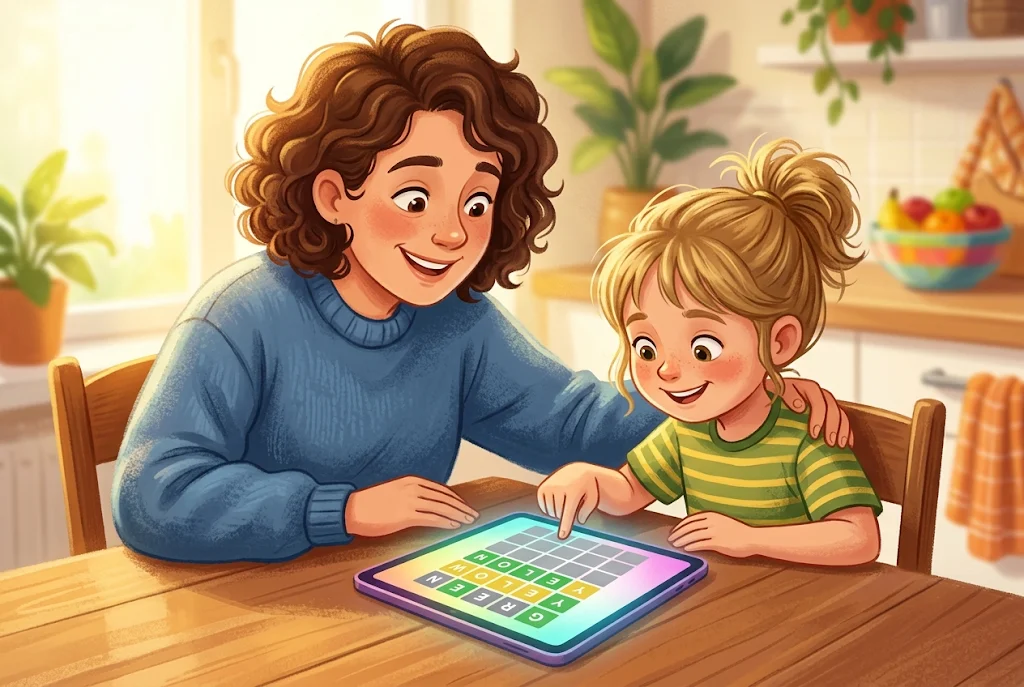
Spellie is a free, browser-based daily word game built for kids. It works like Wordle: you get six tries to guess a hidden word, and colored tiles tell you how close each guess was. The difference is who it’s made for. Spellie uses words that kids in roughly grades 2 to 5 actually know, and it offers three difficulty levels, built-in hints, and collectible emoji rewards, so a young player can finish a puzzle without getting stuck on a word like “query” or “proxy.”
If your child has watched you play Wordle and wanted a turn, this is the game most parents end up finding. Below, you’ll see where it came from, how a round works, how it compares to Wordle, and how to use it at home or in a classroom.
Where Spellie Came From
Spellie started at a kitchen table, not in a game studio. Christopher Porter, a software engineer in Vancouver, was playing Wordle with his daughter Astrid in early 2022. She enjoyed the routine, but many Wordle answers were adult vocabulary she’d never seen.
Porter and a friend built a kid-sized version instead. According to the CBC’s report on the game’s launch, it came directly out of that father-daughter Wordle habit.
Porter shared a few design lessons on his blog post introducing the game. One surprised the team: shorter words turned out to be harder, not easier, because a four-letter guess gives you less feedback than a six-letter one. Young spellers know far more short words than long ones, so the team added hints to the easy level to balance that out.
A few other facts from its early coverage:
- It launched free, with no advertising, and Porter said at the time he planned to keep it that way.
- The source code was published openly on GitHub, so others could suggest fixes and features.
- Teachers and English learners outside Canada, including in Japan and Germany, picked it up within weeks.
Editor’s note: These details reflect the game’s 2022 launch coverage. Check the current site before publishing in case pricing, ads, or ownership have changed.
How to Play Spellie, Step by Step
If you’ve played Wordle, you already know 90% of this. If you haven’t, a round takes about two to five minutes.
- Open the game in a web browser. There’s no download needed. It runs on a phone, tablet, laptop, or classroom smartboard.
- Pick a level. Easy, medium, or hard. Each level has its own puzzle for the day.
- Type a guess. Your guess must be a real word of the right length.
- Read the colors. Each letter tile changes color after you submit.
- Use what you learned for the next guess. Keep letters that turned green in the same spot and move the yellow ones.
- Solve it within six tries. When you get it, you earn an emoji for your collection (on easy and medium).
What the Colors Mean
| Tile color | What it tells you | What to do next |
|---|---|---|
| Green | Right letter, right spot | Keep it exactly where it is |
| Yellow | Right letter, wrong spot | Try it in a different position |
| Gray | Letter isn’t in the word | Stop using it |
A common beginner mistake is reusing gray letters. Kids often do this because they’re focused on the word they want to spell rather than the clues on the screen. A quick tip for parents: before each new guess, ask your child to name one green or yellow letter out loud. It slows them down just enough to use the feedback.
Easy, Medium and Hard: Which Level Fits Your Child?
The three levels are the main reason the game works for such a wide age range. A second grader and a fifth grader can play the same day without either one getting bored or frustrated.
| Level | Word length | Extra help | Best for |
|---|---|---|---|
| Easy | 4 letters | One letter is shown at the start | Early readers, roughly grades 2–3 |
| Medium | Longer words* | Hints available | Confident readers, roughly grades 3–4 |
| Hard | Longest words* | Hints available | Strong spellers, up to about grade 5 vocabulary |
*The easy level’s 4-letter format is widely documented. Several third-party listings describe medium and hard as 5- and 6-letter words; confirm on the live game before quoting exact lengths.
A practical way to choose: start on easy, even if your child is a good reader. If they solve it in three tries or fewer for a week straight, move them up. Starting too hard is the fastest way to turn a fun daily habit into a chore.
Spellie vs Wordle: What’s Actually Different?
Both games share the same core loop, so it’s easy to assume Spellie is just Wordle with a cartoon skin. The real differences are in the word choice and the support around it.
| Feature | Wordle (The New York Times) | Spellie |
|---|---|---|
| Intended players | Adults | Kids, roughly grades 2–5 |
| Puzzles per day | One | One per difficulty level |
| Word length | Always 5 letters | Varies by level |
| Vocabulary | Includes uncommon adult words | Kid-appropriate words |
| Hints | None | Available |
| Rewards | Streaks and stats | Collectible emojis (400+ at launch) |
| Cost | Free to play | Free to play |
The hint system is the biggest practical difference. In Wordle, a bad start can leave you staring at the screen. In Spellie, a stuck seven-year-old can ask for help and still finish, which keeps the daily routine going.
Features Parents and Teachers Like
Beyond the core puzzle, a few settings make the game more usable for different kids:
- Upper or lowercase letters. Younger children who are still learning lowercase can switch the display to match what they’re practicing.
- Keyboard layout options. Choose a standard keyboard or an alphabetical layout. Alphabetical often helps kids who haven’t learned to type yet.
- High-contrast mode. Easier to see for some players, and handy when you’re projecting the game onto a classroom screen.
- Emoji collection. Each solved word adds an emoji. It’s a small reward, but it gives kids a reason to come back the next day.
- Past puzzles. An archive of earlier words can be used for extra practice or review.
Tips to Help Kids Solve the Daily Word
Most kids figure out the basic rules in a single round. The strategy takes a little longer. These habits make the biggest difference for young players:
- Start with a vowel-heavy word. A first guess with two or three different vowels, like “rain” or “boat” on a four-letter puzzle, tells you a lot quickly.
- Don’t repeat letters early. A word with five different letters checks five letters at once. A word like “ball” only checks three.
- Think about common endings. Many kid-level words end in patterns such as -ing, -ed, -ck or a silent e. If the last letters turn green, say the pattern out loud together.
- Use hints as a last step, not the first. Encourage one or two honest guesses before asking for help, so the hint feels earned.
- Sound it out before typing. Saying a guess aloud often catches a misspelling before it costs a try.
Common Mistakes to Avoid
Parents tend to make a few predictable mistakes when they first sit down with a child and this kind of game:
- Giving the answer too soon. It ends the round faster, but it takes away the small win that keeps kids playing.
- Turning it into a test. If every wrong guess gets a correction, the game starts to feel like a quiz. Let the colors do the teaching.
- Playing at the wrong level. A child who fails three days in a row usually needs an easier mode, not more practice at the same one.
- Skipping the “why.” After a solve, ask one quick question, like “Which clue helped most?” That short reflection is where much of the learning sticks.
A realistic goal for a beginner is finishing the easy puzzle most days, even with a hint. Speed and fewer tries come later.
Is Spellie Good for Learning?
It’s a game first, so set realistic expectations. It won’t replace a phonics program or a teacher’s spelling lessons. What it does well is give kids short, daily, low-pressure practice with letter patterns and word structure.
There’s some early evidence behind this. A 2024 research note from a Japanese university, Let’s Look at Spellie: An Online Game for English Language Learners, tested the game with 87 university students learning English. Most responses in its feedback survey were positive, and the author concluded it showed potential for vocabulary practice in class and at home. Keep in mind this was a small classroom trial with adult learners, not a large study of children.
Simple Ways to Use It in Class or at Home
- Morning warm-up. Project the easy puzzle and let the class vote on each guess.
- Word journal. After solving, kids write the word and use it in a sentence.
- Word wall. Add each day’s answer to a shared wall and revisit them on Fridays.
- Partner play. Pair a stronger speller with a newer one and have them explain each guess.
- Family routine. Play your Wordle while your child plays theirs, then compare tries.
Is Spellie Safe for Kids?
Because it runs in a browser and doesn’t require an account to play, there’s no profile, chat, or friend list for kids to deal with. At launch, the creators described it as free and ad-free.
That said, two cautions are worth knowing:
- Watch out for lookalike sites. Because the name is popular, several copycat websites now use “Spellie” in their domain. Some carry ads or link to unrelated games. Bookmark the original game once you’ve confirmed the right address, so your child always opens the same site.
- Don’t confuse it with the app. There’s a separate iPhone and iPad app called Spellie from Iron Games. It’s a different puzzle where you build as many words as possible from seven letters, and its App Store listing shows in-app purchases. It isn’t the Wordle-style kids’ game described here.
As with any website, it’s a good idea to test it yourself for a few minutes before handing the device over.
Spellie, Spelly or Spelli? Finding the Right Game
Plenty of people search for it as “Spelly,” “Spelli,” or simply “Spellie game.” They’re usually looking for the same thing. The original was released at spelliegame.com in 2022. If a search sends you somewhere with heavy ads, pop-ups, or a different style of puzzle, you’ve probably landed on a copy rather than the original Spellie.
The Bottom Line
Spellie takes everything that made Wordle a daily habit and resizes it for kids. Three levels, real hints, and small rewards make it easy for a young speller to win, which is exactly what keeps them coming back. Start your child on easy, play alongside them for the first few days, and treat it as a fun five-minute routine rather than homework.
Frequently Asked Questions
Is Spellie free?
Yes. The original web game launched free to play with no ads. Check the live site for any changes since launch.
What age is Spellie for?
It’s designed for kids in roughly grades 2 to 5, which is about ages 7 to 11. Older kids and English learners can use the hard level.
Do you need to download Spellie?
No. The kids’ Wordle-style game runs in a web browser on phones, tablets, and computers. The Spellie app on the App Store is a different game.
How many tries do you get?
Six tries per puzzle, the same as Wordle.
Can Spellie be used in school?
Yes. Teachers use it as a warm-up, for word walls, and for spelling and phonics practice. High-contrast mode helps when projecting it for a class.