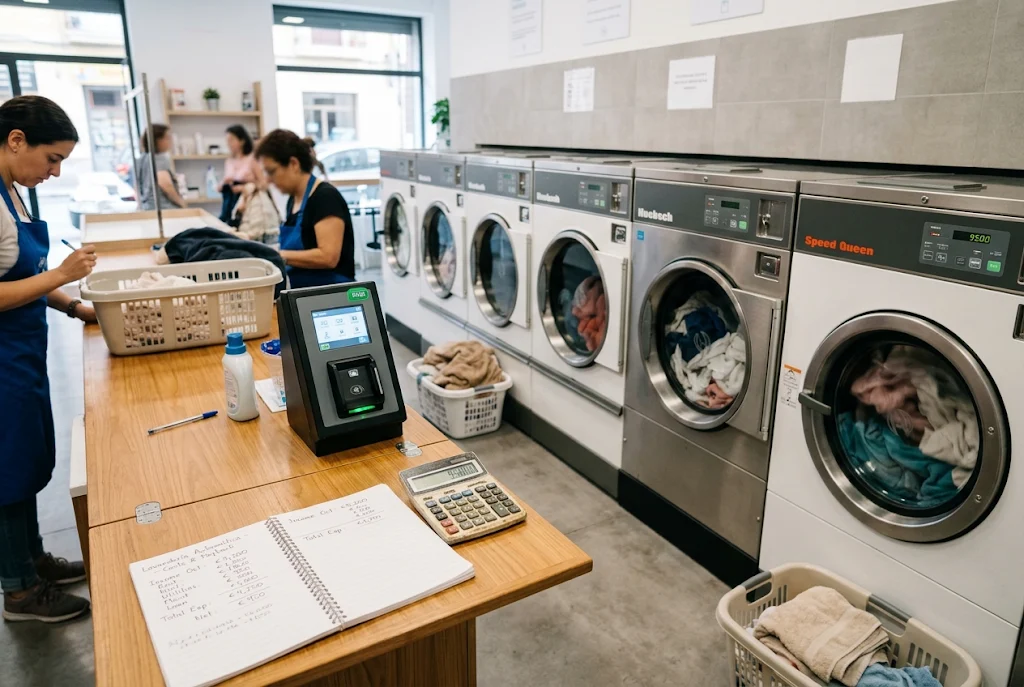
Yes, a lavandería automática (a self-service laundromat, known in Russia as a прачечная самообслуживания) can be profitable in Russia. It isn’t the passive cash machine franchise ads make it sound like, though. The most commonly quoted Russian figures put startup costs at around 2 million rubles. A well-located laundromat can pay that back in roughly 12 to 18 months. A poorly located one may take five years or never get there.
What decides which group you end up in is customer traffic, rent and how well you look after your machines. Below we go through realistic income per visit, the monthly costs, two worked payback scenarios and the break-even number you need to check before you sign a lease.
The Short Answer: What the Numbers Look Like
Here’s a quick summary of the figures that come up again and again in Russian business guides and franchise offers.
| Item | Typical range in Russia | Notes |
|---|---|---|
| Startup investment | ~2 million ₽ | Equipment, renovation, deposit, launch marketing |
| Price of one wash (10–16 kg) | 350–620 ₽ | Moscow and region prices; lower in smaller cities |
| Price of one dry cycle | ~150 ₽ | Often sold in time blocks (10, 20, 40 minutes) |
| Monthly revenue (franchise claims) | ~260,000 ₽ | One brand’s stated average, not a guarantee |
| Payback period | 12–18 months | With a good location; much longer without one |
Treat these as starting points, not promises. Prices, rent and equipment costs change quickly, especially when imported machines are involved, so check them locally before you plan around them.
Who Actually Uses a Self-Service Laundromat in Russia?
A laundromat’s income depends on how often people come through the door, so start with who those people are.
Russian business guides consistently name the same core customers:
- Students and dormitory residents who don’t have their own washing machine
- Tourists and business travellers staying in hotels, hostels or short-term rentals
- Renters whose apartment machine is small, old or broken
- Families washing bulky items, such as duvets, blankets, curtains and pillows that won’t fit a home machine
The last group matters more than many new owners expect. Reviews of Moscow laundromats often mention people bringing duvets and blankets that don’t fit their machine at home. That’s useful: bulky loads use your largest, most expensive machines, and people pay more for them.
Most laundromats are concentrated in Moscow and St. Petersburg. Other large cities are less saturated, and many smaller towns have none at all. That cuts both ways. There’s less competition outside the two capitals, but you’ll also spend money teaching locals that the service exists.
Where the Income Comes From
A laundromat makes money from several small transactions per customer. It doesn’t rely on one big sale.
Washing and drying
The core revenue comes from washing and drying. One Russian franchise publishes these unit prices and costs:
| Service | Price to customer | Stated cost per cycle | Gross margin |
|---|---|---|---|
| Wash, 10 kg load | 350 ₽ | 37 ₽ | ~89% |
| Dry, 10 kg load | 150 ₽ | 18 ₽ | ~88% |
| Detergent dose from dispenser | 50 ₽ | up to 10 ₽ | ~80% |
The margin per cycle looks enormous, and on its own it is. That’s why laundromats get described as “highly profitable”. The catch is that those margins only cover the water, electricity and chemicals for each cycle. Rent, equipment repairs and marketing still have to come out of the total, and they don’t shrink when you have a quiet week.
Average spend per visit
A typical customer washes once, dries once and buys a detergent dose. Using the prices above, that’s about 550 ₽ per visit, with around 65 ₽ in direct costs. Real visits vary, though. Some customers only wash, while others run two machines and dry for 40 minutes.
Extra income streams
Owners in Russia often add:
- Prepaid subscriptions (абонементы), which bring in cash upfront and encourage people to come back
- Specialised machines, such as sneaker washers or 15–18 kg machines for duvets
- Wash-dry-fold service, where staff do the laundry for a fee. This raises income but adds labour costs.
- Small retail, such as laundry bags, stain removers and vending snacks while people wait
None of these will rescue a bad location, but they can raise the average spend by 10–20% at a busy site.
The Monthly Expenses Nobody Should Underestimate
This is where many business plans go wrong. Here’s a realistic monthly cost list for a small laundromat with 4–6 washers and a similar number of dryers.
Fixed costs (you pay these even with zero customers)
One franchisor lists its typical monthly costs as:
- Rent: 30,000 ₽
- Utilities (base charges): 12,000 ₽
- Cleaning and internet: 5,000 ₽
- Advertising: 7,000 ₽
- Taxes and other costs: 10,000 ₽
That adds up to 64,000 ₽. Be careful with the rent figure: 30,000 ₽ is plausible for a small space in a regional city, but in central Moscow or St. Petersburg a suitable ground-floor space can easily cost several times more.
Costs that are often left out
Franchise summaries don’t usually list these, but you should budget for them:
- Maintenance and repairs. Commercial machines run all day. Bearings, door locks, drain pumps and payment terminals break down. Set aside a monthly repair reserve rather than hoping nothing breaks.
- Payment processing fees. Card and QR payments go through acquiring services, which take a percentage of each transaction.
- Software and remote monitoring. Many unstaffed laundromats pay a monthly fee for systems that let the owner see machine status and income online.
- Your own time. Someone has to empty lint filters, refill the detergent dispensers, handle “the machine ate my money” complaints and clean the floors. If that isn’t you, it’s a paid employee.
- Royalties. If you open under a franchise, check whether there’s a monthly royalty or marketing fee and how it’s calculated.
Startup Costs: Where the 2 Million Rubles Goes
Startup budgets vary a lot, but most cover the same items:
| Startup cost | What it covers |
|---|---|
| Washing machines and dryers | Commercial-grade machines, often the biggest single item |
| Renovation | Waterproof flooring, drainage, ventilation, electrical upgrades |
| Water and power connections | Capacity upgrades if the building can’t handle the load |
| Payment and control system | Terminals, software, cameras |
| Deposit and first months’ rent | Usually 1–3 months upfront |
| Franchise fee (if any) | One-off entry fee |
| Launch marketing | Signage, local ads, map listings, opening offers |
One point that surprises first-time owners: the space itself has to meet Russia’s sanitary rules, specifically SP 2.1.3678-20 (СП 2.1.3678-20), which covers requirements for buildings used to provide services to the public. Ventilation, drainage and finishes matter here, and fixing problems after renovation is expensive. Confirm with the landlord and a specialist before you sign.
Two Realistic Payback Scenarios
Here’s how the numbers play out. Both scenarios use the same prices and an investment of 2,000,000 ₽. They’re illustrative models, not forecasts.
Assumptions used in both:
- Average spend: 550 ₽ per visit
- Direct cost per visit: 65 ₽
- Fixed costs: 64,000 ₽ + 15,000 ₽ repair reserve + ~2% payment fees
Scenario A: Good location (about 16 visits a day)
| Line | Monthly amount |
|---|---|
| Visits | ~470 |
| Revenue | ~260,000 ₽ |
| Direct cycle costs | –30,600 ₽ |
| Fixed costs | –64,000 ₽ |
| Repair reserve | –15,000 ₽ |
| Payment fees (~2%) | –5,200 ₽ |
| Profit before owner’s time | ~145,000 ₽ |
Payback: around 14 months. That fits the 12–18 month range most Russian sources quote.
Scenario B: Weak location (about 8 visits a day)
| Line | Monthly amount |
|---|---|
| Visits | ~240 |
| Revenue | ~132,000 ₽ |
| Direct cycle costs | –15,600 ₽ |
| Fixed costs | –64,000 ₽ |
| Repair reserve | –15,000 ₽ |
| Payment fees (~2%) | –2,600 ₽ |
| Profit before owner’s time | ~35,000 ₽ |
Payback: around 57 months, or nearly five years. That’s assuming nothing major breaks along the way.
Halving the traffic doesn’t halve your profit. It cuts it by about 75%, because fixed costs stay the same. This is the most important thing to understand about whether a lavandería automática is profitable.
Your Break-Even Number
Before you commit, work out how many visits a month you need just to cover your costs:
Break-even visits = Monthly fixed costs ÷ Margin per visit
Using the model above:
- Fixed costs (including repairs and fees): roughly 84,000 ₽
- Margin per visit: 550 ₽ – 65 ₽ = 485 ₽
- Break-even: 84,000 ÷ 485 ≈ 173 visits a month, or about 6 a day
Every visit beyond that is profit. If you can’t confidently say your chosen spot will bring in well over six paying customers a day, keep looking for a better one.
Replace the numbers with your real local rent and prices. In Moscow, a rent of 100,000 ₽ pushes the break-even point to roughly 15 visits a day, which completely changes the plan.
What Separates Profitable Laundromats from Struggling Ones
Location beats everything
The best spots tend to be:
- On the ground floor of large residential complexes, where residents can drop in on their way home
- Near universities, dormitories and hostels
- In tourist districts with lots of short-term rentals
- Next to places people already visit, like supermarkets or parcel pickup points, so they can run errands while the machines run
Spend a few weekday evenings and a Saturday morning counting foot traffic before you sign a lease. Also check the map apps: is there already a laundromat within a 10-minute walk?
Machine mix
Don’t fill the room with identical machines. Have a few large-capacity washers for duvets, some mid-size machines for everyday loads and at least one smaller machine. Customers who want to wash a small load will skip you if they have to pay for a large machine.
Reliability and reputation
In an unstaffed business, one broken payment terminal or a machine that swallows money without starting can lead to negative reviews that hurt for months. Fix problems quickly, keep the place clean and answer reviews on the map apps.
Franchise or Independent?
Laundromat franchises are widely available in Russia, with investments starting from a few hundred thousand rubles for small formats to about 2 million rubles for full-size laundromats.
A franchise can help with:
- Choosing equipment and suppliers
- Analysing locations
- A ready-made brand, software and marketing materials
But keep in mind:
- The profit and payback figures in franchise listings are sales material. Ask for actual financial results from several existing locations, not just the best one.
- Ask what happens if your location underperforms, and whether the franchisor will help you move or exit.
- Read the royalty, equipment purchase and territory exclusivity terms carefully.
Going independent saves the franchise fee but means you research equipment, software and location on your own. If this is your first business, the franchise route often reduces beginner mistakes. You just pay for that.
Legal and Tax Basics in Russia
You can register either as a sole proprietor (ИП) or a limited company (ООО). The activity code that covers self-service laundromats is OKVED 96.01, “Washing and dry-cleaning of textile and fur products”, which explicitly includes laundries run with self-service machines.
Common tax options for small laundromats include the simplified tax system (УСН), either 6% of income or 15% of income minus expenses, and in some regions the patent system (ПСН). Which one works out cheaper depends on your expenses, region and turnover. Tax rules in Russia have changed several times in recent years, so talk to a qualified accountant before you register. Don’t rely on online summaries, including this one.
Common Mistakes That Hurt Profitability
- Signing a lease before checking the space. Inadequate drainage, ventilation or power capacity can add hundreds of thousands of rubles to renovation costs.
- Believing the franchise brochure. Use the scenarios above and stress-test with lower traffic.
- Skipping the repair budget. Commercial machines are tough but not indestructible.
- Underestimating marketing in smaller cities. Where laundromats are rare, you need to explain what the service is, not just where you are.
- Ignoring the waiting experience. Seats, Wi-Fi, a clean space and good lighting at night make customers come back.
The Bottom Line
A lavandería automática in Russia can be a solid business with high margins per cycle and low staffing needs. Realistic payback is around 12–18 months, but only if you can get enough customers through the door. The economics depend heavily on fixed costs, so a weak location or expensive rent can easily stretch payback to several years.
Your next step: pick two or three possible locations, get real rent quotes, and calculate your own break-even visits per day using the formula above. If the number looks easy to reach, it’s worth taking further. If it looks like a stretch, it’s better to find out now than after you’ve spent 2 million rubles.
Frequently Asked Questions
How much does it cost to open a self-service laundromat in Russia?
Most Russian guides put a typical full-size launch at around 2 million rubles. Small franchise formats advertise lower entry costs, while larger laundromats in Moscow can cost considerably more.
How long does it take for a laundromat to pay for itself?
With a good location, around 12–18 months is commonly quoted. With low traffic or high rent, payback can stretch to four or five years.
Can a laundromat run without staff?
Many in Russia operate unstaffed, using card or QR payments and remote monitoring. Someone still needs to clean, refill supplies and deal with breakdowns several times a week.
Is it better to open in Moscow or a regional city?
Moscow has more demand but also higher rent and more competition. Regional cities often have little competition, but you’ll spend more on teaching customers about the service. Your break-even calculation will show which works better for your budget.
What tax system do laundromats use in Russia?
Many use the simplified tax system (УСН) or, where available, the patent system. The best choice depends on your region and costs, so check with an accountant.