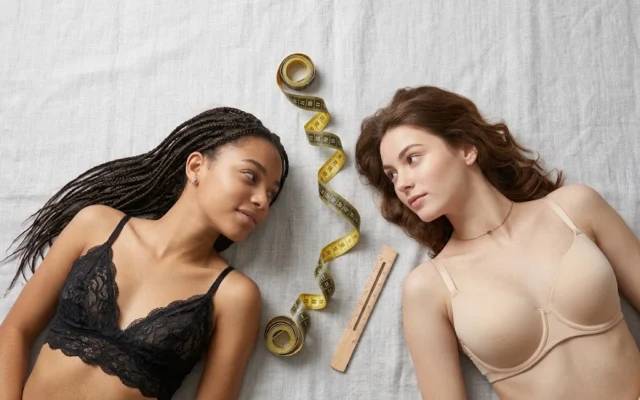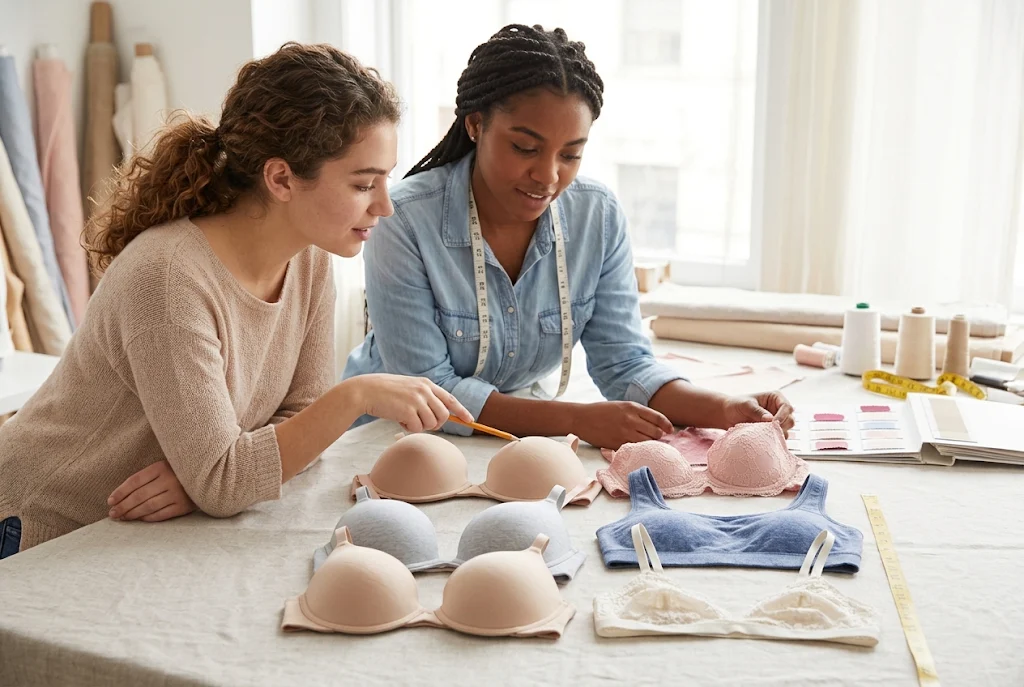
Most people own one or two bra styles and wear them with everything, then wonder why a new top looks wrong. Usually the size isn’t the problem. The shape is. A plunge, a balconette and a full cup in the same size will look and feel very different under the same blouse.
The short answer: a T-shirt or full-cup style works for most everyday outfits. Plunge and balconette cuts suit low or wide necklines, sports and minimiser styles handle function, and strapless, multiway and adhesive options cover special outfits. Below you’ll find all 15 types, what each one does well, where it falls short, and the outfits it suits best.
Before You Shop: How Sizes Work in Germany
If you shop in Germany, your label probably reads something like 75B or 80C, not 34B. That’s because German shops use the European EN 13402 system, and it changes how you compare sizes when you order from UK or US brands.
Here’s how it works:
- The number is your underbust in centimetres, rounded to the nearest 5 (65, 70, 75, 80 and so on).
- The letter shows the difference between your bust and underbust. Under the European EN 13402 standard, each cup letter adds about 2 cm, while UK and US cups step up by one inch (2.54 cm).
- US bands often run differently. Some US brands still add inches to your underbust measurement, so a US 34 is not always the same as a European 75.
What this means for you: when you order from an international brand, use that brand’s own size chart and enter your measurements in centimetres. Don’t just convert one label to another. The gap grows as cup sizes get larger, so a straight conversion can be off by a full letter or more.
Everyday Styles
These are the ones you’ll reach for most days, so it’s worth getting them right first.
1. T-Shirt Bra
A T-shirt style has smooth, moulded cups with no seams or lace on the outside. This bra’s whole job is to disappear under thin, fitted fabrics.
- Wear it with: jersey tops, knit dresses, office shirts, fitted sweaters
- Good to know: a moulded cup on its own doesn’t make something a T-shirt style. Some moulded cups are unlined and can still show through light fabric. If you want full smoothness, look for a lightly lined or foam cup.
- Skip it if: you find foam cups too warm in summer
2. Full-Cup
A full-cup bra covers the whole breast and usually have a higher centre and sides. They give the most containment of any non-sports style.
- Wear it with: high necklines, workwear, long days on your feet
- Good to know: it’s often the most comfortable choice for fuller busts. If the top edge shows above your usual tops, you may want a slightly lower cut instead.
3. Wireless or Soft-Cup
These have no underwire. Support comes from the fabric, seams, a firmer band and sometimes moulded foam. Comfort-first styles like these have grown a lot in recent years, and many now come in a much wider size range than they used to.
- Wear it with: home days, travel, long flights, relaxed weekends
- Good to know: “wireless” doesn’t mean “unsupportive”. A well-fitted soft-cup with a firm band can hold more than a poorly fitted wired one.
4. Bralette
By comparing the Bralette & Bra, A bralette is a lighter, unpadded and usually wire-free piece, often made of lace or soft cotton. It’s meant to be a little bit seen.
- Wear it with: loose shirts, cardigans, open-back tops, layered outfits
- Good to know: most bralettes are sold in S/M/L sizes and give light support. They tend to suit smaller cup sizes best. Some brands now make banded and cup-sized versions for fuller busts.
Styles Built Around Necklines
Here the neckline of your outfit should decide which style you pick.
5. Demi Cup
“Demi” means half, and these cups cover roughly the lower half to three quarters of the breast. The top edge sits lower than on a full cup.
- Wear it with: sweetheart, scoop and lower-cut necklines
- Good to know: brands use the word “demi” loosely, so the same label can mean slightly different cuts depending on where you buy. Check the product photos, not just the name.
6. Balconette
A balconette bra has a flatter, more horizontal top edge and straps set wider apart. It lifts from below without pushing inward.
- Wear it with: square necklines, wide boat necks, off-the-shoulder-adjacent tops where the straps can stay hidden
- Good to know: the centre front usually sits higher than on a plunge. So it’s a poor match for deep V-necks, where the middle may peek out. Many people with larger cup sizes like the lift it gives without squashing.
7. Plunge
A plunge bra has a low, narrow centre piece (called the gore) and cups angled inward to form a V.
- Wear it with: deep V-necks, wrap dresses, low-cut blouses
- Good to know: plunge cups often run a little shallower than full cups. If your normal size feels tight at the top, try the next cup up in plunge styles only.
8. Push-Up
A push-up bra has extra padding at the bottom or sides of the cup to lift and bring the breasts closer together.
- Wear it with: evening wear, fitted dresses, special occasions
- Good to know: it’s a styling piece, not an all-day workhorse. The padding can feel warm, and the shape can look too strong under casual or work clothes.
Special-Purpose Styles
These solve specific problems, whether that’s movement, hiding straps or a life stage.
9. Sports Bra
These are built to limit movement during exercise. They usually come in three support levels:
| Support level | Typical activities |
|---|---|
| Low | Yoga, Pilates, walking, stretching |
| Medium | Cycling, weight training, hiking |
| High | Running, HIIT, team sports, jumping |
- Good to know: compression styles press the breasts against the chest and suit smaller cups. Encapsulation styles have separate cups and generally work better for larger cups. Some high-impact designs combine both.
- Replace it when: the band stretches out or the fabric loses its snap, as that’s when support drops off.
10. Minimiser
A minimiser bra spreads breast tissue more evenly to reduce forward projection. It doesn’t actually make anything smaller.
- Wear it with: button-front blouses that gape across the bust, tailored jackets, fitted shirts
- Good to know: if your shirts gape at the buttons, try a minimiser first before sizing up the shirt.
11. Strapless
A strapless style has no straps, or removable ones. It relies on a firmer band, silicone grip strips and often a slightly wider wing to stay in place.
- Wear it with: strapless, halterneck and one-shoulder outfits
- Good to know: the band does all the work here. Many people find one band size down from their usual size keeps a strapless style from slipping. Try it on and lift your arms before you buy.
12. Multiway or Convertible
These come with straps you can rearrange: halter, crossback, one-shoulder or none at all.
- Wear it with: racerback tops, halter dresses, outfits with unusual strap lines
- Good to know: one well-fitted multiway piece can replace two or three special styles, which makes it a smart pick for travel or a capsule wardrobe.
13. Longline
A longline bra has a deeper band that extends down the ribcage, sometimes to the waist.
- Wear it with: fitted dresses, crop-top styling, vintage-inspired outfits
- Good to know: the extra band spreads pressure, so many people find it more comfortable than they expected. It also helps smooth the line under fitted fabric.
14. Nursing Bra
Nursing styles have clips or drop-down panels so you can feed without taking the whole thing off. They’re usually wire-free and stretchy to cope with size changes.
- Wear it with: everyday clothes during the breastfeeding months
- Good to know: size often changes after the birth and again as feeding settles into a pattern. A stretchy, soft-cup design is more forgiving than a fixed size. A midwife, lactation consultant or trained fitter can advise you on timing and fit.
15. Adhesive or Stick-On
These are cups that stick directly to the skin, with no band or straps.
- Wear it with: backless dresses, deep plunges and very open backs
- Good to know: they give very little lift and are best for smaller cup sizes and short events. Check the fit and run a small skin test a few days before an important occasion. If your skin is sensitive, the adhesive may not suit you.
Quick Match: Outfit to Style
| Outfit | Style to reach for |
|---|---|
| Thin T-shirt or knit dress | T-shirt |
| Deep V-neck or wrap dress | Plunge |
| Square or wide neckline | Balconette |
| Gaping button-front shirt | Minimiser |
| Strapless or one-shoulder | Strapless or multiway |
| Backless dress | Adhesive or low-back multiway |
| Gym session or run | Sports (match the impact level) |
| Lazy Sunday or long flight | Wireless or bralette |
How to Build a Small Bra Wardrobe
You don’t need all 15 types. Most people do well with a short list built around how they actually dress. Here’s a simple way to work it out:
- Start with your most worn tops. Look at what you wore over the last two weeks. If it’s mostly T-shirts and knits, your first bra should be a smooth everyday style.
- Add one neckline style. If you own several V-necks, pick a plunge. If square and wide necks are more your thing, pick a balconette.
- Cover your activity. If you run or train, a sports bra matched to that impact level is worth more than another everyday piece.
- Add specials only when you need them. Buy a strapless or adhesive option when a specific outfit calls for it, not “just in case”.
- Rotate. Wearing the same bra two days in a row gives the elastic no time to recover. Two or three everyday pieces in rotation usually last longer.
A simple starter set for many wardrobes is two T-shirt styles in a skin-tone shade and black, one plunge or balconette, and one sports bra.
Common Mistakes When Choosing a Style
- Blaming the size when it’s the shape. If a cup gapes at the top but fits at the bottom, a balconette or demi may suit you better than a smaller size.
- Wearing one style under everything. Even three well-chosen pieces, like a T-shirt style, a plunge and a sports style, will cover most outfits.
- Ignoring the band. Most of the support comes from the band, not the straps. If you keep tightening the straps, the band is probably too loose.
- Converting sizes by guesswork. As covered above, EU, UK and US labels don’t line up neatly. Use each brand’s own chart.
- Buying without trying a test outfit. Bring or wear the top you’re shopping for. Fitting rooms are the fastest way to see whether a cut works.
Final Takeaway
The right bra for an outfit is mostly about matching the cut to the neckline and the day ahead. Start with a smooth everyday style that fits well. Then add the one or two shapes your wardrobe needs most, such as a plunge for V-necks or a supportive sports piece if you train. Measure yourself in centimetres, check each brand’s chart, and pick the shape for the outfit rather than the label.
FAQ
What is the most versatile bra style? For most people, a well-fitted T-shirt style in a shade close to your skin tone. It works under the widest range of everyday clothing.
What’s the difference between a balconette and a demi cup? A balconette has a flatter top edge and wide-set straps, which suits square necklines. A demi usually has a more rounded, lower cut that suits scoop and sweetheart necklines. Brands use both terms loosely.
Are wireless styles less supportive? Not necessarily. Support depends mostly on the band and the fit. A firm, well-fitted soft-cup can support well, especially for everyday wear.
How do I convert a German size like 75B to a UK size? There’s no exact one-to-one conversion, because cup steps differ (2 cm in the EU vs one inch in the UK and US). The most reliable way is to measure your underbust and bust in centimetres and use the target brand’s chart.
How many bras does one person need? There’s no fixed number. A practical base is two or three everyday pieces to rotate, plus one style for each special need you actually have, like sports or strapless.