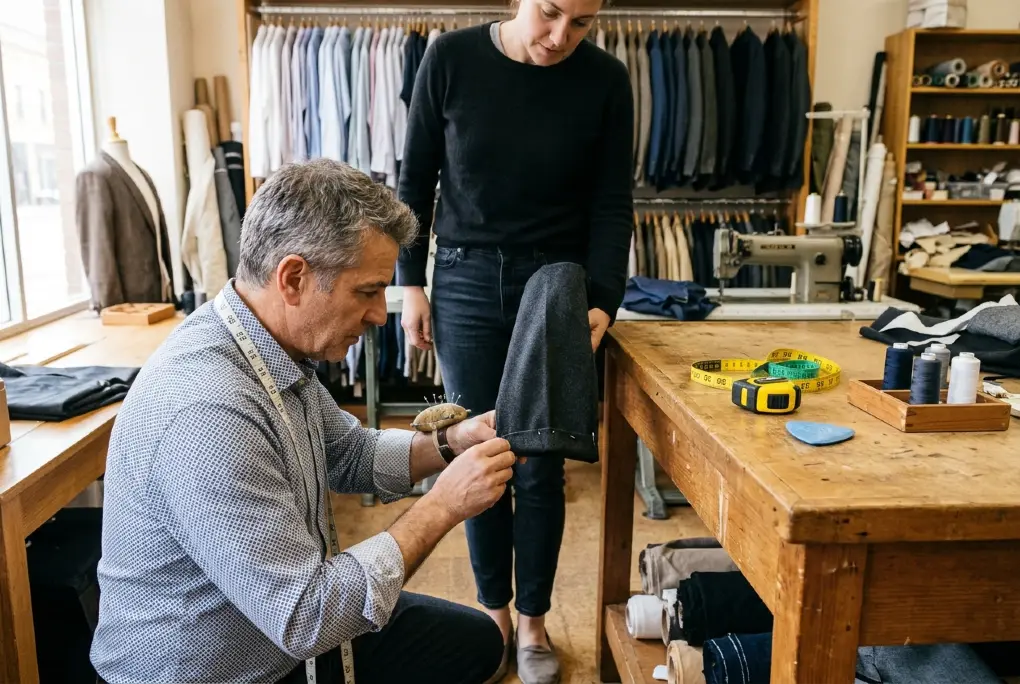
The quickest way to find a good tailor is to search “alterations near me,” narrow the list to two or three shops with recent, detailed reviews, and test the best one with a small, cheap job first. A simple hem on everyday trousers is a good test. Judge the shop on how it measures you, explains the work, quotes the price and turnaround, and how the garment looks when you pick it up. Only then hand over a suit, a formal dress, or a wedding gown.
That’s the short version. The rest of this guide covers what to look for at each step, which red flags to take seriously, and how to match the right kind of tailor to the job you actually need.
Why “Near Me” Results Aren’t All Equal
A local search gives you a map full of options, but those listings cover very different businesses:
- Independent tailor or seamstress shops. These usually have the widest range of skills, from hems to full restructuring.
- Dry cleaners with an in-house tailor. They’re convenient for basic fixes, though the skill level varies a lot from one location to the next.
- Dry cleaners that send work out. Your garment goes to a third party, which can add days and makes quality harder to control.
- Bridal specialists. They focus on gowns, bridesmaid dresses and formalwear, and they often book up months in advance.
- Menswear tailors. They’re strongest on suits, jackets and trousers.
Before you compare reviews, figure out which type of shop fits your garment. A dry cleaner that’s great at shortening jeans may not be the right place for a beaded gown. A bridal specialist may turn away a quick zipper swap or price it high.
How to Find a Trustworthy Tailor: Step by Step
1. Search With the Job in Mind
A generic search for alterations near me works, but adding the garment gets you closer to the right specialist. Searches like “wedding dress alterations near me,” “suit tailor near me,” or “leather jacket repair” filter out shops that don’t handle that work.
Shortlist three to five places within a distance you’ll realistically travel. Most jobs take at least two visits, drop-off and pickup, and fitted garments often need a third.
2. Read Reviews for Detail, Not Stars
A 4.8 rating tells you less than the content of the reviews. Look for:
- Specific garments mentioned. “Took in my bridesmaid dress and kept the lace pattern intact” says a lot more than “great service.”
- Comments on deadlines. Missed dates are the most common complaint in this trade.
- How the owner replies to negative reviews. A calm, specific reply is a good sign. A defensive one isn’t.
- Recent dates. Staff changes can raise or lower quality quickly, so reviews from the last year matter most.
Be wary of a sudden burst of short, glowing reviews posted close together. In the US, the Federal Trade Commission adopted a rule against fake consumer reviews in 2024. It bans buying reviews and posting fake ones, but fake reviews still appear, so judge the pattern, not just the score.
3. Call or Visit Before You Commit
A two-minute phone call tells you a lot. Ask:
- Do you do this type of alteration in-house?
- Roughly what does it cost, and is a fitting included?
- What’s your current turnaround?
- Do you charge extra for rush work?
If they’re vague about everything, including whether the work is done on site, move on to the next shop.
4. Start With a Low-Stakes Job
This is the step most people skip. Before trusting a shop with a $1,500 dress or your best suit, give it a pair of trousers to hem or a shirt to take in at the sides. You’ll learn how accurate their pinning is, how clean the stitching looks, and whether they hit the date they gave you, all for a small cost.
5. Watch How They Measure and Pin
A careful tailor will:
- Ask you to wear the shoes you’ll actually wear with the garment, which is essential for hems.
- Pin you while you’re standing naturally, not while you’re stretching or holding your breath.
- Ask how you want it to feel, not only how it should look.
- Point out limits honestly, for example, “we can’t let this out more than half an inch, there’s no seam allowance.”
That last point matters. A tailor who says some changes aren’t possible is usually more trustworthy than one who promises everything.
Matching the Tailor to the Job
Alteration work ranges from simple to highly specialized. Here’s a rough guide to what to expect for each type of job.
| Type of job | Examples | Who to use | Typical turnaround* |
|---|---|---|---|
| Basic | Hemming trousers, replacing buttons, simple seam repair | Most tailors and in-house dry cleaners | Same day to a few days |
| Moderate | Taking in a dress, shortening sleeves, replacing a zipper | Independent tailor or seamstress | Several days to 2 weeks |
| Structural | Re-cutting a suit jacket, resizing a fitted bodice | Experienced specialist | 1–3 weeks, often with a fitting |
| Bridal and formal | Wedding gown hem and bustle, beaded or lace work | Bridal specialist | Multiple fittings over 2–3 months |
| Specialty materials | Leather, suede, technical outerwear | Shops that list these materials | Varies widely, ask first |
*Turnaround depends heavily on the season. Spring and early summer (wedding and prom season) and the weeks before major holidays are usually the busiest.
Same Day Alterations: What’s Realistic
Many shops offer same-day or next-day service on basic jobs, often for an extra fee. Plain hems, button replacements and small repairs are the usual candidates. If you’re searching for same day alterations near me, call ahead and confirm before you drive over. Same-day service depends on how busy the shop is that morning, not just on the job itself.
Anything involving lining, lace, beading or multiple fittings generally can’t be rushed safely.
Wedding and Formal Dresses
Wedding dress alterations deserve their own planning. Many bridal seamstresses suggest booking your first fitting around two to three months before the wedding, then one or two follow-ups. When comparing wedding dress alterations near me, ask each shop:
- Whether they’ve worked on your fabric type (silk, lace, tulle, crepe).
- Whether bustling is included or priced separately.
- How many fittings the quote covers.
- What happens if your measurements change between fittings.
Bridesmaid and prom dresses are simpler, but the same timing rule applies. Book early in busy months.
Red Flags That Should Make You Walk Away
- No written ticket or receipt. You should leave with something that lists the garment, the work and the pickup date.
- A refusal to quote even a range. Exact prices may depend on the fitting, but a skilled tailor can give you a ballpark.
- Pinning you sitting down or in the wrong shoes. This leads to hems that are visibly off.
- Promising big changes with no caveats. Taking a garment down two or more sizes, or letting it out with no seam allowance, has real limits.
- Pressure to add work you didn’t ask for. Suggestions are fine, but upselling isn’t.
What Alterations Cost
Prices vary widely by city, garment and the tailor’s experience, so treat any figure you see online as a rough guide. Simple hems and button jobs are usually the cheapest. Structural work on jackets and fitted dresses costs much more, and bridal work is typically the most expensive alteration category of all. Rush fees are common.
The best way to avoid surprises is to get a written quote after the fitting and ask what’s included. When comparing clothing alterations near me, a slightly higher price from a tailor with detailed, recent reviews is usually the safer choice.
How to Get Better Results From Any Tailor
- Bring the right shoes and undergarments to every fitting.
- Know what you want. Photos of a fit you like help more than “make it slimmer.”
- Try the garment on at pickup, before you leave the shop. Fixing small issues on the spot is much easier than coming back later.
- Keep your ticket until you’re happy with the work.
- Ask whether a change can be undone. Cutting fabric is permanent, while taking in a seam often isn’t.
Final Takeaway
Finding a good tailor through a search for alterations near me comes down to three things: pick a shop whose specialty matches your garment, read reviews for specifics instead of stars, and test them with a small job first. Once you find someone reliable, stay with them. A tailor who already knows your measurements and preferences will save you time on every garment after that.
FAQ
How do I know if a tailor is good before giving them an expensive garment?
Give them a small, inexpensive job first, like a trouser hem. Check the stitching, the accuracy of the length and whether they met the deadline.
Can dry cleaners do alterations?
Many can, especially basic jobs. Ask whether the work is done on site or sent out, since that affects both turnaround and quality.
How early should I book wedding dress alterations?
Many bridal seamstresses recommend a first fitting about two to three months before the wedding, with one or two follow-ups. Busy seasons may need earlier booking.
Can any garment be made bigger?
Not always. Letting a garment out depends on how much extra fabric (seam allowance) is inside the seams. Many ready-made clothes have very little.

