When someone dies in San Javier, on Murcia’s Mar Menor coast, families usually have two questions straight away: who do we call, and how fast does it all happen? If you’re a visitor or a foreign resident who doesn’t speak much Spanish, it can feel like everything moves before you’ve had time to think.
Here’s the short answer. A funeraria is a funeral company. In San Javier, the main local facility is a tanatorio-crematorio (a funeral home with viewing rooms and a cremation unit), and it sits opposite the municipal cemetery. Spanish funerals usually happen within a day or two, and the funeraria takes care of most of the paperwork. If the person who died was a Russian citizen, there are extra steps with the Russian consulate, and getting the body home takes longer than it used to.
This guide covers each stage in plain terms: who does what, what it costs, and what people tend to miss.
What “Funeraria San Javier” Usually Means
Lots of towns in the Spanish-speaking world are called San Javier, including places in Chile and Argentina, so searches for “Funeraria San Javier” bring up a mix of unrelated businesses. This article is about San Javier in the Region of Murcia, south-east Spain.
It’s a mid-sized municipality. Official regional statistics put it at 36,524 registered residents (INE figures for 1 January 2025, published December 2025). The municipality also includes Santiago de la Ribera on the Mar Menor shore, so the same funeral services cover the resort areas as well as the town centre.
Funeraria, tanatorio and crematorio: what’s the difference?
These three words often show up together, and in Spain they mean different things:
| Spanish term | What it is | What it does for you |
|---|---|---|
| Funeraria | The funeral company | Collects the body, arranges the service, handles permits and paperwork |
| Tanatorio | The funeral home building | Private viewing rooms (salas de velatorio) where family and friends gather |
| Crematorio | The cremation facility | Carries out the cremation and hands the ashes to the family |
| Cementerio municipal | The town cemetery | Run by the council, which sets the fees for niches and graves |
In San Javier, one company can cover the funeraria, tanatorio and crematorio roles, but the cemetery is still a council matter with its own fees.
Funeral Providers in San Javier
The best-documented facility is run by the Rocamer group, a regional funeral and insurance company. According to its profile with the international funeral association Thanos, Rocamer opened the San Javier tanatorio-crematorium in 2004, opposite the municipal cemetery. The same profile says the group handles national and international transfers, repatriations, embalming, and legal and document management.
Other funeral businesses are registered in the municipality too. Business directories list Atalaya Servicios Funerarios S.L., for example, on Calle Doctor Ferrán. Opening hours, staff and services change, so phone or visit the provider before you assume anything. Don’t rely on an old directory listing.
A useful habit: when you call, ask whether anyone on the team speaks English or Russian. Many providers on this coast serve foreign families regularly, but you can’t count on it at 3 a.m.
What Happens in the First 48 Hours
Spain moves quickly after a death. A traditional wake and funeral commonly happen within one or two days, which surprises people from countries where a week or more is normal.
Here’s the usual order of events:
- A doctor confirms the death. In hospital, staff handle this. At home, call 112 or the person’s GP. The doctor issues the medical death certificate (certificado médico de defunción).
- The police or a court may get involved. If the death was sudden, violent or unexplained, a judge decides when the body can be released. That can add days.
- Call the funeraria, or the insurer first. If the deceased had funeral insurance, the insurer usually chooses the funeral company and pays it directly.
- The death is registered. The funeraria normally registers the death at the Civil Registry (Registro Civil) and gets the burial or cremation licence.
- The wake (velatorio). The family can use a private room at the tanatorio, often for most of a day, so people can come and go.
- Burial or cremation. Under Spain’s national mortuary rules (Decree 2263/1974, still applied in Murcia alongside a 1991 regional order), burial or cremation generally can’t take place until 24 hours after death, apart from specific exceptions.
What to expect at a Spanish wake
If you’ve never been to a Spanish velatorio, it’s more relaxed than many visitors expect. People drop in for 20 minutes or a few hours, hug the family, chat quietly in the room or the café area, and leave. Nobody expects you to stay all day. Dark, simple clothing is the norm, but you won’t be turned away for wearing everyday clothes when you’ve come straight from work or the airport.
Families often have the option of a short religious service in the tanatorio chapel or a local church before the burial or cremation. If the deceased wasn’t religious, or followed an Orthodox tradition, say so early. Most funeral companies can arrange a civil ceremony or help you contact a priest of the right church.
If the person had funeral insurance
Funeral insurance (seguro de decesos) is very common in Spain, and many foreign residents buy it too. Look for a policy card or bank statements showing regular premiums. Call the insurer before you sign anything with a funeral company. If you sign your own contract first, you could end up paying out of pocket for services the policy would have covered.
How Much Does a Funeral Cost in San Javier?
No San Javier price list has been published, so the most reliable guide is national data:
- OCU study (October 2021): Spain’s consumer organisation got quotes from 113 funeral homes in 29 cities. The average was €3,739 for a burial and €3,617 for a cremation. In Alicante, the nearest city in the study, a burial averaged €5,455.
- Insurer estimates (June 2026): Zurich Spain put the cost of a complete funeral at €3,500 to €6,500 in 2026, depending on the province.
Expect the final bill for San Javier to land somewhere in that national range. It can go well above it if you add extras or need international transport.
What a quote should list
Ask for a written, itemised quote (presupuesto detallado). It should cover:
- Coffin or cremation urn
- Collection and transport of the body (hearse)
- Viewing room hire at the tanatorio
- Preparation of the body, or embalming if needed
- Cremation fee, or cemetery fees (niche or grave concession, burial fee)
- Flowers, wreaths and printed notices (esquelas)
- Paperwork and permits
Comparing two itemised quotes is the simplest way to spot an inflated “package” price. Funerals happen fast, but most companies can send a quote within an hour or two.
Burial or Cremation: The Practical Differences
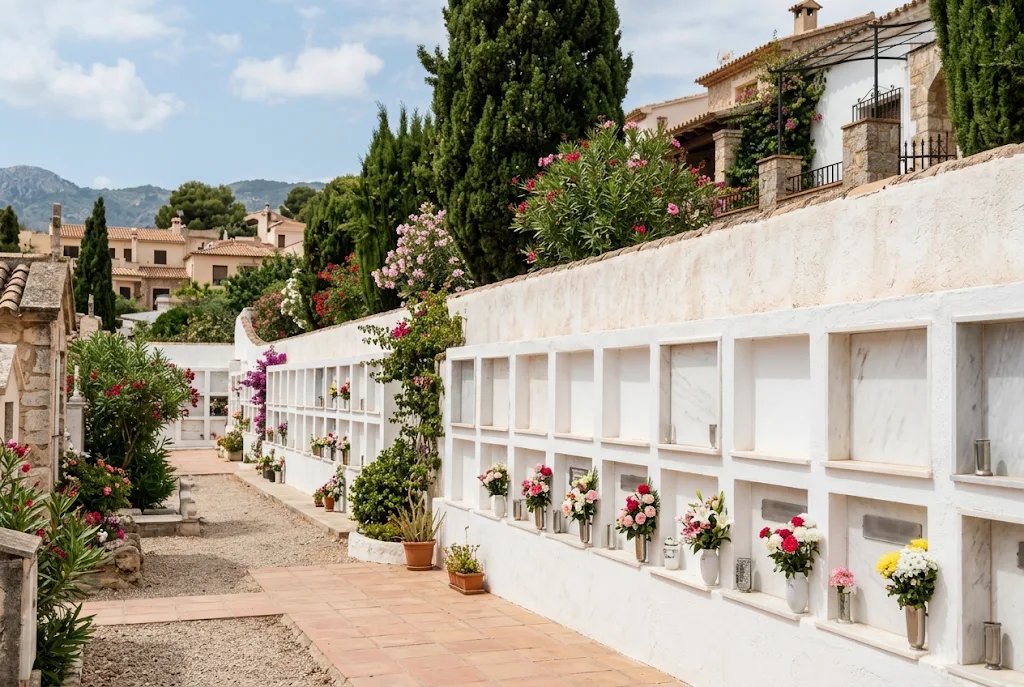
Many Spanish cemeteries use niches (nichos): wall vaults stacked in rows, rather than in-ground graves. Niches are often rented under a time-limited concession rather than bought outright. Ask the council or the funeraria how long the concession lasts and what happens when it ends.
Cremation can be done locally, because San Javier’s tanatorio has its own crematorium. The family gets the ashes in an urn. Before you scatter ashes anywhere (at sea, on a beach, in a park), ask the funeraria about the local rules, since permission depends on the place and the authority involved.
Cremation can cost about the same as burial once everything is added up, as the OCU figures show. Choose based on the person’s wishes and where the family will want to visit, not just the price.
When the Deceased Is a Russian Citizen
San Javier has many foreign residents and visitors, including Russian speakers. If the person who died held Russian citizenship, add these steps.
Contact the Russian consulate early. Russia’s embassy in Spain has its consular section in Madrid (Calle Joaquín Costa, 33). There’s also an honorary consulate in Valencia, which is the nearest one to Murcia. Get current phone numbers and hours from the embassy’s official website, spain.mid.ru, because these details change.
Plan for longer journeys. Spain’s Foreign Ministry travel advice for Russia (updated June 2026) notes that European airspace is closed to Russian aircraft and that air links between Russia and other countries have been sharply reduced. In practice, repatriating a body usually means a routing through a third country. That adds time, documents and cost. Get a firm quote from a funeraria that has done international transfers before you commit.
Get the documents in order. Russian authorities will generally need the Spanish death certificate with an apostille, plus a certified translation into Russian. The consulate can confirm exactly what it needs.
Repatriation checklist for Russian families
- Spanish death certificate (several copies)
- Apostille on the certificate for use in Russia
- Certified translation into Russian
- Embalming certificate and sealed-coffin certificate from the funeraria
- Transport permit issued through the Spanish authorities
- The deceased’s passport, or a copy
- Written confirmation of the full route and airline
Some families decide to cremate in Spain and take the urn home instead, which can be simpler. Check the airline’s rules for carrying urns, and Russian customs requirements, before you travel.
Paperwork After the Funeral
Death certificate. This is free. You can request it online through the Ministry of Justice’s electronic portal (Sede Electrónica) with Spain’s Cl@ve digital ID, or at the Civil Registry. Some private websites charge a “processing fee” for this same free document, so skip them.
Last wishes and life insurance certificates. Spain keeps a central register of wills (Registro General de Actos de Última Voluntad) and another of life insurance contracts. To find out whether the person left a Spanish will or held a life policy, request both certificates from the Ministry, attaching the official death certificate. You normally can’t apply until 15 working days after the death.
Inheritance. If the deceased owned property, a bank account or a car in Spain, a Spanish notary will usually be involved. Cross-border estates (Spain plus Russia, for example) get complicated quickly. Hire a lawyer who handles international successions instead of trying to piece it together yourself.
Common Mistakes Families Make
- Signing with a funeraria before checking for insurance. The policy may already cover a full service.
- Accepting a verbal price. Always ask for the quote in writing, item by item.
- Forgetting cemetery fees. Council charges for niches or graves are often billed separately.
- Ordering too few death certificates. Banks, insurers, consulates and notaries may each want one.
- Booking flights for relatives too early. If a court is involved, the funeral date can move.
- Assuming the consulate pays. Consulates help with documents, but transport costs are almost always the family’s responsibility.
Final Thoughts
Funerals in San Javier move fast, but they follow a clear order: medical certificate, funeraria, registration, wake, then burial or cremation. Most of the stress comes from not knowing what’s next, and from signing too quickly. Check for insurance first, ask for an itemised quote, and if the deceased was Russian, contact the consulate early and allow extra time for travel. A good Funeraria San Javier provider will explain each step. If one won’t put its prices in writing, call another.
FAQ
How quickly do funerals happen in San Javier? Usually within one to two days. As a general rule, burial or cremation can’t take place until 24 hours after death.
Does San Javier have a crematorium? Yes. The town’s tanatorio, which opened in 2004 opposite the municipal cemetery, includes a cremation unit.
Can the body of a Russian citizen be sent home from Spain? Yes, but there are no direct flights, so expect a route through a third country, extra documents and a higher cost. Contact the Russian consulate early.
Is the Spanish death certificate free? Yes. You can get it free online from the Ministry of Justice or at the Civil Registry. Ignore websites that charge for it.