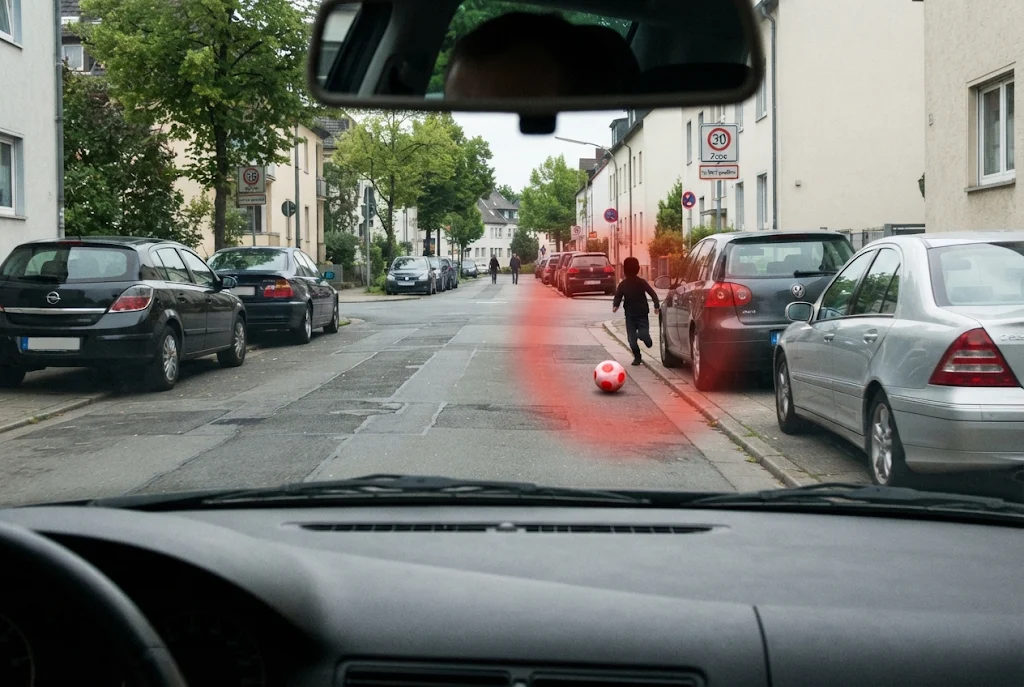
You press play, a short street scene runs for a few seconds, and then the screen asks: “Warum müssen Sie hier bremsen?” Three or four answers appear, and more than one can be correct.
The short answer: you have to brake in these questions because something in the scene can become dangerous within the next second or two, and the law expects you to prevent it rather than react to it. The hazard is usually a child near the road, a bus at a stop, a pedestrian at a crossing, a vehicle ahead slowing down, a lane that’s closing, a slow vehicle you’re closing in on, or a cyclist or e-scooter rider you can’t pass safely. Your job is to spot the actual reason, not just “there’s traffic.”
Below are the seven situations that cover most versions of this question, how to read each one, and the mistakes that cost points.
Where This Question Comes From
“Warum müssen Sie hier bremsen?” is a question stem in the official German theory test (Theorieprüfung) for licence class B and other classes. It appears with photos and with short video clips, and the same wording is reused for many different traffic scenes. That’s why you can’t memorise one answer for it. You have to learn to read the situation.
A few facts about the test worth knowing in 2026:
- Each question carries between 2 and 5 error points, and your total error points decide whether you pass.
- Questions can have several correct answers, and you only get the points if you tick all the right ones and none of the wrong ones.
- The class B catalogue currently has 1,169 possible questions. The federal government plans to cut it to about 840 questions as part of its driving licence reform, but the content you have to know is set by EU rules and isn’t meant to shrink.
The reform was still going through the legislative process during 2026, so check with your driving school which catalogue applies on your test date.
Bremsen, Verzögern, Bremsbereit: Know the Difference
The wording in these questions matters more than most learners think. Three similar phrases come up again and again:
| German wording | What it means in practice |
|---|---|
| Bremsen | Actively use the brake now to lose speed |
| Verzögern | Reduce speed, by easing off the accelerator or braking gently |
| Bremsbereit sein | Foot covering the brake, ready to stop at once |
When the question asks why you must brake, the scene usually shows a hazard that’s already developing, not just a possible one. If you see a version saying “verzögern und bremsbereit sein,” the danger is more likely to be a risk you should prepare for, such as children standing on the pavement.
The 7 Hazard Scenarios Behind “Warum Müssen Sie Hier Bremsen?”
1. Children Near the Road
This is the classic one. A ball rolls between parked cars, a child stands at the kerb looking at an ice cream van on the other side, or a group of kids walks home from school.
German law is unusually strict here. Under § 3 of the StVO, drivers must behave towards children, people needing help and older people, especially by cutting their speed and being ready to brake, so that any danger to them is ruled out. That’s a much higher bar than “be careful.”
What to look for: a ball, a bike lying on the pavement, a school sign, small feet visible under a parked van. If any of these appear, “a child could run onto the road” is very likely one of the correct answers.
2. A Bus at a Stop With Hazard Lights On
A city bus or a marked school bus stands at a stop with its hazard lights flashing. Passengers may step out behind or in front of it without looking.
The rules step up as the risk grows. You may not overtake a bus that’s approaching a stop with hazard lights on. Once it’s stopped with hazard lights on, you can only pass at walking speed (Schrittgeschwindigkeit) and at a distance that keeps passengers safe, and this applies to oncoming traffic on the same carriageway too. If needed, you wait.
Common trap: learners think the rule only applies when they’re behind the bus. It also applies when you’re coming from the other direction.
3. Pedestrians at a Zebra Crossing
Someone is standing at a zebra crossing (Fußgängerüberweg), or walking towards it quickly. If they clearly want to cross, you must let them, which means approaching at moderate speed and stopping if necessary.
What makes it tricky: the person in the clip might be half-hidden by a tram stop, a kiosk or a parked delivery van. Video questions often show the pedestrian only briefly, so watch the edges of the frame, not just the road.
4. The Vehicle Ahead Slows Down
The car in front suddenly loses speed. Maybe it’s about to turn into a driveway, maybe there’s a traffic jam ahead, maybe the driver just spotted a parking space.
There’s a detail many learners miss. Electric and hybrid cars often slow down noticeably through energy recovery (recuperation) without the driver touching the brake. Depending on the car, the brake lights may not come on. So don’t wait for brake lights. Watch the gap. If it shrinks quickly, you brake.
Practical check: in the video, compare how fast the car ahead seems to grow in your windscreen. That’s a better clue than its rear lights.
5. A Lane Ending or a Lorry Merging
On a motorway or a dual carriageway, the right lane ends because of roadworks or a narrowing. A lorry in that lane signals and needs to move into yours.
In this situation, the correct behaviour is to slow down and let the lorry merge, using the zip-merge principle (Reißverschlussverfahren) just before the narrowing. Speeding up to “close the gap” is the wrong answer every time.
Clue in the clip: a yellow roadworks sign, red-and-white barriers, or the lorry’s indicator. If you see any of these, the lorry’s lane change is almost certainly the reason you must brake.
6. A Slow Vehicle on a Country Road
You’re driving outside town at normal speed and come up behind a tractor, a horse rider, or a farm vehicle pulling a trailer. Often this happens just after a bend or a hilltop, so you see it late.
Here the reason to brake is the speed difference. A tractor might be doing around 25 km/h while you’re at 90 km/h, which closes the gap at more than 60 km/h. Overtaking is often impossible because of the bend, oncoming traffic or a solid line.
Also check for: mud or straw on the road surface near fields. It can reduce grip and lengthen your braking distance.
7. Cyclists and E-Scooter Riders You Can’t Pass Safely
A cyclist or e-scooter rider is ahead on a narrow road, and oncoming traffic means you can’t keep the required gap. The rule is at least 1.5 metres of side distance when overtaking inside built-up areas and 2 metres outside them.
If you can’t give that space, you don’t squeeze past. You brake, stay behind and wait. Clips may also show a cyclist about to swerve around a pothole or an open car door, which is another strong reason to slow down.
How Far You Need to Stop: The Numbers Behind the Answer
Many brake questions come down to physics. The rule-of-thumb formulas used in German driving theory are:
- Reaction distance = (speed in km/h ÷ 10) × 3
- Braking distance = (speed ÷ 10) × (speed ÷ 10)
- Stopping distance = reaction distance + braking distance
- Emergency braking: halve the braking distance
| Speed | Reaction distance | Normal braking | Stopping distance |
|---|---|---|---|
| 30 km/h | 9 m | 9 m | 18 m |
| 50 km/h | 15 m | 25 m | 40 m |
| 70 km/h | 21 m | 49 m | 70 m |
| 100 km/h | 30 m | 100 m | 130 m |
Look at the jump from 30 to 50 km/h. The stopping distance more than doubles. That’s exactly why children and buses (scenarios 1 and 2) get so much attention in the test. These are rules of thumb for a dry road. On wet or icy roads, real distances are longer.
A Simple Method for Answering Brake Questions
When a “Warum müssen Sie hier bremsen?” clip starts, use the same routine every time:
- Scan the edges first. Pavements, gaps between parked cars, bus stops and side roads hide most of the hazards.
- Name the road user. Child, pedestrian, bus passenger, lorry, cyclist? The correct answers usually point to a specific person or vehicle.
- Ask what happens next. Picture the next two seconds. Who could step out, swerve or slow down?
- Check each answer on its own. Don’t assume only one is right. Tick every option that describes a real danger in that scene.
- Reject generic answers. Options like “because the speed limit is 50” are often traps when the real reason is a person in the scene.
Mistakes That Cost Points
- Picking only one answer. Many brake questions have two correct options, for example the child and the parked car blocking the view.
- Focusing on the car directly ahead. The danger is often off to the side.
- Confusing “may” with “must”. If the bus has hazard lights on, walking speed isn’t optional.
- Learning answers by picture. If your app shows the same image every time, you start memorising the photo instead of the reasoning. This rarely works well in the real test.
- Rushing the video. Wait until you’ve seen the full clip before choosing your answers.
It’s worth taking seriously. ZDF reported in February 2026 that only 63 percent of candidates passed the theory test on their first attempt the year before.
Final Takeaway
There’s no single correct answer to “Warum müssen Sie hier bremsen?”, but there is a reliable pattern. Look for the person or vehicle that could create danger in the next moment, check whether the law asks for extra care in that situation, and pick every option that describes it. Practise with the official question set through your driving school or a licensed theory app, and when a question confuses you, ask your driving instructor to walk through the scene with you. This article is a study aid. The official catalogue and current StVO text always take priority.
FAQ
Is “Warum müssen Sie hier bremsen?” always a video question?
No. The same wording is used for photo questions and video questions. In the video version, the hazard can appear only briefly, so watch the whole clip carefully.
Can more than one answer be correct?
Yes. Many of these questions have two or more correct answers. You only get the points if you tick all the correct ones and none of the wrong ones.
Can I take the German theory test in English?
Yes, the theory test is offered in several foreign languages, including English. Check with your driving school or the testing organisation (TÜV or DEKRA, depending on your region) which languages are available where you’ll take the test.
What’s the difference between braking and being ready to brake?
Braking means actively slowing down now. Being ready to brake (bremsbereit) means your foot covers the brake pedal so you can stop instantly if the situation gets worse.