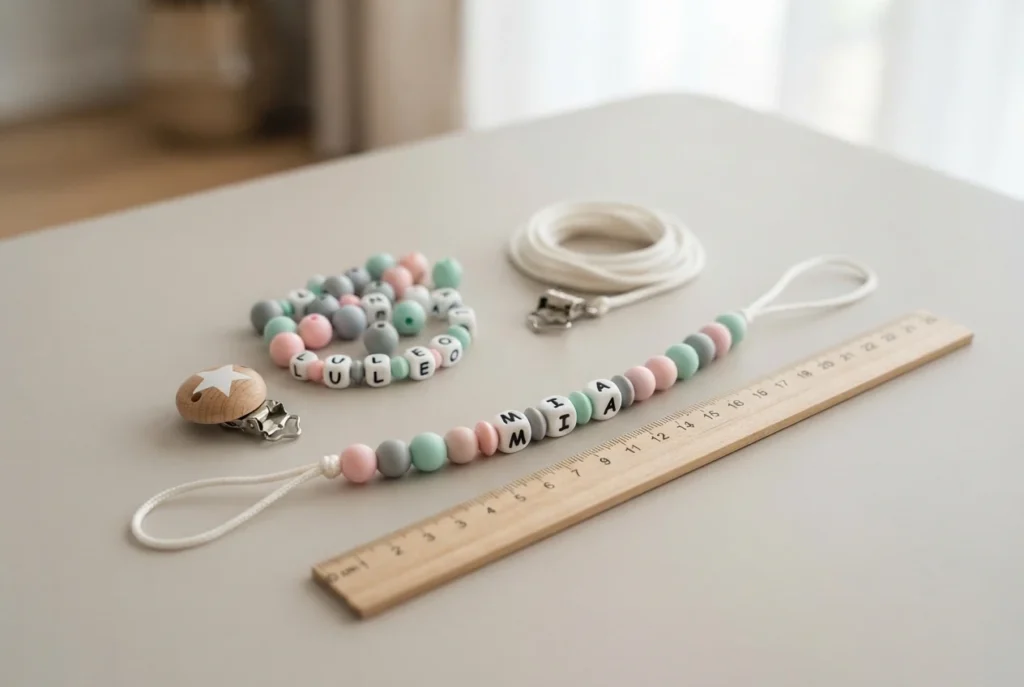
You can make a Schnullerkette mit Namen at home in about an hour with a safety clip, a strong cord, food-safe beads, letter beads and a pacifier connector. The one rule you can’t bend is length: under the European safety standard for pacifier holders, the finished chain must stay at or under 220 mm (22 cm). Plan the name around that limit, knot between every bead, and pull-test the chain before your baby ever uses it.
This guide covers the full build, the safety rules that apply in Germany as of November 2026, and the mistakes people make most often when they make one at home.
Why the Safety Rules Matter More Than the Design
A pacifier chain looks like a small craft project, but it sits next to a baby’s neck and mouth all day. Strangling and choking are the two real risks, and both come from a chain that’s too long, beads that come loose, or a clip that blocks airflow if swallowed.
The rules come from the standard DIN EN 12586. In April 2025, CEN published a revised version, EN 12586:2025, which replaced the older 2007 edition (with its 2011 amendment). Germany adopted it as DIN EN 12586:2025-06, and it covers soother holders for children from birth up to 36 months.
The 2025 revision added a few things worth knowing even as a hobby maker:
- New rules on magnetic parts
- A ban on button and coin batteries in soother holders
- Revised requirements and testing for the ventilation holes in clips
- New rules on suffocation risks from packaging
You don’t need to buy the standard to make one for your own child. You do need to follow its basic logic, because the limits are there for good reason.
What You Need Before You Start
Every Schnullerkette mit Namen is built from the same five parts, and their quality decides how safe the result is. Buy parts sold specifically for pacifier chains rather than general craft beads. Many shops in Germany sell them as sets, and good sellers state that their parts meet EN 71-3 (the standard limiting harmful substances that can leach from toy materials).
| Part | What to look for | Why it matters |
|---|---|---|
| Clip | Plastic or wood-and-steel clip with ventilation holes | If a baby ever gets it into the throat, the holes let air through |
| Cord | Braided polyester or nylon, saliva-resistant, about 2 mm thick | Thin cords snap; cotton frays and soaks up saliva |
| Beads | Silicone or untreated hardwood, made for teething products | Glass, metal and painted craft beads can chip or flake |
| Letter beads | Silicone letter beads, often around 12 mm | Big enough to grip, soft on gums |
| Connector | Silicone ring for pacifiers with a handle, or a loop for ring-free pacifiers | Has to match the pacifier you actually use |
| Tools | Lighter, scissors, ruler, thin wire or a beading needle | For threading and sealing the cord ends |
One thing to skip: don’t take beads off an evil eye bracelet or any other piece of jewellery. Jewellery beads are often glass, small and loosely strung, and they aren’t made to go anywhere near a baby’s mouth. If you like the evil eye look, some sellers make larger silicone beads with that motif for teething products. Check that they’re labelled for baby use.
Plan the Name Before You Cut Anything
The name is the whole point of a Schnullerkette mit Namen, and it’s also where most home-made chains go wrong. People choose a long name, string every letter, add a few decorative beads and end up over 22 cm.
Do the Length Maths First
Lay all your beads in a row on a ruler before you thread anything. Include the clip end and the pacifier loop, because they take up length too.
A rough example with 12 mm letter beads:
- “Mila” (4 letters): about 48 mm of letters, which leaves plenty of room for spacer beads
- “Johanna” (7 letters): about 84 mm, which still fits but leaves less space for decoration
- “Maximilian” (10 letters): about 120 mm, which is tight once you add the clip, connector and knots
That’s why many German shops cap personalisation at six to eight letters and refuse double names.
Options for Long Names
If the name doesn’t fit comfortably, you have a few honest options:
- Use a nickname or shortened form (“Max” instead of “Maximilian”).
- Use initials with a small symbol bead between them.
- Use smaller letter beads, as long as they’re still made for baby products.
- Put the full name on a matching pram chain (Kinderwagenkette). Those are a separate product, but the same rule applies: never use one as a pacifier holder.
What you shouldn’t do is make the chain longer to fit the name.
Step-by-Step: Making Your Schnullerkette mit Namen
Step 1: Cut and Seal the Cord
Cut about 60 cm of cord. That sounds far too long, but knots eat up cord quickly and you need extra to work with. Briefly melt both ends with a lighter so they don’t fray. Let them cool before you touch them.
Step 2: Attach the Clip
Thread the cord through the clip’s eyelet. Tie a tight double knot, leaving a tail of around 5 cm. Some makers thread the tail back through the first two beads later to hide it.
Step 3: Thread the First Spacer Beads
Start with one or two plain beads next to the clip. Tie a knot after each bead. Knotting between beads is the single most important habit: if the cord ever breaks, only one bead comes loose instead of the whole row.
Step 4: Add the Name
Thread the letter beads in order and check the spelling against your plan after every letter. It’s surprisingly easy to thread a “b” for a “d” or a “W” for an “M”. Knot between letters, or at least before and after the name block.
Step 5: Finish With Spacers and the Connector
Add your final beads, then the silicone ring or the loop for your pacifier. For a loop, pass the cord back through the last bead to form a small eye that can wrap around the pacifier handle.
Step 6: Tie Off and Hide the Ends
Tie two tight knots at the end, trim the excess cord, and seal the end with a quick touch of the lighter. Push any knot ends inside a bead if you can.
Step 7: Measure, Then Pull-Test
Lay your finished Schnullerkette mit Namen flat, straighten it without stretching the cord, and measure it from end to end. If it’s over 22 cm, take beads off. Don’t try to argue with a few millimetres.
Then hold the clip in one hand and the connector in the other and pull hard several times. Tug on individual beads, too. Nothing should slide, stretch or creak. A home test isn’t the same as laboratory testing, but it catches weak knots before your baby does.
Common Mistakes When Making One at Home
Product testers and German market surveillance authorities keep finding the same faults in pacifier chains, both shop-bought and handmade. Most problems come down to a handful of repeat errors:
- Making it longer “just a bit”. The Regierungspräsidium Tübingen warned parents in 2019 not to extend pacifier holders themselves, because extra length sharply raises the risk of strangulation.
- Too many beads. Heavily decorated chains with lots of small parts are where testers keep finding faults. Fewer, larger beads are safer.
- Thin or fancy cord. Elastic, leather lace and thin cotton thread all fail sooner than braided synthetic cord.
- A clip without holes. Öko-Test rated a clip without ventilation holes as a serious safety defect, and recalls in Germany have been issued for exactly this reason.
- Mixing in jewellery parts. That includes charms, metal letters and beads from bracelets.
- Skipping knots. A single knot at each end means one cut or snap releases every bead at once.
Using the Chain Safely Every Day
Making the chain is only half the job. Even a carefully made Schnullerkette mit Namen needs the right habits around it, and a few minutes of checking each week goes a long way.
- Take it off before sleep, whether that’s naps or night-time. It’s meant for waking hours when an adult is around.
- Clip it to clothing, not to a pram bar, a cot or a car seat strap.
- Check it before each use for frayed cord, cracked beads or a loose clip.
- Clean silicone parts with warm water and mild soap. Wipe wooden beads with a damp cloth and let them dry fully. Don’t boil wooden or mixed chains unless the parts are labelled as boil-safe.
- Retire it once it shows wear. A new cord costs very little compared with the risk.
DIY or Buy Ready-Made?
Making your own makes sense if you enjoy crafting, want a specific colour scheme, or need a nickname or spelling that shops don’t offer. You control every part, and you can make a spare in the same design.
Buying ready-made makes more sense if you want a chain that’s been through laboratory testing, or if you’re short on time with a newborn at home. When you buy, look for a clear statement that the product meets DIN EN 12586, the seller’s full contact details, and printed safety notes. A missing warning text is a red flag, not a small oversight.
Making Chains as Gifts or to Sell
A home-made Schnullerkette mit Namen makes a thoughtful gift for a birth or baptism. If you give one away, include a short note on safe use (maximum length, no sleep, regular checks), because the new parents won’t know how carefully it was made.
Selling is a different matter. In the EU, the General Product Safety Regulation has applied since 13 December 2024, and pacifier holders are a product category where German sellers have faced formal legal warnings over missing safety notices. If you’re thinking about selling on Etsy or a market stall, speak to a product-safety specialist or a testing lab before listing anything. Don’t copy warning text from another shop and assume that’s enough.
Wrapping Up
A good home-made Schnullerkette mit Namen is a short one: a clip with ventilation holes, strong braided cord, baby-safe beads, a knot after every bead and a finished length of 22 cm or less. Plan the name to fit the length, not the other way round, and pull-test it before the first use. If you’re unsure about any part, a ready-made chain that states it meets DIN EN 12586 is the simplest choice.
FAQ
How long can a Schnullerkette mit Namen be?
No longer than 220 mm (22 cm) under DIN EN 12586. Shorter is fine as long as it still reaches the pacifier comfortably.
Can I use wooden letter beads for a Schnullerkette mit Namen?
Yes, if they’re untreated hardwood or finished with a coating labelled safe for children’s products. Avoid painted craft letters, which can flake.
What if the baby’s name is too long?
Use a nickname, initials or smaller baby-safe letter beads. Never lengthen the chain to fit more letters.
Can my baby sleep with a pacifier chain?
No. Remove it before naps and night-time sleep.
Does a home-made chain need to meet DIN EN 12586?
For your own child it’s a voluntary guide, but following its limits is the safest approach. If you sell chains, product-safety obligations apply and you should get professional advice.